
Key Takeaways
- Foundation models are rapidly absorbing basic orchestration mechanisms (e.g., JSON output, tool calling), making simplistic "harness" frameworks obsolete.
- However, models cannot replace the enterprise need for a deterministic strategy layer that provides observability, multi-model cost routing, security (RBAC), and auditable compliance.
- "Environment Engineering"—redesigning systems to be agent-friendly—is a powerful long-term vision, but it's impractical for most enterprises today due to the immense cost of refactoring legacy systems and digitizing tacit knowledge.
- The critical, immediate opportunity lies in building a sophisticated control plane—an evolution of the harness—that bridges the gap between probabilistic AI and deterministic business requirements. This is the focus of Epsilla's Agent-as-a-Service (AaaS) platform.
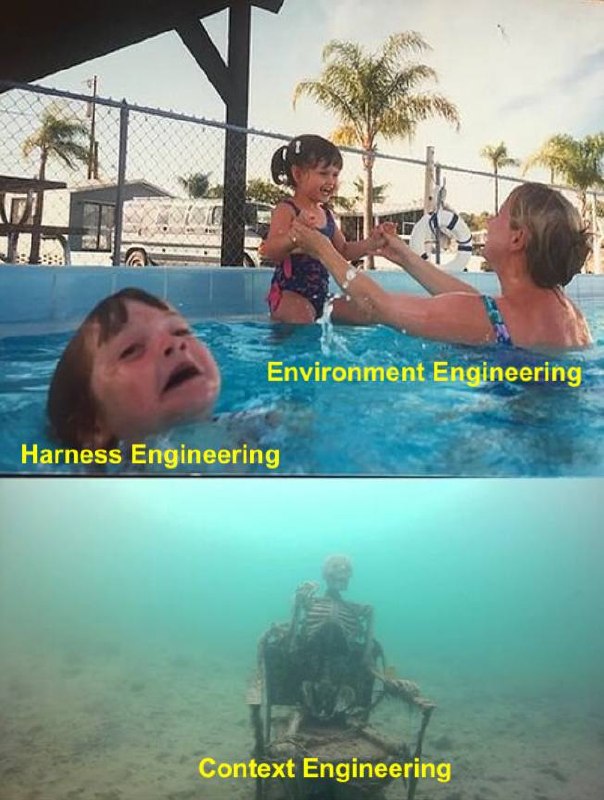
The lexicon of AI engineering is experiencing a kind of hyperinflation. We’ve been on a dizzying treadmill of terminology, accelerating from Prompt Engineering in 2023 to Context Engineering, and then to Harness Engineering in late 2025. Now, a new term is dominating engineering discourse in Silicon Valley: "Environment Engineering."
The argument, championed by sharp engineers observing the latest API updates from OpenAI and Anthropic, is that the "harness" is dead. They contend that foundational models like GPT-5 and Claude 4 are systematically cannibalizing the orchestration logic that developers once painstakingly wrote. With native structured JSON output, robust tool-calling APIs, and built-in context caching, the value of a simple wrapper or execution loop is plummeting to zero.
Their conclusion? Stop building complex middleware. Instead, focus on Environment Engineering: refactor your software and data into clean, structured, agent-friendly interfaces, perhaps using emerging standards like Model Context Protocol (MCP). The evidence, such as Anthropic's experiments showing agents performing brilliantly in well-defined digital environments, seems compelling.
This line of thinking, however, represents a dangerously linear extrapolation of technical trends. It ignores the most fundamental paradox of applying AI in a corporate setting: large language models are probabilistic systems, but the world of business demands deterministic outcomes.
While the buzzwords change, the core challenge remains. As founders and engineers, our most valuable resources—time, capital, and focus—must be allocated to what creates defensible, long-term value. This requires a clear-eyed worldview. The debate between Harness and Environment isn't just semantics; it's a strategic fork in the road. And choosing the wrong path leads to obsolescence.
The Case for Obsolescence: Why "Harness is Dead" Has a Point
Let's be intellectually honest. The argument against simplistic harnesses is strong and rooted in clear trends.
First, there is immense downward pressure from the base models. What required hundreds of lines of code for retry logic, JSON format validation, or context window management a year ago is now a simple parameter in an API call to GPT-5. The "infrastructure" of AI is becoming ruthlessly efficient. Any framework whose primary value is merely wrapping a prompt chain and a basic execution loop is being systematically dismantled and offered as a native feature. Its moat has evaporated.
Second, there is a powerful upward pull from the demonstrated leverage of Environment Engineering. Anthropic's research confirms a critical insight: often, an agent's failure is not a failure of its "brain" (the model) but a failure to comprehend its "world" (the environment). An agent attempting to navigate a chaotic, inconsistent real-world terminal is like a Formula 1 car in a swamp. By contrast, an agent given a set of clean, well-documented APIs in a structured environment performs with astonishing competence.
The takeaway seems obvious: stop trying to build a better monster truck (a more complex harness) and start paving the road (engineering the environment). If this were the complete picture, the strategic path for any AI-native company would be clear: embrace the foundation model APIs, abandon the custom control layer, and pivot all resources to building pristine, agent-native environments. But this analysis omits the most critical piece of the puzzle.
The Enterprise Paradox: API Mechanisms vs. Business Strategy
The notion that the future of enterprise AI is simply a direct line between a model API and a clean environment is a dangerous fantasy. It ignores the unyielding laws of business reality.
An LLM, at its core, is a probability distribution over a sequence of tokens. It is non-deterministic. Business operations, particularly in regulated or mission-critical domains, require the exact opposite: observability, auditability, and predictability. This chasm between the probabilistic nature of AI and the deterministic needs of the enterprise is where a true control plane—the evolution of the harness—becomes not just valuable, but indispensable.
Foundation model APIs can absorb mechanisms, but they cannot own strategy.
An API can tell you how to call a tool. It cannot decide when to trigger a fallback plan if that tool fails. It cannot determine how to dynamically route a complex query across a dozen specialized models to optimize for cost, latency, and accuracy. It cannot enforce Role-Based Access Control (RBAC) to ensure an agent only accesses data its user is authorized to see. And it certainly cannot provide a complete, immutable audit trail of its decision-making process to satisfy a compliance officer.
These are not mechanisms; they are strategic policies. This is the domain of a control plane.
- Observability: An enterprise needs to know precisely why an agent made a decision. The entire reasoning trace must be captured and auditable.
- Dynamic Routing & Cost Control: A sophisticated system doesn't rely on a single model. It needs a gateway that intelligently routes sub-tasks to the most efficient model—perhaps Claude 4 for creative writing, a fine-tuned Llama 4 for data extraction, and GPT-5 for complex causal reasoning—all while managing a strict token budget.
- Systemic Fault Tolerance: When a model hallucinates or an API goes down, the system must react with deterministic, pre-defined error handling and recovery procedures. You cannot ask a probabilistic model to reliably police itself.
- Persistent, Structured Memory: For an agent to be more than a stateless tool, it needs a memory of its past interactions, successes, and failures. This memory must be structured and reliable, not just a blob of text in a context window.
This is precisely why we built Epsilla's AgentStudio. It is not a simple wrapper. It is an enterprise-grade Agent-as-a-Service (AaaS) platform designed as this essential control plane. It provides the RBAC, the multi-model routing gateway, the audit logs, and the fault tolerance that businesses require. Our Semantic Graph technology provides the persistent, structured memory that allows agents to learn and operate deterministically within a specific corporate context, turning a powerful but unpredictable model into a reliable corporate asset.
The Sobering Reality of Environment Engineering
So, what about Environment Engineering? Is it not a worthwhile pursuit? It absolutely is, but its role must be understood correctly. It is a long-term destination, not a short-term shortcut.
In digitally native domains like code generation, the environment is already highly structured. This is why we see such rapid progress with agents like Devin. The "world" is text, files, and APIs—perfect for an LLM.
However, step outside this pristine digital world and you hit the "Wall of Legacy Systems and Tacit Knowledge." Consider optimizing a manufacturing supply chain. The "environment" includes a 20-year-old ERP system with poor documentation, the institutional knowledge of senior engineers who diagnose machinery by "listening to the sound it makes," and thousands of ambiguous order notes scattered across emails and Excel spreadsheets.
The cost and complexity of refactoring this chaotic reality into a set of clean, agent-friendly APIs are astronomical. Most businesses cannot and will not re-architect their core, revenue-generating systems—which may have cost tens of millions to build—just to make them more convenient for an AI agent. The inertia is immense.
This means that for the vast majority of real-world business problems, the agent must adapt to the messy, noisy, human-centric world, not the other way around. This again places the burden of success squarely on the sophistication of the control plane that guides the agent through this morass.
A Three-Act Play for the AI Value Chain
The evolution of the AI stack can be viewed as a three-act play.
Act I: The Reign of Models (2023-2025). In this era, model capability was the primary determinant of value. Each SOTA release from OpenAI or Anthropic redefined the industry's ceiling. The formula was simple: AI Application Value ≈ Model Capability.
Act II: The Rise of the Control Plane (2025-2028). We are in the opening scenes of this act. As base model capabilities begin to plateau and commoditize, the industry is discovering that simply calling a powerful API is insufficient for building enterprise-grade products. The bottlenecks are now reliability, cost, and security. The formula is evolving: AI Application Value = Model Capability × Harness Efficiency. That multiplier is where the battle is now being fought. A robust control plane can take an agent's success rate on a complex task from 20% to over 70%. This is where platforms like Epsilla create immense value.
Act III: The Symbiosis of Environment & Data (2028+). This is the endgame. Once models are utilities and control planes are mature, the ultimate defensible moat will belong to companies that have deeply embedded their agentic systems into specific business environments. This creates a powerful flywheel where the agent's interactions continuously refine both its understanding of the environment and a proprietary data asset. The final formula will be exponential: AI Ultimate Value = (Model × Harness) ^ (Data × Environment).
Environment Engineering is a bet on Act III. It is the correct long-term vision. But to get there, you must first build and master the tools of Act II. The "harness" isn't dead; it's maturing from a simple tool into the strategic cockpit required to navigate the complexities of the real world. Dismissing it is to miss the most significant, value-creating opportunity in AI today.
FAQ: The Future of Agent Engineering
Isn't "Environment Engineering" just a new name for good API design?
Partially, but it's more holistic. It extends beyond APIs to include data schemas, access protocols (like MCP), and even user interfaces, all designed with the agent as the primary consumer. The goal is to reduce the "impedance mismatch" between the agent's cognitive model and the system it's operating on.
If foundation models keep improving, won't they eventually handle strategy too?
While models will absorb more complex reasoning, they are unlikely to ever own enterprise-specific policy. A business cannot delegate final authority over its security rules, compliance checks, or budget constraints to a third-party, probabilistic model. This strategic layer of control must remain within the enterprise's domain.
What's the first step for a company wanting to build reliable AI agents today?
Focus on the control plane. Don't start by trying to refactor your entire legacy environment. Instead, implement a robust Agent-as-a-Service platform that provides observability, multi-model routing, and security. This allows you to deploy agents safely in your existing environment and deliver value immediately while planning a longer-term environment strategy.