
Key Takeaways
- The emergence of multi-agent pipelines, like the 12-agent system in the
academic-research-skillsproject, represents a structural shift from monolithic models to specialized, collaborative AI teams.- The critical flaw in current text-based agentic workflows is their reliance on a lossy, ephemeral Model Context Protocol (MCP), leading to hallucinated citations and data integrity failures, even with dedicated "Integrity Check" agents.
- Audits revealing that even three rounds of integrity checks miss a third of all issues prove that adding more agents to a flawed MCP yields diminishing returns. The problem is foundational, not procedural.
- The solution is to replace the linear, text-passing chain with a central, persistent source of truth. A Semantic Graph, acting as a shared knowledge base, grounds all agents, making hallucinations structurally impossible rather than merely detectable.
- Epsilla's architecture, combining a Semantic Graph with an Agent-as-a-Service (AaaS) orchestration layer, provides the necessary infrastructure to build robust, verifiable, and scalable multi-agent systems for complex knowledge work.
The discourse around AI has shifted. We've moved past the novelty of single-shot generation and are now confronting the engineering reality of building systems that perform complex, multi-stage knowledge work. A striking example of this frontier is the open-source academic-research-skills project, a proof-of-concept that deploys a 12-agent team to automate the entire academic paper writing process. This isn't just another wrapper around an API; it's a meticulously architected workflow that mimics a human research group, complete with specialized roles and quality gates. As founders and builders, we must analyze such systems not as curiosities, but as blueprints for the future of automated work—and identify their foundational weaknesses before we build our own enterprises upon them.
The architecture is impressive in its design. It deconstructs the monolithic task of "writing a paper" into a ten-stage pipeline: Research, Writing, Integrity Check, a five-agent Peer Review, Socratic Coaching, Revision, Finalization, and even LaTeX formatting. Roles are assigned with clear responsibilities: an Architect designs the overall paper structure, a Methodology Reviewer scrutinizes the experimental design, and a Devil's Advocate actively seeks out flaws in the argument. This division of labor is a sophisticated and necessary step toward reliable AI.
Most critically, the designers elevated the "Integrity Check" to a first-class stage in the pipeline. They correctly identified that the Achilles' heel of today's models—hallucinated citations, fabricated data, and misremembered facts—must be addressed head-on. This is not an afterthought; it is a dedicated quality gate. Yet, this is precisely where the entire paradigm reveals its critical flaw. Audits of the system's output are sobering. Even after three full rounds of this multi-agent review and integrity process, the system failed to catch nearly a third of all factual and citation errors.
Why? The answer is not that the models, even future 2026-era models like Claude 4 or GPT-5, are inadequate. The problem is the system's underlying architecture. This 12-agent team operates on a primitive Model Context Protocol (MCP). State is passed from one agent to the next as a massive, unstructured blob of text. The Research agent hands a document to the Writer; the Writer hands a draft to the Integrity Checker; the Checker hands a commented draft to the Reviewers. Each step is a potential point of failure, a game of telephone where context is degraded, misunderstood, or outright invented. The Integrity Check agent is, itself, just an LLM tasked with reading another LLM's potentially flawed output and spotting errors based on the context it was given. It's a closed loop, with no external anchor to ground truth. Adding more reviewers to this chain is like asking more people to check for water in a leaky bucket—it doesn't fix the hole.
This is the fundamental misstep of first-generation multi-agent systems: they treat the symptom (hallucination) with a procedure (checking) rather than solving the root cause (lack of a persistent, verifiable state).
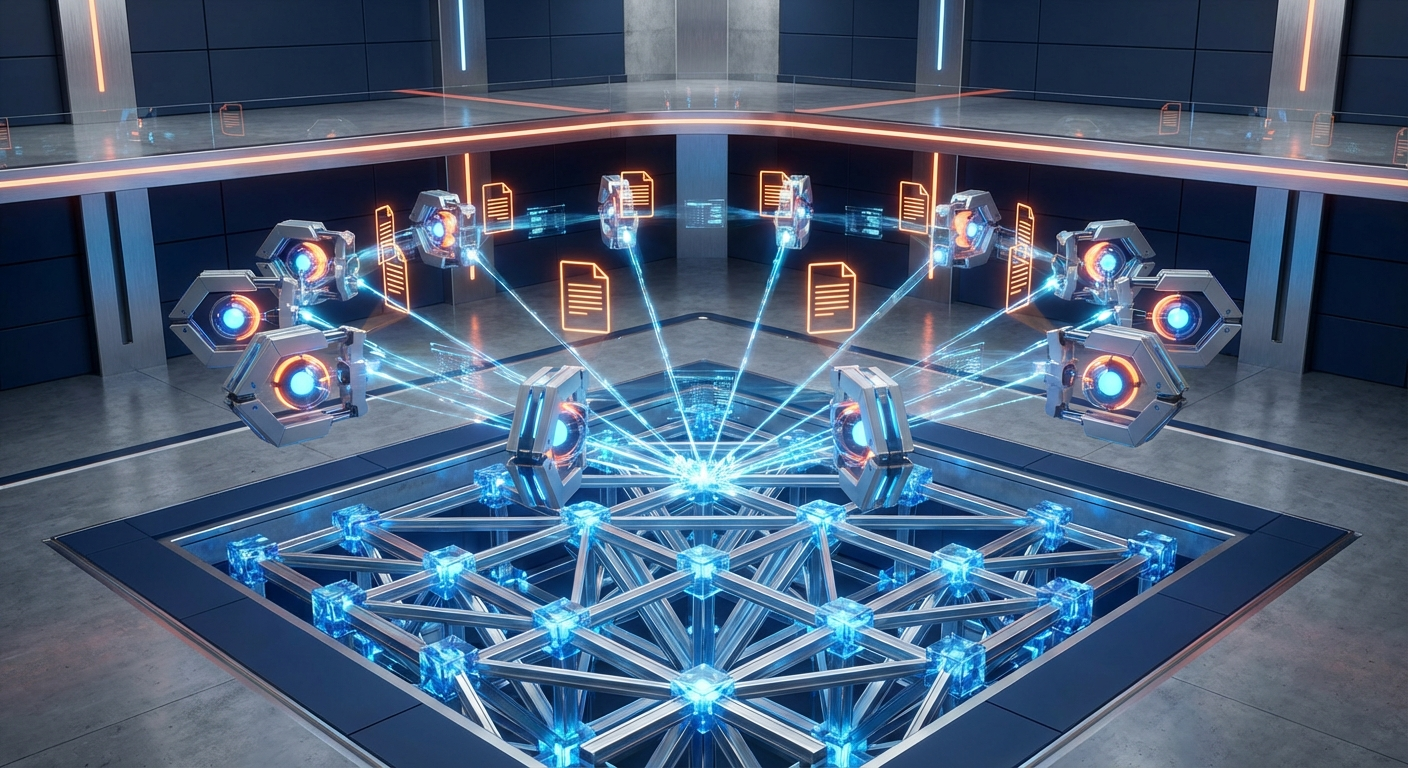
The only viable path forward is to replace this ephemeral, chain-based MCP with a persistent, shared source of truth. The agents should not be passing a narrative between themselves; they should be collaboratively building and querying a centralized knowledge base. This is the core principle behind Epsilla. Our Semantic Graph is not merely a database; it is the shared cognitive workspace for an entire team of AI agents.
Let's re-imagine the 12-agent academic workflow, but anchored by an Epsilla Semantic Graph.
In the Research stage, the agent's primary task is not to write a summary, but to populate the graph. It ingests source papers, extracts key entities (concepts, methods, results, authors), and maps their relationships. Each claim, each data point, each citation is stored as a structured node in the graph, immutably linked to its source document. The graph becomes the single, verifiable repository of ground-truth information for the project.
When the Writing agent begins its work, it does not receive a long, potentially flawed text prompt. Instead, it receives a directive and queries the Semantic Graph. To write the literature review, it queries for all nodes related to "prior work" and their documented relationships. To describe the methodology, it pulls the structured parameters from the "experimental setup" nodes. When it needs to cite a source, it doesn't invent a reference; it retrieves the unique identifier for the corresponding node in the graph. The prose is generated around a skeleton of unimpeachable, grounded facts.
The Integrity Check stage is transformed entirely. It ceases to be a probabilistic pattern-matching exercise and becomes a deterministic audit. The Auditor Agent systematically parses the generated draft, treating every factual claim and citation as a query to be executed against the Semantic Graph. "The draft claims that Smith et al. (2024) found a 15% improvement. Does a node exist in the graph representing this claim, directly linked to the 'Smith et al. (2024)' source node?" If the query returns false, the claim is flagged. Hallucination is not just detected; it is structurally prevented. The 33% error rate seen in the pure-LLM pipeline plummets to near zero because the system is, by design, incapable of asserting facts that are not present in its verified knowledge base.
This graph-centric architecture enables a far more powerful orchestration model than a simple linear pipeline. With Epsilla's Agent-as-a-Service (AaaS) framework, specialized agents can be deployed to operate on the graph in parallel. The Methodology Reviewer can run a query to find all nodes tagged "methodology" and validate their internal consistency. The Devil's Advocate can execute a query to find claims in the graph with the weakest evidentiary support (e.g., linked to only a single, uncorroborated source).
This is the future of complex AI work. It is not about creating ever-longer chains of prompts. It is about building a robust, shared understanding of a problem space—the Semantic Graph—and then orchestrating specialized agents to reason over and interact with that shared understanding. The academic-research-skills project is an invaluable contribution because it so clearly demonstrates the power of agent specialization while simultaneously revealing the fatal weakness of an ungrounded, text-passing architecture.
As we move into the era of GPT-5, Claude 4, and Llama 4, the raw generative and reasoning capabilities of models will become a given. The defining competitive advantage will not be the quality of a single model, but the robustness of the system that orchestrates them. The founders who succeed will be those who recognize that intelligence without a reliable memory and a verifiable connection to reality is a liability. They will be the ones who stop trying to patch the leaky bucket and instead build a proper well—a persistent, structured, and queryable source of truth that grounds every agent, every task, and every decision.
FAQ: Multi-Agent Research Pipelines
What is the main limitation of current multi-agent workflows?
Their primary weakness is the reliance on a "pass-the-document" Model Context Protocol. This linear, text-based sharing of state is inefficient and lossy, leading to error propagation and hallucinations that even dedicated checker agents struggle to reliably detect and fix.
How does a Semantic Graph solve the hallucination problem?
It provides a persistent, verifiable source of truth that acts as a shared memory for all agents. Instead of inventing facts from a prompt, agents must query the graph for grounded data and citations, making every claim auditable against a ground-truth data structure.
Is Agent-as-a-Service (AaaS) just another name for prompt-chaining?
No. AaaS is a more sophisticated orchestration model where specialized agents are deployed to perform tasks on a shared, persistent backend, like a Semantic Graph. This enables more complex, parallel, and reliable workflows than a simple linear chain of prompts.