
Key Takeaways
- The debate ignited by Andrej Karpathy's "LLM Wiki" correctly identifies the fundamental flaw of traditional RAG: opaque, context-poor vector chunks are an obsolete paradigm for knowledge management.
- Karpathy’s method of "compiling" raw data into a structured, human-readable Markdown Wiki is a conceptual breakthrough, moving from passive retrieval to active, agentic knowledge synthesis.
- However, a local folder of
.mdfiles managed via Obsidian is a personal productivity hack, not a viable enterprise architecture. It presents insurmountable challenges in security, access control, and scalability.- The enterprise-grade evolution of the LLM Wiki is not a file system; it's a secure, multi-tenant Semantic Graph. This architecture provides the transparency and structure of Karpathy's Wiki with the Role-Based Access Control (RBAC) and auditability required for corporate data.
- Epsilla's Semantic Graph, managed through AgentStudio and audited by ClawTrace, is the production-ready infrastructure that delivers on the promise of Karpathy's prototype, enabling a true, self-healing corporate brain.
The technical community on X is currently consumed by a single, electrifying debate, sparked by a GitHub Gist from Andrej Karpathy that has amassed over 17 million views. The premise, amplified by thousands of developers, is that his "LLM Wiki" methodology has effectively killed Retrieval-Augmented Generation (RAG).
This is not hyperbole. It's the first tremor of a foundational paradigm shift.
For the last three years, RAG has been the default architecture for applying LLMs to proprietary data. The process is crude but was, until now, effective enough: chop documents into arbitrary chunks, convert them into mathematical vectors, and store them in a specialized database. When a user asks a question, a similarity search finds the "most relevant" vector chunks to stuff into the model's context window.
Karpathy’s approach abandons this entirely. He treats raw data—papers, code, blog posts—as source code. He then uses an LLM not to index, but to compile this raw material into a structured, interconnected, and self-healing Wiki of Markdown files. The result is a human-readable, auditable source of truth, free from the "black box" of vector math.
The community is right to be energized. Karpathy has exposed the profound limitations of what we can now call RAG 1.0. However, the conclusion that a folder of Markdown files is the future of enterprise knowledge is dangerously naive. His implementation is a brilliant prototype, a proof-of-concept for a single user. It is not, and can never be, an enterprise solution.
The true takeaway is this: the principle of a compiled, structured knowledge base is correct. The implementation requires robust, enterprise-grade infrastructure. The future is not a local file system; it's a secure, server-side Semantic Graph.
Deconstructing the "Compilation" Paradigm
To understand why this is such a significant leap, we must dissect Karpathy's workflow. It’s not about finding a better way to search; it’s about creating a better substrate for reasoning. The process unfolds in three distinct, continuous phases:
- Ingestion: The
raw/Directory. All source material—PDFs, web clippings, code repositories, images—is dumped into a single directory. The guiding principle here is maximum fidelity to the original source. There is no pre-processing or chunking. This is the "source code" of the knowledge base. - Compilation: The LLM as Compiler. This is the core innovation. An LLM (Karpathy uses Claude, but a future GPT-6 or Llama 4 would be even more effective) is tasked with reading the
raw/directory and incrementally building the Wiki. This is not a simple summarization task. The LLM acts as a compiler, performing several critical functions: - Synthesis: It generates structured, encyclopedic entries for key concepts.
- Structuring: It creates a coherent directory structure and internal hierarchy.
- Interlinking: Crucially, it creates backlinks between related concepts, building a dense web of knowledge that mimics a true wiki.
- Abstraction: It distills complex information into concise summaries and identifies key entities.
- Active Maintenance: The Self-Healing System. The Wiki is not a static artifact. Karpathy describes running periodic "health checks" or "code linting" where an LLM agent scans the entire knowledge base. It identifies inconsistencies, flags missing information, suggests new connections, and can even use web search to pull in new data to fill gaps. This transforms the knowledge base from a dead archive into a living, evolving organism.
The power of this approach is that it shifts the burden of organization from the human to the AI. It avoids the central flaw of RAG 1.0: the irretrievable loss of context during the chunking process. A vector embedding of a paragraph has no intrinsic understanding of its place within a document, its relationship to other concepts, or its relative importance. It is a mathematical ghost, detached from its source.
Karpathy’s compiled Markdown file, by contrast, is the source of truth. Every statement made by the AI can be traced back to a specific, human-readable file that can be edited, verified, or deleted. This is the auditability that enterprises have been desperately seeking.
The Enterprise Gap: Why a Local Wiki is a Non-Starter
The excitement in the developer community is palpable because this system solves a personal knowledge management problem beautifully. Vamshi Reddy's observation on X that "Every enterprise has a raw directory. No one has ever compiled it. This is the product," is profoundly astute.
However, translating this personal workflow into a corporate environment reveals its fatal flaws. Running a company's collective intelligence on a local folder of Markdown files, viewed through Obsidian, is an operational, security, and governance catastrophe waiting to happen.
Consider the practical questions from a founder's perspective:
- Access Control: How do you implement Role-Based Access Control (RBAC) on a file system? How do you ensure that the finance team can't access sensitive R&D data, or that a junior engineer can't view executive strategy documents? A simple
chmodis not a security strategy. - Auditability & Governance: Who changed which file, and when? How do you trace the reasoning path of an agent that synthesizes a report from ten different sources? A Git history is a developer tool, not a compliance-grade audit log. For any regulated industry, this is a non-starter.
- Scalability: Karpathy’s project involved about 100 articles. A mid-sized enterprise deals with millions of documents, Slack messages, emails, and reports. A file-system-based approach will collapse under the weight of I/O constraints and the sheer complexity of managing millions of interlinked files.
- Data Exfiltration: In this model, the "entire brain" of the company exists as a set of easily copied text files. A disgruntled employee could
zip -rthe entire knowledge base and walk out the door with the company's most valuable intellectual property.
Karpathy's LLM Wiki is a brilliant conceptual blueprint. But the house itself must be built with enterprise-grade materials.
The Epsilla Architecture: From LLM Wiki to Enterprise Semantic Graph
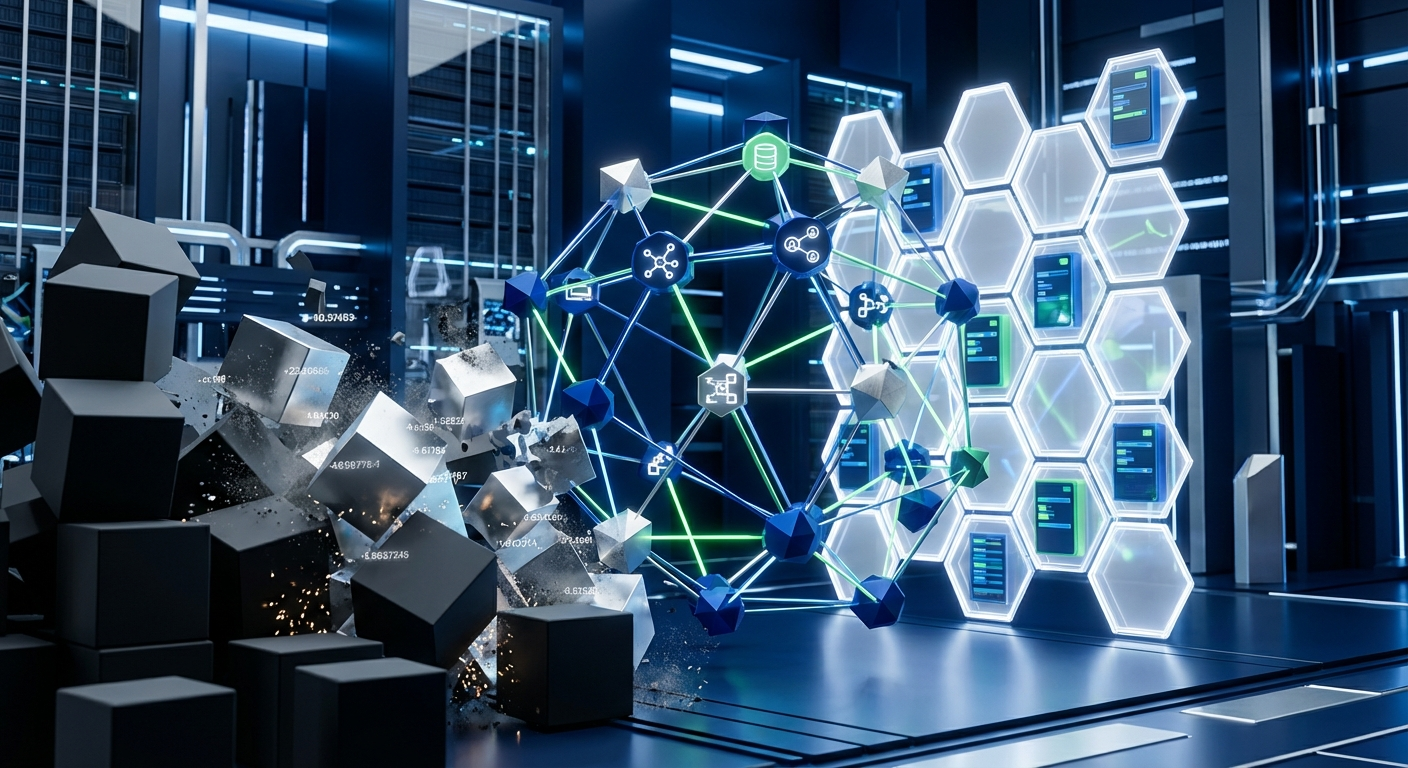
The logical, scalable, and secure evolution of the LLM Wiki is what we at Epsilla have been building: the Semantic Graph.
The Semantic Graph takes the core principles of Karpathy’s system—structured, interconnected, and human-readable knowledge—and implements them on a robust, server-side architecture designed for multi-tenant enterprise use.
It is not a vector database. It is not a folder of files. It is a living, queryable representation of your organization's collective intelligence.
Here’s how it maps directly to Karpathy's concepts, but solves the enterprise challenges:
- Structured Nodes, Not Opaque Chunks: Instead of arbitrary vector chunks, the fundamental unit of the Semantic Graph is a "node." A node is a structured object representing a concept, a document, a person, a meeting, or a piece of code. Each node contains human-readable summaries, metadata, and properties—the "compiled" knowledge—generated by LLM agents.
- Explicit Relationships, Not Implicit Similarity: Instead of relying solely on vector similarity, the Semantic Graph stores explicit, labeled relationships between nodes (e.g.,
[Document A]--[CITES]-->[Paper B],[Employee X]--[Authored]-->[Report Y]). This is the enterprise version of Karpathy’s backlinks, creating a rich, traversable graph that preserves context far more effectively than any vector search can. - Enterprise-Grade Security and Governance: The Semantic Graph is built on a foundation of strict RBAC. Access to nodes and relationships is governed by granular permissions, ensuring data is only visible to authorized users and agents. Every interaction with the graph—every query, every update, every synthesis—is immutably logged and auditable via our observability platform, ClawTrace. This moves beyond simple file readability to true enterprise compliance.
- Agentic Maintenance at Scale: The "self-healing" and "compilation" processes are not manual scripts. They are managed, production-level services deployed through AgentStudio. These agents continuously ingest new data from sources like Slack, Confluence, and GitHub, compiling it into the graph in real-time. They perform the "health checks" Karpathy described, but as scalable, monitored Agent-as-a-Service (AaaS) deployments.
In this model, vector search is not eliminated; it is relegated to its proper role. It becomes a powerful tool for candidate selection—finding potentially relevant nodes within the graph to feed into a reasoning agent. But the final source of truth and context comes from the structured data and explicit relationships within the graph itself.
The Road to 2026: MCP and the True Corporate Brain
The "RAG is dead" conversation is a signpost. It indicates that we are moving from an era of static information retrieval to one of dynamic knowledge synthesis. By 2026, with the arrival of models like GPT-6 and Claude 4, the concept of simply "searching" for information will seem archaic.
The dominant paradigm will be the Model Context Protocol (MCP), a standardized way for powerful autonomous agents to interact with structured knowledge sources like Epsilla's Semantic Graph. These agents won't just answer questions. They will perform complex, multi-step tasks by traversing the graph, synthesizing new knowledge, and updating the graph with their findings. They will become the primary workforce for knowledge-based tasks.
An agent tasked with creating a competitive analysis report won't just be fed a jumble of vector chunks. It will be granted specific, audited access to a subgraph containing nodes for market reports, internal sales data, and engineering roadmaps. It will reason over the explicit relationships between these nodes to generate insights that are impossible to derive from disconnected text snippets. The final report, itself a new node in the graph, becomes a permanent, reusable asset.
Karpathy's experiment was a flare sent up from the future. It illuminated the path away from the dead end of RAG 1.0. The community's enthusiastic response confirms the destination is correct. Now, the work begins to build the enterprise-grade highway to get there. That highway is not made of Markdown files. It is built on the secure, scalable, and intelligent foundation of the Semantic Graph.
FAQ: The LLM Wiki vs RAG
Isn't the Semantic Graph just a fancy vector database?
No. It prioritizes structured, human-readable nodes and explicit relationships over opaque vector chunks. This provides true context, auditability, and a foundation for complex reasoning that is impossible with vector-only systems. It represents knowledge, not just text.
Can we still use vector search with Epsilla's Semantic Graph?
Yes, absolutely. Vector search becomes a powerful tool for candidate generation within the graph, not the final source of truth. It helps find potentially relevant nodes to feed into an agent, which then reasons over the rich, structured graph data for superior accuracy.
How does this approach handle real-time data ingestion?
Unlike a static Wiki that requires manual recompilation, the Semantic Graph is designed for dynamic, real-time updates. Our managed ingestion pipelines, configured in AgentStudio, continuously "compile" new data from any source into graph nodes and relationships, ensuring the corporate brain is always current.