
Key Takeaways
- The agentic AI landscape is rapidly maturing from experimental prototypes to enterprise-grade, hardened infrastructure.
- Purpose-built hardware like Nvidia's Vera CPU signals a fundamental shift, optimizing for the unique compute patterns of agentic reasoning and tool use, not just inference.
- Secure, isolated execution environments are now non-negotiable, with MicroVMs like NanoClaw providing the necessary sandboxing for running untrusted agent code safely.
- Efficiency is paramount; interfaces are evolving from context-heavy schemas (MCP) to parsimonious CLIs (Apideck) to reduce operational costs.
- Interoperability requires standardization. Declarative formats like Agent Format are emerging to define agent capabilities and prevent ecosystem fragmentation.
- Reliability in probabilistic systems is being solved by imposing deterministic gates, ensuring critical agent actions are predictable and verifiable.
The initial, chaotic proliferation of AI agents is consolidating. The era of proof-of-concept wrappers around LLM APIs is giving way to a more disciplined, architectural phase. We are witnessing the hardening of the agentic stack, a necessary evolution for any technology moving from the lab to the enterprise. This isn't about novel agent capabilities; it's about building the robust, secure, and efficient infrastructure required to deploy them at scale. The conversation has shifted from "Can an agent do this?" to "How can we run a million agents reliably and securely?"
This maturation is happening at every layer. At the silicon level, the announcement of the Nvidia Vera CPU, Purpose-Built for Agentic AI is a critical signal. For too long, we've been forcing agentic workloads—which are characterized by complex decision trees, tool-use orchestration, and dynamic planning—onto hardware designed for dense matrix multiplication. Vera acknowledges that agentic computation is a distinct paradigm. Optimizing for this at the hardware level will unlock performance and efficiency gains that are simply unattainable through software alone.
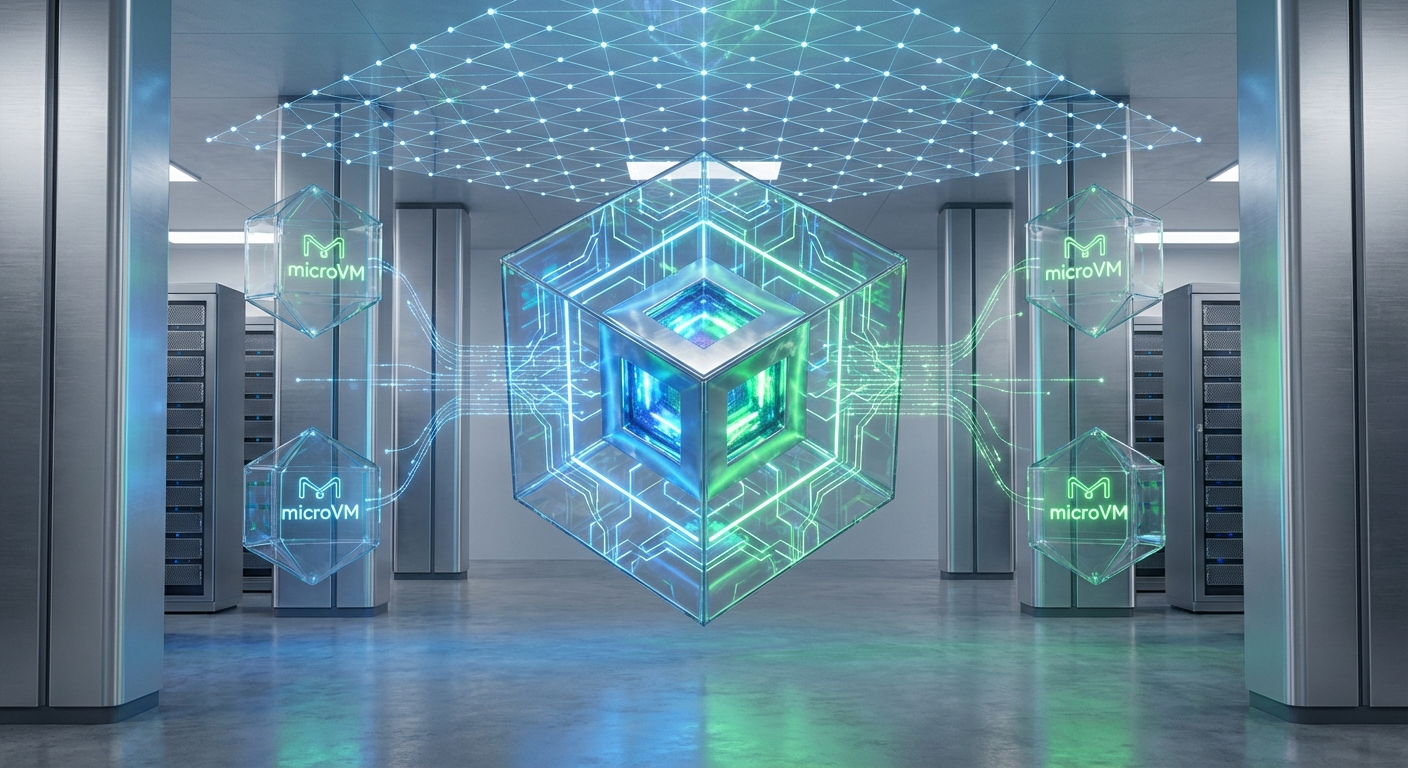
Above the silicon, the execution environment is being secured. The prospect of autonomous agents with API access running arbitrary code has been a major blocker for enterprise adoption. The collaboration between NanoClaw and Docker to isolate AI agents inside MicroVM sandboxes directly addresses this. Standard containers share a kernel, which presents an unacceptable attack surface. MicroVMs provide true kernel-level isolation, creating a secure sandbox where an agent can operate without posing a systemic risk. This is the foundational security primitive that CSOs have been waiting for.
With secure execution comes the need for efficient operation. The early "Model Context Protocol" (MCP) approach of feeding massive API specifications into an agent's context window is brutally inefficient and costly. It's a brute-force method that doesn't scale. The emergence of streamlined interfaces like the Apideck CLI demonstrates a more intelligent approach. By providing a concise, command-line interface for tool use, context consumption is drastically reduced, leading to faster response times and lower token costs. This is the kind of pragmatic engineering that separates sustainable products from expensive demos.
As the ecosystem of tools and agents grows, interoperability becomes the next bottleneck. A fragmented landscape of proprietary agent definitions is a dead end. This is why a standard like Agent Format is so vital. A declarative, standardized way to define an agent's goals, permissions, and available tools allows for a modular and competitive marketplace. You can swap out models, tools, and even orchestration platforms without a complete rewrite. Standards are the bedrock of all mature technology ecosystems.
Finally, we must impose order on the inherent non-determinism of the underlying models. An agent managing logistics or financial transactions cannot be purely probabilistic. The concept of Deterministic Gates for Probabilistic AI Agents is the solution. By inserting logical checkpoints, validation steps, and human-in-the-loop approvals for high-stakes actions, we build guardrails that ensure reliability. The probabilistic core can be used for generation and reasoning, but deterministic gates enforce the business logic.
These are the hardened components of the new agentic stack: purpose-built silicon, secure sandboxes, efficient interfaces, and common standards, all governed by deterministic logic. But components alone do not make a system. They require an intelligent orchestration and memory layer to connect them. This is precisely where Epsilla operates. Our Agent-as-a-Service platform is the connective tissue. We leverage our Semantic Graph to provide the persistent memory and complex reasoning fabric that agents need to perform sophisticated, multi-step tasks. Our platform orchestrates the lifecycle of agents within NanoClaw sandboxes, intelligently selects the most efficient tools like the Apideck CLI, and manages the state required for deterministic gates to function. We don't build the bricks; we provide the architectural blueprint and the smart mortar that holds them together.
FAQ: Agentic Infrastructure
Why is specialized hardware like the Nvidia Vera CPU necessary for AI agents?
Standard GPUs are optimized for parallel processing of large, dense matrix calculations, which is ideal for training and inference on large language models. Agentic workloads, however, are different. They involve more sequential decision-making, logical reasoning, environmental interaction, and tool-use orchestration. These tasks are often less parallelizable and create different computational bottlenecks. A purpose-built CPU like Vera is designed to accelerate these specific functions, leading to faster, more power-efficient agent performance than can be achieved by running the same logic on general-purpose or GPU hardware.
How do MicroVM sandboxes like NanoClaw differ from standard containerization for AI agents?
Standard containers (like Docker) share the host machine's operating system kernel. While they provide process and filesystem isolation, a vulnerability in the shared kernel could allow a malicious process in one container to "break out" and affect the host or other containers. This is an unacceptable risk for running autonomous AI agents that can execute arbitrary code. MicroVMs, like those used by NanoClaw, provide a much stronger security boundary. Each MicroVM runs its own tiny, independent kernel, offering true hardware-level virtualization and isolation from the host and other agents.
What role does a Semantic Graph play in an ecosystem of standardized agents?
In an ecosystem where agents are defined by a common standard like Agent Format, the key differentiator becomes the intelligence of the orchestration layer. A Semantic Graph provides the crucial long-term memory and reasoning framework. It allows an agent system to understand the complex relationships between entities—users, data, tools, past actions, and goals. Instead of just having a transactional memory, the graph enables agents to reason over interconnected knowledge, identify non-obvious patterns, and maintain context across long-running, complex tasks. It's the brain that powers the standardized limbs.