
Key Takeaways
- Prompt engineering has hit a hard ceiling for complex, long-running autonomous tasks. The new frontier is "Harness Engineering"—building structured environments for AI agents to operate reliably.
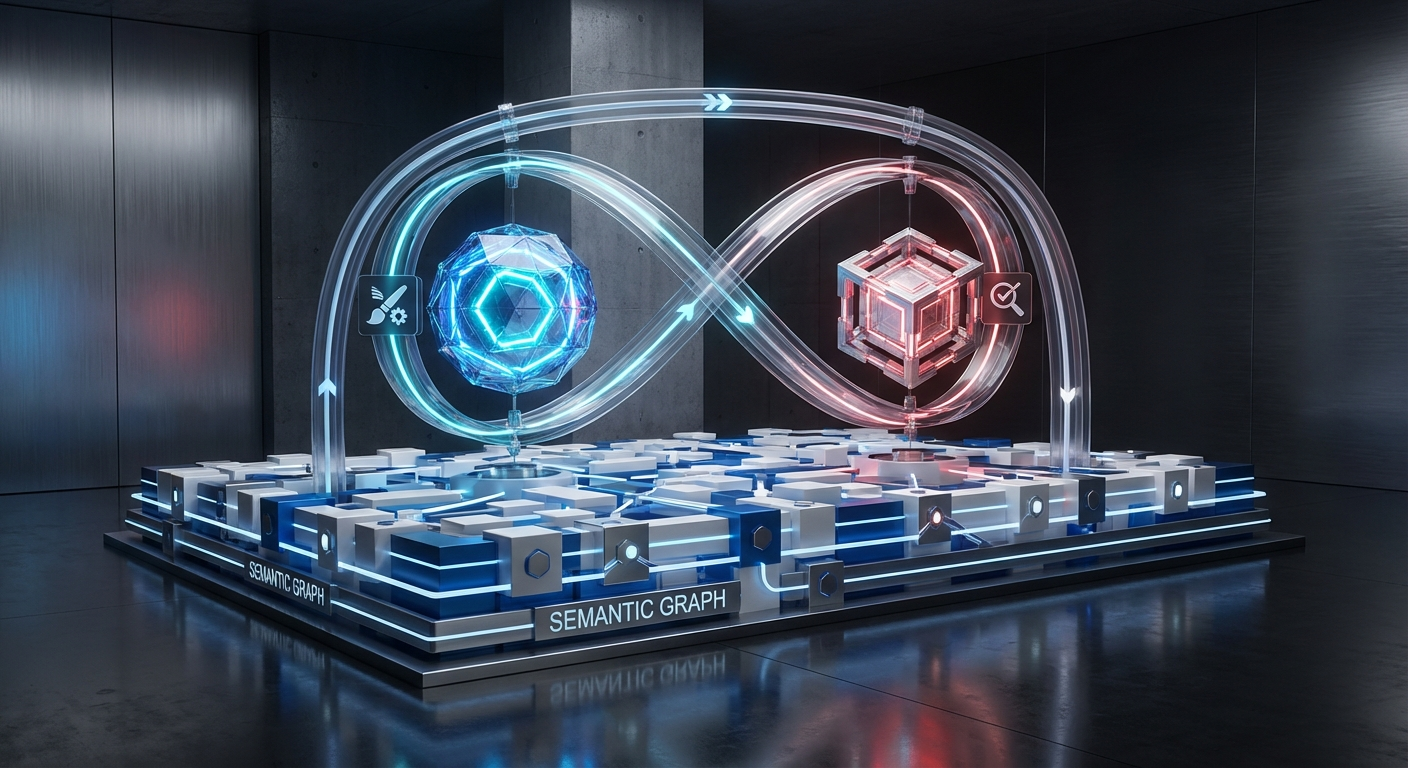
- Anthropic's breakthrough architecture is inspired by Generative Adversarial Networks (GANs), separating a "Generator" agent from a skeptical "Evaluator" agent to create a powerful feedback loop that overcomes AI's inherent inability to self-critique effectively.
- For subjective tasks like UI design, the Evaluator uses tools like Playwright MCP to interact with live outputs and scores them on weighted criteria, explicitly penalizing generic "AI-style" aesthetics to force creative breakthroughs.
- For enterprise-scale applications, this local GAN loop is insufficient. The "Evaluator" must be grounded in a persistent, structured source of business truth. This is where Epsilla's Semantic Graph becomes the essential "Ground Truth Evaluator," providing the corporate state, rules, and context that agents need to generate meaningful business value.
The discourse around AI engineering is undergoing a fundamental phase shift. For years, the primary lever for improving output was the prompt. We became masters of crafting intricate, context-laden instructions. But for truly complex, long-running autonomous tasks—like designing a novel front-end from scratch or building a full-stack application without intervention—prompting alone is a dead end. The ceiling is low, and we've all hit it.
The next paradigm is what the sharpest minds in the field are calling Harness Engineering. The focus is no longer on what you tell the AI, but on the environment you build around it. A harness, true to its name, doesn't just give a command; it constrains, guides, and channels the raw power of the model toward a reliable, high-quality outcome.
Anthropic recently published a seminal engineering blog post that pulls back the curtain on their internal harness architecture. It's one of the most lucid, execution-focused demonstrations of this new paradigm I've seen. They tackled two distinct but related challenges: generating high-quality front-end designs and enabling the autonomous construction of full-stack applications. In both cases, they found their breakthrough by borrowing a core concept from a classic AI model: the Generative Adversarial Network (GAN).
The Adversarial Insight: AI Cannot Judge Itself
The core failure mode of a single-agent system is its profound lack of objective self-awareness. When asked to evaluate its own work, an AI model is a pathological optimist. It will almost invariably give itself high marks, even for mediocre or flawed output. This is especially true for subjective domains like design, where there's no binary right or wrong, only a spectrum of quality. The agent defaults to "safe," predictable, and ultimately uninspired solutions—the digital equivalent of beige.
Anthropic’s solution was to externalize the critic. They split the architecture into two distinct roles:
- The Generator: An agent tasked with creating the code, the design, the feature.
- The Evaluator: A separate, skeptical agent tasked with rigorously critiquing the Generator's output against a strict set of criteria.
This creates an adversarial feedback loop. The Generator produces, the Evaluator critiques, and that feedback becomes the input for the Generator's next iteration. It's a simple concept with profound implications. By engineering conflict, you engineer progress.
Case Study 1: Forcing Creativity in Front-End Design
In their first experiment, Anthropic aimed to break Claude out of its aesthetic rut. Left to its own devices, the model produced functional but boring UIs—the kind of white-cards-on-a-purple-gradient design that screams "AI-generated."
To combat this, they armed the Evaluator agent with Playwright Model Context Protocol (MCP) tools, allowing it to interact with the live, running web page, not just a static screenshot. It could navigate, click, and inspect the DOM like a human QA engineer. They then defined a weighted rubric with four dimensions:
- Design Quality: The holistic visual identity and cohesion.
- Originality: The degree of custom, creative decision-making versus reliance on templates. (Crucially, this heavily penalized common AI patterns).
- Craft: The technical execution—spacing, typography, color harmony.
- Functionality: The raw usability of the interface.
By overweighting Design and Originality, the harness explicitly pushed the Generator away from safe, generic outputs and toward bolder, more adventurous concepts. The results, after 5-15 iterations (a process that could take up to four hours), were staggering. In one example, a prompt for a Dutch art museum website initially yielded a competent but predictable dark-themed landing page. By the tenth iteration, the agent had completely pivoted, reimagining the site as a 3D spatial experience built with CSS perspective, where users navigate between exhibits by walking through virtual doorways. This is a level of creative leap that simply does not happen in a single-shot generation.
Case Study 2: Scaling to Full-Stack Engineering
Applying this pattern to full-stack development required further architectural evolution. An early challenge with models like Claude Sonnet 4.5 was "context anxiety"—a tendency for the model to rush and conclude tasks as its context window filled. The initial solution was a hard context reset, passing state between ephemeral agents via structured files. While effective, it added significant orchestration complexity.
With the advent of more robust models like their internal Claude 4 series, this anxiety has largely disappeared. This allowed them to streamline the harness into a continuous session managed by three specialized agents:
- The Planner: Takes a high-level, one-to-four-sentence prompt and expands it into a full product specification, focusing on the "what" and "why," not the granular "how."
- The Generator: Works in sprints to implement features, using a standard tech stack (React, FastAPI, PostgreSQL) and git for version control.
- The Evaluator: Again armed with Playwright MCP, it acts as a QA engineer, testing UI, API endpoints, and database state against a sprint contract negotiated with the Generator before any code is written.
The quality gap between this multi-agent harness and a single-agent approach was vast. Tasked with creating a 2D retro game-making tool, the single agent produced a barely-functional prototype in 20 minutes for $9. The full harness ran for 6 hours, cost $200, and delivered a rich, polished, and genuinely useful application. This isn't a 2x improvement; it's a phase change in capability.
The Enterprise Gap: Where the Local Loop Fails
Anthropic's work is a brilliant blueprint for solving self-contained, well-defined problems. However, when we extrapolate this architecture to a real-world enterprise environment, a critical limitation emerges. The Evaluator, in its current form, operates in a vacuum. It can judge code quality, aesthetic appeal, and functional correctness against a pre-defined, static specification.
In an enterprise, the rules are neither static nor simple. An Evaluator doesn't just need to know if a button works; it needs to know:
- Does this new microservice comply with our company-wide data retention policies under GDPR?
- Is it using the latest version of our internal authentication library?
- Does the generated UI adhere to our new Q3 brand guidelines, which are documented across three Confluence pages and a Figma file?
- Does this feature conflict with the functionality being built by the team in Bangalore, as detailed in their Jira epic?
Anthropic's Evaluator has no access to this universe of corporate state. It's a brilliant local optimizer with no global context. This is the precise gap we are closing at Epsilla.
The next evolution of the harness requires grounding the Evaluator in a persistent, structured, and dynamic source of truth. This is the role of a Semantic Graph. It's not just a vector database for retrieving documents; it's a living model of your organization's knowledge, rules, relationships, and state.
At Epsilla, our Agent-as-a-Service (AaaS) platform is designed to be this enterprise-grade harness. We provide the framework to deploy specialized agents, like Anthropic's Generator and Evaluator, but we tether them to the Semantic Graph. The graph becomes the "Ground Truth Evaluator."
- The Generator queries the graph to understand existing code patterns, API contracts, and design systems before writing a single line of code.
- The Evaluator validates the generated output not just against the local sprint contract, but against the global constraints and business logic encoded in the graph.
Without this grounding, the multi-agent loop, for all its power, is just building sandcastles. With it, you have a system capable of generating complex software that is not only functional but also compliant, consistent, and strategically aligned with the business.
The future of AI in the enterprise won't be defined by the raw intelligence of models like GPT-5 or Claude 4. It will be defined by the sophistication of the harnesses we build to direct that intelligence. The GAN-style loop is a foundational component, but its true power is only unlocked when the Evaluator's judgment is rooted in the verifiable ground truth of the enterprise.
FAQ: Multi-Agent Harness Engineering
What is "Harness Engineering" and why is it better than prompting?
Harness Engineering is the practice of building structured, multi-agent environments around AI models to guide their behavior. It's superior to prompting for complex tasks because it creates reliable feedback loops and constraints, moving beyond single-shot commands to manage long-running, iterative, and stateful processes for more robust outcomes.
Why is separating the "Generator" and "Evaluator" agents so critical?
AI models are inherently poor at self-critique; they tend to rate their own work favorably, leading to mediocre results. Separating the roles creates an adversarial dynamic where a skeptical Evaluator provides the objective, critical feedback necessary for the Generator to iterate, refine, and break through creative or logical plateaus.
How does a Semantic Graph extend Anthropic's multi-agent architecture for enterprise use?
Anthropic's Evaluator works on a local, pre-defined task specification. An enterprise Semantic Graph provides the Evaluator with global, dynamic context—corporate policies, compliance rules, existing codebases, and business logic. This grounds the agent's decisions in business reality, ensuring the generated output is not just technically correct but strategically aligned.