
Key Takeaways
- The historical business model of knowledge work—profiting from information asymmetry—is obsolete. AI has commoditized information retrieval, making basic RAG a table-stakes technology, not a competitive moat.
- The next frontier of value creation is not in retrieving information, but in delivering judgment, strategy, and operational certainty. This requires moving beyond simple Q&A to automated, multi-step execution.
- Enterprises must evolve from building retrieval systems to orchestrating autonomous agents. This requires a new tech stack: a Semantic Graph for deep contextual memory and an orchestration layer like Epsilla's AgentStudio to manage complex workflows.
- The future isn't selling time or data; it's selling intelligent, automated systems that prevent problems and deliver predictable outcomes.
For centuries, the value of knowledge workers—lawyers, consultants, analysts—was built on a simple premise: an information monopoly. They possessed access to and understanding of complex, unstructured data that was opaque to their clients. A lawyer’s value was rooted in knowing the law you didn’t; a consultant’s, in possessing market data you couldn’t access. This information asymmetry was their moat, and they charged a premium to bridge it.
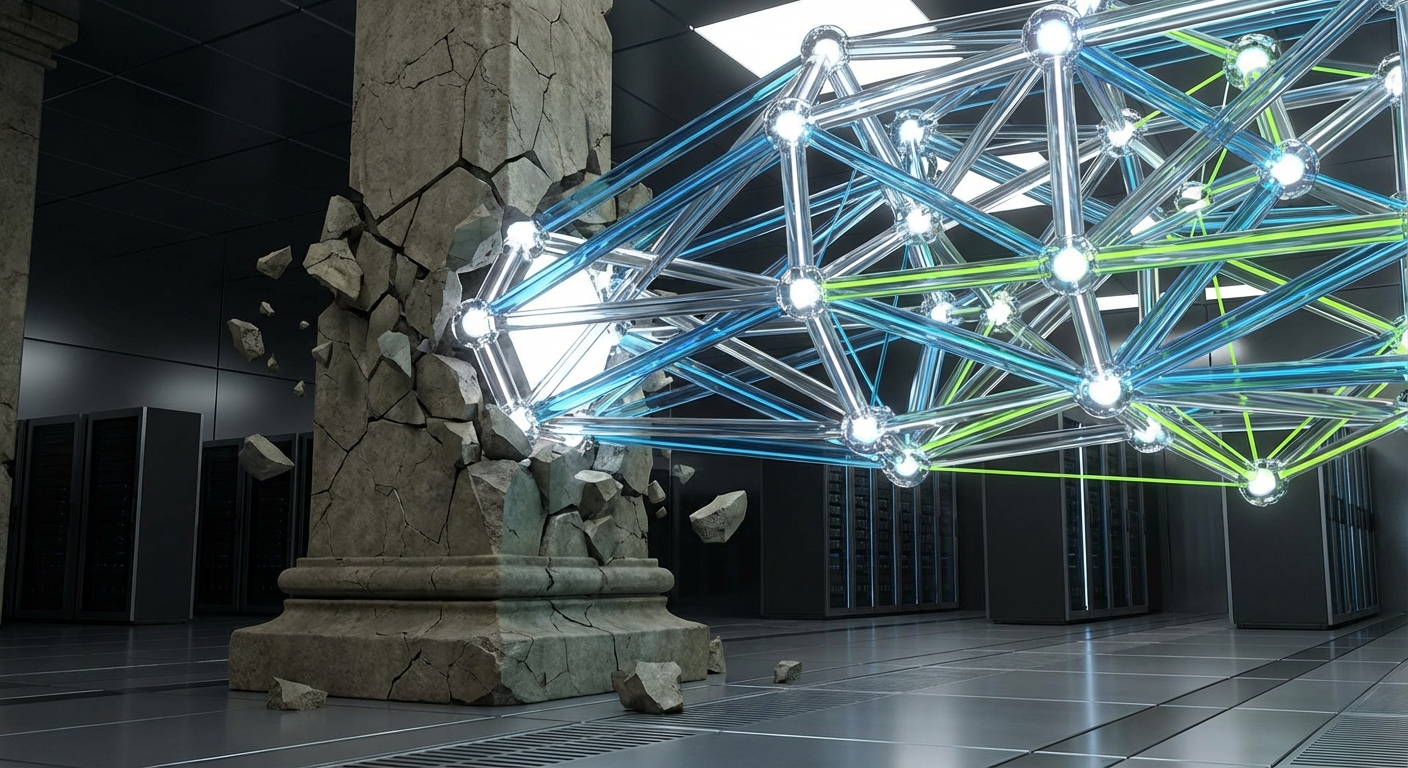
That moat has been drained.
The rise of powerful foundation models has democratized access to information on an unprecedented scale. The core function of a junior associate—retrieving case law, summarizing statutes, drafting a standard non-disclosure agreement—is now a trivial task for an LLM. Retrieval-Augmented Generation (RAG) has become the default architecture for enterprise AI, allowing anyone to "chat" with their documents.
This is the great flattening. But to mistake this for the end of high-value knowledge work is a failure of imagination. It is merely the end of selling information. The game has changed. The new currency isn't retrieval; it's judgment. And the new business model isn't selling hours; it's selling automated systems that deliver certainty.
The RAG Ceiling: From Information Retrieval to Strategic Judgment
The fundamental limitation of a standard RAG system is that it operates on a flat plane of information. It is exceptionally good at answering the question, "What does this document say?" It can parse a 100-page contract and identify clauses that mention liability. It can scan a market research report and extract growth projections.
But it cannot answer the critical business questions that follow:
- Of these ten flagged liability clauses, which are standard boilerplate and which are hidden landmines?
- What is the practical, real-world risk of this clause being invoked by this specific counterparty in this market?
- Given this 30% chance of litigation, is the strategic reward worth the risk?
This is the RAG ceiling. It provides information, but it cannot provide wisdom. It retrieves facts, but it lacks the contextual understanding—the "dark knowledge"—that defines expertise. An experienced lawyer doesn't just know what the law says; she knows how a particular judge in a specific circuit tends to rule. She knows which contractual risks are theoretical versus which are weaponized in practice.
This is the chasm between information and judgment. A RAG system can tell you a contract has risks. An expert tells you to delete Clause 7, amend Clause 12, and ignore the rest because they are paper tigers. AI can tell you the probability of winning a lawsuit is 30%. An expert can tell you whether you can afford to bet three years of your company's life on those odds.
Building the Judgment Layer: Why Your Agent Needs a Semantic Graph
To break through the RAG ceiling, enterprise agents need more than a vector index. They need a memory structure that mirrors the interconnected, weighted knowledge of a human expert. They need a brain, not just a library.
This is why we built Epsilla's Semantic Graph.
Unlike a vector database, which stores data as isolated points in semantic space, a Semantic Graph encodes the relationships between them. It creates a rich, multi-dimensional map of your organization's knowledge. It doesn't just know that "Clause 7.1" is related to "indemnification." It knows that Clause 7.1 has been litigated three times in the past five years, that it was introduced by a specific counterparty known for aggressive tactics, and that it resulted in an average financial loss of $1.2 million.
This graph-based structure is the key to digitizing and scaling "dark knowledge." It allows an AI agent to reason about second- and third-order effects. It can trace the lineage of a decision, understand the precedent, and weigh potential outcomes based on a rich tapestry of historical context, not just keyword similarity. When an agent queries a Semantic Graph, it isn't just retrieving a fact; it's tapping into the accumulated wisdom of the entire organization.
From Judgment to Execution: Orchestrating Agents with AgentStudio
Possessing judgment is necessary, but insufficient. The ultimate value lies in translating that judgment into action. The most valuable legal service isn't winning a lawsuit; it's creating a system that prevents the dispute from ever occurring.
This is the shift from providing advice to delivering an automated system. It’s the difference between a lawyer charging by the hour to review contracts and an Agent-as-a-Service (AaaS) that provides a company with an autonomous contract negotiation workflow.
This is where orchestration becomes critical. A truly valuable enterprise agent is not a monolithic entity but a coordinated system of specialized functions. This requires a platform designed for building, testing, and deploying these complex, multi-step workflows. It requires Epsilla's AgentStudio.
Consider a sophisticated contract analysis agent built within AgentStudio:
- Ingestion & Initial Pass: The agent ingests a new Master Service Agreement. A basic RAG module performs an initial scan, identifying and categorizing key clauses.
- Deep Contextual Analysis: For each non-standard clause, the agent queries the Semantic Graph. It assesses the clause against the company’s playbook, historical negotiation data with this counterparty, and relevant case law outcomes stored in the graph.
- Risk-Weighted Judgment: The agent synthesizes this information to generate a judgment. It doesn't just flag a clause as "risky"; it assigns a specific risk score and provides a rationale grounded in the graph's data ("High risk: This exact phrasing led to a compliance breach in Q3 2024 with a similar client").
- Automated Execution: Based on the judgment, the agent executes a pre-defined workflow. It might automatically accept standard clauses, draft a specific redline for a medium-risk clause using approved language, and escalate a high-risk clause to the General Counsel with a full contextual summary.
This entire process is managed through a robust Model Context Protocol (MCP), ensuring the agent maintains state and intent across dozens of steps. The output isn't a document; it's a completed business process. You are no longer selling legal review; you are selling a system for risk-managed, high-velocity contracting.
The New Moat is Certainty-as-a-Service
As we look toward the capabilities of 2026-era models like GPT-5 and Claude 4, their advanced reasoning, when grounded by the deep memory of a Semantic Graph and orchestrated by a platform like AgentStudio, will make these autonomous systems the default for enterprise operations.
The competitive landscape for knowledge work has been permanently redrawn. Your advantage no longer comes from hoarding information. It comes from the sophistication of the intelligent systems you build to act upon it. Clients and customers will not pay a premium for data they can get themselves. They will pay a massive premium for certainty—the certainty that their contracts are optimized, their compliance is automated, and their risks are proactively neutralized before they manifest.
Stop building chatbots that fetch answers. Start building autonomous agents that execute workflows and deliver outcomes. The information monopoly is dead. The age of the execution engine has begun.
FAQ: AI Agents in Legal and Knowledge Work
Isn't basic RAG "good enough" for most enterprise use cases?
For simple information retrieval, yes. But "good enough" is not a competitive advantage. RAG is a commodity. For high-value tasks requiring judgment, risk assessment, and multi-step reasoning—like contract negotiation or strategic analysis—RAG alone is dangerously insufficient as it lacks deep contextual understanding and can't weigh nuanced factors.
How does a Semantic Graph differ from a traditional knowledge graph or vector database?
A vector database stores data points based on semantic similarity but misses the explicit relationships between them. A traditional knowledge graph has rigid, pre-defined schemas. Epsilla's Semantic Graph combines the flexibility of vector search with the rich, structured connections of a graph, allowing it to dynamically represent complex, evolving relationships—the digital equivalent of an expert's intuition.
What is the first practical step for a company to move from a RAG system to an agent-based workflow?
Start by identifying a high-value, repetitive process currently reliant on human judgment (e.g., initial contract review, compliance checks). Instead of just retrieving information, map out the decision-making logic. Begin building a Semantic Graph around this process to capture the "dark knowledge" and use an orchestration tool like AgentStudio to automate the first few steps.