
Key Takeaways
- The enterprise AI focus is shifting from a monolithic "bigger is better" model race to the architecture of sophisticated, multi-agent systems. The real value lies in the system, not the individual model.
- Production-grade agents require a new infrastructure stack built on two emerging pillars: a "Perception and Action" layer for environmental interaction and a robust orchestration framework for coordinating specialized agents.
- The critical, and often missing, component is a persistent, structured memory layer. Simple vector databases are insufficient for complex reasoning. A Semantic Graph is required to provide agents with the relational context and long-term memory needed to execute complex tasks and prevent hallucination.
- Epsilla's AgentStudio provides the Agent-as-a-Service (AaaS) control plane for orchestrating these systems, while our Semantic Graph serves as the essential grounding layer, the shared "brain" for enterprise agent swarms.
The discourse in the AI space remains disproportionately captivated by the parameter count of the next foundation model. While the development of GPT-5, Claude 4, and Llama 4 is an important axis of progress, it is a dangerous strategic distraction for enterprise leaders. The assumption that a single, larger model will solve complex, multi-faceted business problems is a fallacy. The future of enterprise AI is not a monolith; it is a meticulously architected, distributed system of coordinated, specialized agents.
The most telling signals are not coming from the large labs, but from the builders in the trenches. A question posed by the user twoelf on Hacker News cuts to the core of this shift: "Is it still worth making 'Huge' Language Models for dev tools?" This question is not about dismissing scale, but about questioning its monolithic application. The answer is that for specialized, high-stakes domains like software development, a single, general-purpose intelligence is giving way to a federation of specialized agents. The architectural patterns emerging to support this new paradigm reveal the true shape of the AI-native enterprise.
The Fragmentation of Intelligence: From LLMs to Multi-Agent Systems
The principle of specialization is a cornerstone of efficient systems design. We don't use a single, universal tool for every task in a workshop; we use a collection of specialized instruments. The same logic is now being applied to AI. Early, yet powerful, examples of this are surfacing. InitialPhase55's project, SimFic (https://simfic.net), demonstrates a multi-agent narrative simulation. While its domain is interactive fiction, the underlying architecture—multiple agents interacting to create a cohesive, emergent outcome—is a direct precursor to enterprise workflows.
Consider a more pointed example: ttlcc13's Factagora (https://factagora.com/), a system where AI agents debate one another to answer questions that a single LLM might refuse. This is more than a novelty. It is a primitive but effective implementation of a "checks and balances" system for reasoning. One agent acts as a generator, another as a critic, and a third as a synthesizer. This pattern dramatically improves robustness and reduces the risk of single-model failure or bias.
In an enterprise context, this translates to a software development workflow where a "Planner" agent deconstructs a feature request from Jira into a technical specification. A "Coder" agent, fine-tuned on the company's specific codebase and style guides, writes the implementation. A "Security" agent, trained on OWASP principles, reviews the code for vulnerabilities, and a "QA" agent generates unit and integration tests. These agents are not just calling a single, massive LLM. They are smaller, more efficient, and expert in their domain. Orchestrating this swarm is where the true engineering challenge—and competitive advantage—lies.
The Agent's Gateway to Reality: The Perception and Action Layer
An agent, no matter how intelligent, is inert if it is trapped in a black box. To perform meaningful work, it must perceive its environment and act upon it. This has given rise to a critical new infrastructure category: the perception and action layer. This is the I/O for agentic systems.
We see this taking shape with tools like Hollow (https://artiqal.vercel.app/hollow), a project by LahanF described as "serverless web perception for AI agents." This is not just a web scraper; it is an attempt to create a structured, reliable way for an agent to "see" and interpret the unstructured chaos of the web. Similarly, andrew_zhong's robust LLM extractor (https://github.com/lightfeed/extractor) focuses on the same problem: turning messy HTML into clean, actionable data for an LLM.
These tools are the sensory organs of the agent. In the enterprise, the "web" is a vast landscape of internal APIs, Confluence pages, Salesforce records, legacy databases, and Git repositories. A production-grade agent system requires a robust and secure perception layer to interact with these systems. The action layer is the inverse: a set of tools and APIs that allow the agent to write code, update a database, send an email, or create a Jira ticket.
The logical extreme of this trend is represented by projects like Kora (https://intuitivecompute.com/), an "AI-native OS" from jwatters. The ambition to rewrite the operating system itself underscores the fundamental nature of this shift. The entire compute stack is being re-evaluated to better serve as a substrate for agents that must constantly perceive and act upon a dynamic environment.
The Missing Substrate: Grounding Agents in a Semantic Graph
Herein lies the critical failure point of most current agentic designs. A swarm of specialized agents, even with perfect perception, will descend into chaos without a shared, persistent, and structured understanding of their world. They lack long-term memory and, more importantly, an understanding of the relationships between entities. This is why agents hallucinate, lose context in long-running tasks, and fail at complex, multi-step reasoning.
Standard vector search, while useful for retrieving semantically similar documents, is fundamentally insufficient. It can tell an agent that a document about "Project Chimera" is related to the term "Q3 deadline," but it cannot convey the crucial relationship: "Project Chimera is blocked by a dependency owned by the Platform Team, which jeopardizes the Q3 deadline." This relational, causal understanding is the difference between a simple chatbot and an autonomous system capable of genuine problem-solving.
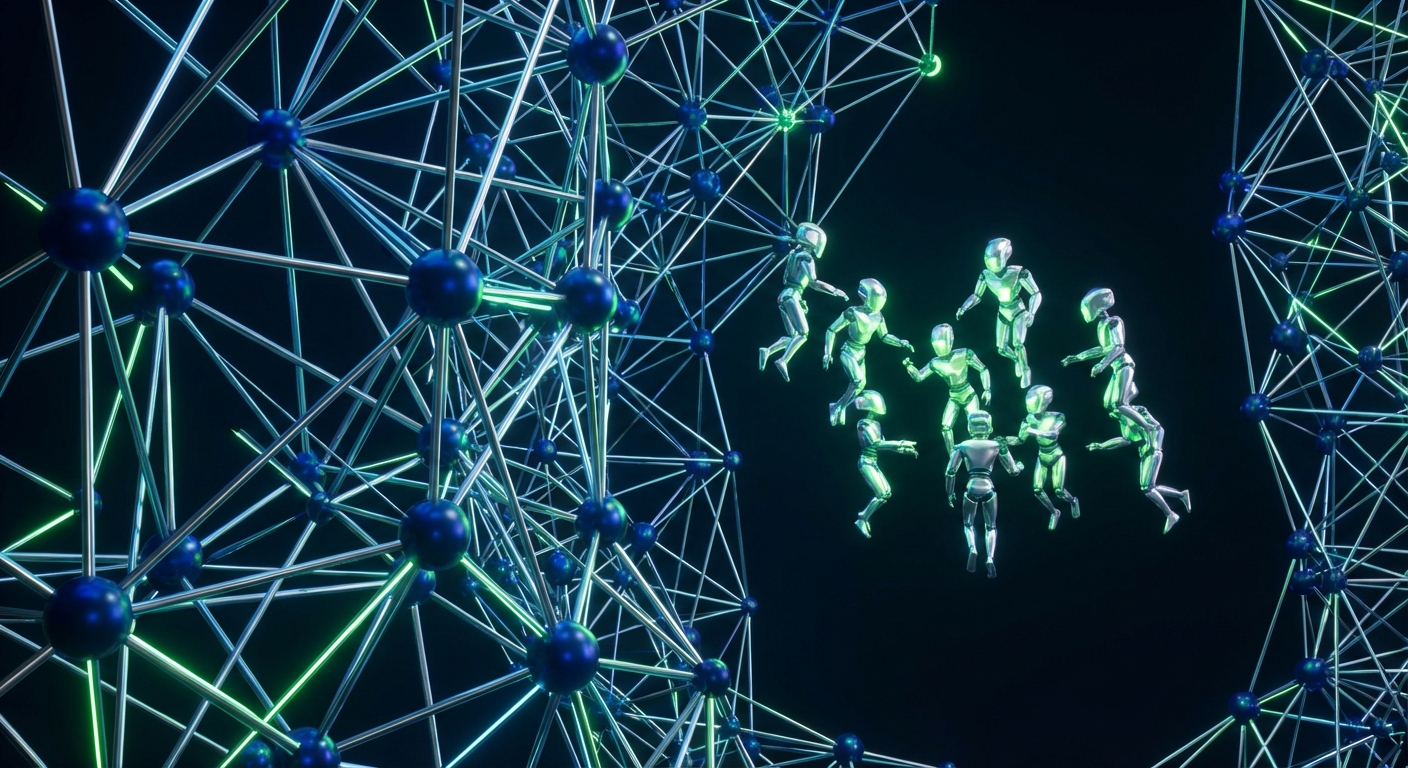
This is the problem we built Epsilla to solve. The necessary foundation for any sophisticated multi-agent system is not a database; it is a brain. Our Semantic Graph is that brain. It is a persistent memory layer that combines the power of vector embeddings with the explicit, relational structure of a knowledge graph. It doesn't just store data; it stores understanding. Each entity—a user, a piece of code, a project, a document—is a node, and their relationships are the edges. This graph becomes the single source of truth, the shared context that all agents in a system read from and write to. It is the substrate that grounds them in reality.
When a new feature request comes in, the Planner agent queries the Semantic Graph to understand existing code dependencies, identify relevant stakeholders, and surface potential conflicts. The Coder agent uses the graph to find the most relevant code snippets and understand the architectural patterns of the services it must modify. The state of the entire project, from inception to deployment, is mapped and maintained within the graph. This is how you build systems that don't just execute commands, but accumulate knowledge and improve over time.
This is the Model Context Protocol (MCP) in action—a standardized way for agents to interact with a rich, contextual memory layer, ensuring coherence and accuracy.
The Control Plane: Orchestrating the Agent-Native Enterprise
With a perception layer for I/O and a Semantic Graph for memory, the final piece is the control plane for orchestration. This is the role of Epsilla's AgentStudio. As an Agent-as-a-Service (AaaS) platform, AgentStudio provides the framework to define, deploy, monitor, and manage these complex multi-agent systems.
It is the environment where you define the roles of your specialized agents, equip them with the necessary tools from your perception and action layer, and—most critically—connect them to the Semantic Graph as their shared cognitive substrate. AgentStudio manages the message passing, the task delegation, and the state synchronization between agents, allowing developers to focus on the logic of the workflow rather than the plumbing of the distributed system.
The path forward for any serious enterprise AI strategy is clear. The obsession with monolithic model scale is a strategic dead end. The durable advantage will be built by those who focus on architecting the system. The challenge for us as founders and builders is to construct the three pillars of this new AI-native stack: a robust perception/action layer for environmental interaction, a sophisticated AaaS control plane for multi-agent orchestration, and a foundational Semantic Graph to provide the persistent memory and grounding necessary for autonomous operation. This is the architecture for 2026 and beyond. The time to build it is now.