
Key Takeaways
- The infrastructure for AI agents is rapidly maturing at the execution layer, with major advances in sandboxing speed, specialized silicon, and safety mechanisms.
- These components—while necessary—are fragmented point solutions. They solve for execution but create a new, more complex problem of orchestration, governance, and memory.
- True enterprise-grade Agent-as-a-Service (AaaS) requires a centralized control plane and a shared memory fabric, like a Semantic Graph, to unify these disparate infrastructure pieces into a cohesive, intelligent system.
- The strategic battleground is shifting from building individual agents to building the orchestration platform that can manage a fleet of them securely and effectively.
The initial fervor around agentic AI has subsided. We've moved past the proof-of-concept stage where a single agent autonomously booking a flight was considered a breakthrough. The market, particularly at the enterprise level, is now grappling with a far more consequential set of problems: how to deploy, manage, secure, and scale a fleet of thousands of specialized agents operating on sensitive corporate data. The conversation has evolved from "Can it work?" to "How do we industrialize it?"
Recent developments signal a clear trend: the foundational execution layer is hardening at an accelerated pace. We are witnessing an arms race in the underlying infrastructure, with distinct battlefronts emerging in security, hardware, and control. While each innovation is a critical step forward, they also highlight a glaring architectural gap that most are overlooking.
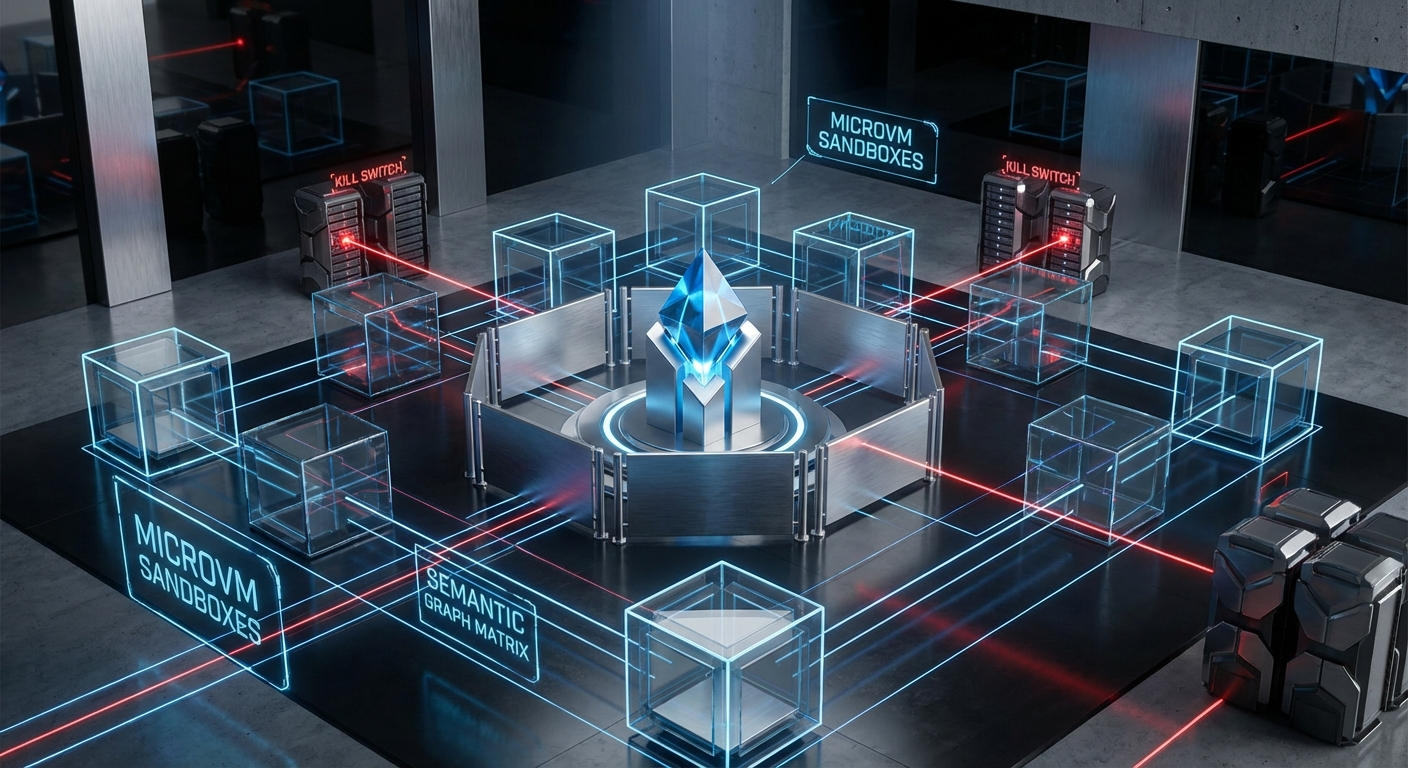
First, consider the challenge of secure, high-throughput execution. The idea of letting a 2026-era model like GPT-5 or Llama 4 run with open-ended permissions on a production network is a non-starter for any competent CISO. The necessary response is ephemeral, high-performance sandboxing. Cloudflare’s work on sandboxing AI agents, 100x faster is a prime example of this trend. By leveraging WebAssembly (Wasm) and the V8 engine’s isolation primitives, they are creating lightweight, secure execution environments that can be spun up and torn down in milliseconds. This is a fundamental enabler for massively parallel agentic workflows. It allows an enterprise to deploy thousands of agents for discrete tasks—analyzing a single document, processing an invoice, triaging a support ticket—with a dramatically reduced attack surface for each instance.
However, this solves one problem while creating another. A thousand ephemeral sandboxes are a thousand isolated, amnesiac workers. They possess no shared context, no persistent memory, and no mechanism for coordinated strategy. They are fast, but they are also fundamentally unintelligent as a collective. This approach provides the muscle, but not the mind.
Second, the hardware itself is being reimagined for agentic workloads. General-purpose CPUs and even GPUs are suboptimal for the unique inference patterns of agents, which involve complex decision trees, tool use, and environmental interaction rather than just raw token generation. Alibaba Releases High-Performance XuanTie C950 Chip Targeting Agentic AI, a move that signals the market’s maturation. This isn't just about incremental performance gains; it's about architectural specialization. Purpose-built silicon will drastically lower the cost and latency of agentic operations, making them economically viable at a scale we can barely imagine today. Yet, this too contributes to the fragmentation of the infrastructure stack. Enterprises will soon face a heterogeneous environment of specialized hardware that requires a sophisticated orchestration layer to manage and allocate resources effectively.
Third, as agents become more powerful and autonomous, the need for robust safety mechanisms becomes paramount. The fear of a "rogue agent" is not merely science fiction; it's a practical risk management issue involving financial, reputational, and operational peril. The novel approach of using bond convexity math to build a kill switch for rogue AI agents is an intellectually elegant solution. It models agent resource consumption like a financial instrument and triggers a shutdown when behavior deviates beyond established risk parameters. This is a crucial piece of the puzzle, providing a last-resort backstop that is essential for building enterprise trust.
But a kill switch, by definition, is a reactive measure. It’s the emergency brake, not the steering wheel. It prevents catastrophe but does not provide proactive governance, auditability, or fine-grained policy enforcement. Relying solely on kill switches is like managing a factory by waiting for fires and then pulling the alarm.
This is the core of the issue. We are building faster engines, stronger chassis, and better airbags. But we are completely neglecting the driver, the navigation system, and the central communications network that allows a fleet of vehicles to operate in concert.
This is the architectural void that we at Epsilla are focused on. The future of enterprise AI is not these isolated components, but the intelligent fabric that weaves them together. Our Agent-as-a-Service (AaaS) platform is designed to be this orchestration layer. It sits above the fragmented execution infrastructure, providing the essential governance, memory, and coordination that transforms a collection of fast, dumb scripts into a cohesive, intelligent workforce.
The key is our Semantic Graph. This is not just a vector database; it is a dynamic, persistent, and shared long-term memory for the entire fleet of agents. When an agent executes a task within a Cloudflare sandbox, its learnings, outputs, and contextual understanding are not discarded when the sandbox is destroyed. Instead, they are integrated back into the Semantic Graph. This shared "brain" allows for true collaboration and compounding knowledge. An agent analyzing a Q4 sales report can leverage the context derived by another agent that processed Q3 data, even if they were run on different hardware days apart.
This is where our Model Context Protocol (MCP) becomes critical. MCP is the standardized language that allows our AaaS orchestrator to pass rich, graph-based context between the Semantic Graph and any agent, regardless of whether it's powered by GPT-5, Claude 4, or a specialized open-source model. It ensures that an agent, upon instantiation in its ephemeral sandbox, arrives with the full situational awareness required for its task. It executes, reports back, and the collective intelligence of the system grows.
Without this orchestration layer, enterprise agent deployment will fail. You will have blazingly fast, secure, and cheap execution environments that produce a chaotic mess of uncoordinated, unauditable, and ultimately low-value outputs. The real value is not in a single agent's execution speed but in the orchestrated intelligence of the entire system over time. The infrastructure arms race is a positive and necessary development, but it is only setting the stage. The decisive victory will go to whoever builds the unifying control plane.
FAQ: Agentic Infrastructure
Why isn't faster hardware and sandboxing enough for enterprise agents?
They solve for execution speed and security in isolation but lack orchestration, shared memory, and governance. An enterprise needs a unified system, not just a collection of fast, disconnected workers. Without a central control plane, you cannot manage complex, collaborative tasks, ensure compliance, or build compounding knowledge over time.
What is a Semantic Graph and why is it critical for AaaS?
A Semantic Graph is a persistent, interconnected knowledge base that acts as a shared long-term memory for a fleet of AI agents. It's critical because it allows agents, which often run in stateless environments, to learn from past interactions, understand complex relationships in data, and collaborate effectively on tasks.
How does a governance layer differ from a simple kill switch?
A kill switch is a reactive, last-resort safety measure that stops a rogue process. A governance layer is a proactive framework that sets rules, permissions, and objectives before an agent acts. It ensures agents operate within compliance, align with business goals, and provides a full audit trail for accountability.