
Key Takeaways
- The ability to generate output (code, text, images) is rapidly becoming a commodity thanks to powerful local agents. The true competitive moat is no longer what you can build, but the deep, proprietary context your AI operates on.
- The common approach of creating complex prompts and chained workflows to manage business context inevitably leads to "Prompt Hell"—a brittle, unscalable system of patches that breaks with every new variable.
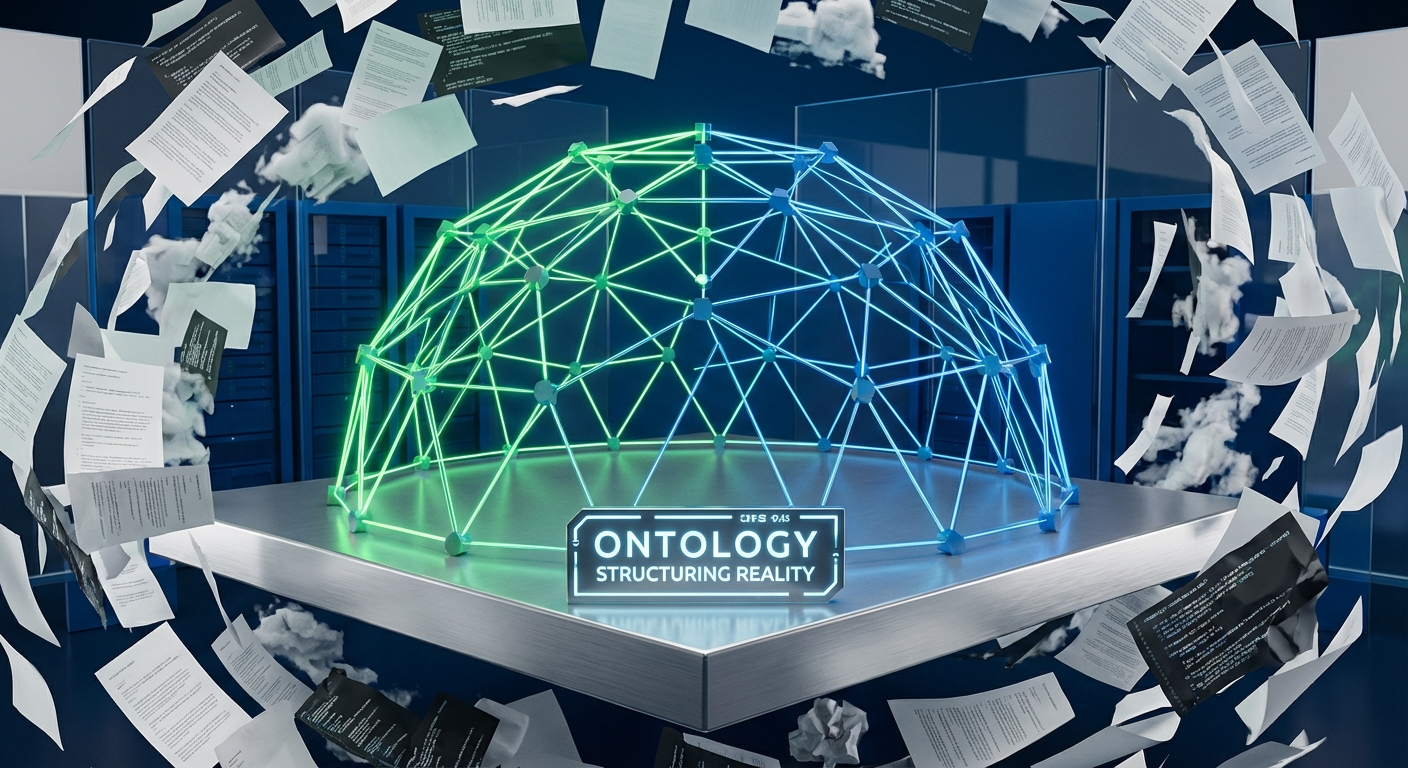
- The solution is not more complex automation, but a more profound underlying structure: an enterprise ontology. This is a dynamic, operational digital twin of your business, not just a static data model.
- At Epsilla, we see this ontology as a Semantic Graph. It models not just data points, but the relationships, states, and permissible actions between them, creating a persistent, queryable "brain" for your organization.
- Our AgentStudio platform allows agents to operate on this Semantic Graph, giving them long-term memory and deep contextual awareness, thus avoiding prompt rot. Observability for this entire system is provided by ClawTrace, ensuring every agentic action is auditable and secure.
The Moment the World Shifted
There was a moment last year that hit me with the force of a physical impact. It wasn't the launch of some groundbreaking new model or a flashy demo. It was something much quieter, happening right in my own terminal. I was integrating a local coding agent, a descendant of tools like Codex CLI, into my daily workflow.
I watched it read my project files, understand a feature request I wrote in plain English, modify the existing codebase, and execute the changes. It wasn't just a code snippet generator; it was a lightweight engineering proxy, a tireless digital intern turning ideas into running code.
My first reaction wasn't excitement. It was a cold shot of anxiety.
The thought that flashed through my mind was this: if the raw production of features, content, and products can be infinitely scaled—if output is becoming effectively free—then what is the actual, defensible value in a business? What is the next defensible moat?
More pointedly, how do we, as founders and builders, leverage AI to solve the real problems of our business, not just create another clever tool that generates more noise without changing the outcome?
This isn't an academic question. My work, like that of any founder, is a chaotic stream of complex, long-cycle decisions. It's not about single-task completion. It's about navigating a perpetual storm of inputs: investor updates, user interview transcripts, board meeting minutes, product requirement documents (PRDs), executive feedback, and the constantly shifting state of the projects themselves.
The bottleneck was never a lack of information or a shortage of tools. The real friction, the thing that consumed 80% of my cognitive load, was the constant, manual effort of synthesis. Information was everywhere, but it wasn't integrated into a coherent system. Actions were taken, but they didn't form a closed loop of learning. Judgments were made, but they didn't compound into a reusable, institutional capability.
I realized the AI product I truly needed to build wasn't one that could simply write better materials. It was one that could ingest the raw, messy reality of the business, understand it, and actively help operate it.
The Road to Ruin: My Journey into "Prompt Hell"
My initial approach was intuitive, logical, and almost entirely wrong.
Faced with a deluge of unstructured information, I did what any engineer would do: I tried to structure it with rules.
- If the information is messy, I'll create more templates.
- If the AI's expression is inconsistent, I'll write longer, more detailed prompts.
- If the business has many different scenarios, I'll build a specialized workflow for each one.
For a short time, it even seemed to work. I built a library of prompt templates for everything: post-mortem analyses, meeting summaries, project status updates, competitive intelligence reports. I crafted elaborate, multi-step chains that would take a raw transcript, extract key entities, summarize discussion points, and suggest action items.
But I wasn't building a system. I was building a prison of patches. I was descending into Prompt Hell.
Every new business scenario required a new set of prompts. Every new data format forced me to rewrite the instructions, explaining to the LLM how it should handle this new variation. Every minor evolution in our business strategy threatened to break the entire fragile structure. I was spending all my time writing instruction manuals for the AI instead of building a system that could think for itself.
Looking back, I was making a classic mistake: I thought I needed more sophisticated automation, when what I actually needed was a more profound underlying structure. I was trying to build a skyscraper on a foundation of sand, and the "prompts" were the frantic, desperate attempts to shore up the cracking walls.
The Ontological Shift: From Representing the World to Operating Within It
The real breakthrough didn't come from a new AI model or a clever prompting technique. It came from revisiting a concept I had previously misunderstood: Ontology.
I'd heard Palantir talk about their "Ontology" for years, but I had dismissed it as a fancy term for a semantic layer or a more complex data model. It was only when I dug into their definition that the pieces clicked into place. Palantir doesn't describe their ontology as a data catalog; they call it the organization's operational layer.
It's a digital twin of the real-world organization, composed not just of semantic elements like objects, properties, and links, but critically, of executable elements like actions, functions, and dynamic security.
This was the lightning bolt.
All my efforts in Prompt Hell were focused on the first part: representing the world. My chains could summarize, classify, and report. They could tell me what was in a document. But the real world of business isn't a static collection of documents. It's a dynamic, stateful system where the most important questions are:
- Which object (e.g., Project Phoenix, Q3 Marketing Campaign) is changing?
- What is its current state (e.g., In-Development, At-Risk, Completed)?
- What other objects and people is it related to?
- What action should be triggered next based on this state change?
- What rules govern whether this action is permissible?
- How does the outcome of that action feed back to update the system?
A truly useful AI system isn't one that just writes better prose. It's one that can translate the messy, unstructured reality of business into a structured, actionable, and iterable model. This is why a true ontology isn't just about nouns and verbs; it's about permissions, triggers, and state machines. It's about building a world model that can act.
This insight completely reframed my vision for the next generation of AI products. The goal was no longer to build a better summarizer or a smarter writer. The goal was to build a Business Operating System.
The Epsilla Architecture: From Flat Files to a Semantic Graph
Once you see the world this way, you realize that the foundational technologies most companies are using for AI—namely, standard RAG pipelines on top of vector databases—are fundamentally inadequate for this task. A vector database is a brilliant tool for semantic search, for finding relevant "chunks" of text. But it's a terrible way to represent the persistent, interconnected reality of a business. It's a filing cabinet, not a brain.
This is why at Epsilla, we've centered our entire architecture on the concept of the Semantic Graph. This is our implementation of an enterprise ontology.
Instead of just storing document chunks, our Semantic Graph stores the core entities of your business—Projects, Employees, Customers, Meetings, Decisions—as nodes. The relationships between them—Manages, Attends, Depends On, Was Decided In—are stored as edges. Each node and edge has properties, states, and metadata.
This isn't just a database. It's a living, queryable model of your business context.
With this foundation, the problem of "Prompt Hell" dissolves. We no longer need to stuff all the context into a single, fragile prompt. Instead, we build and deploy agents using our AgentStudio platform. AgentStudio is our Agent-as-a-Service (AaaS) offering, but with a critical difference: our agents are designed to operate on the Semantic Graph.
When a new piece of information arrives—say, the transcript of a project check-in meeting—it doesn't just get chunked and vectorized. An ingestion agent parses the transcript, identifies the entities mentioned (Project Phoenix, Sarah (PM), Q2 deadline), understands the state changes ("the deadline is now at risk"), and updates the corresponding nodes and edges in the Semantic Graph.
Now, when a second agent is tasked with "writing a weekly update for the leadership team on all at-risk projects," it doesn't need a 10,000-token prompt with the last 50 documents attached. It performs a structured query against the Semantic Graph: SELECT all projects WHERE state = 'At-Risk'. It retrieves the project nodes, their owners, their dependencies, and the recent events (like the meeting) that led to the state change. It has perfect, long-term, structured context.
The interaction is governed by what we call a Model Context Protocol (MCP), a standardized set of rules for how agents can read from, write to, and trigger actions within the graph. This provides the safety and predictability that is impossible with free-form prompt chains.
Of course, a system this powerful requires a new level of oversight. You can't have autonomous agents modifying the core operational model of your business without a bulletproof audit trail. That's why we built ClawTrace. ClawTrace is an observability platform specifically designed for agentic systems. It logs every query, every graph modification, and every action taken by every agent, allowing you to trace any output back to its precise origin within the ontology. It provides the "explainability" and security that CIOs and CISOs demand.
Before and After: From Managing Files to Operating a System
Let's make this concrete.
The Old Workflow (Prompt Hell):
- Receive a dozen new documents (meeting notes, emails, reports).
- Manually read each one to understand the context.
- Craft a specific prompt for an LLM to summarize the key points.
- Manually cross-reference the summary with your project tracking spreadsheet.
- Update the status in the spreadsheet.
- Write a separate summary email for stakeholders.
- When a leader asks a question, repeat the entire process of gathering context from memory and documents.
The core pain point here is context fragmentation. Every piece of data is an island. Every judgment is ephemeral. Every action is a manual, one-off event. You are perpetually "organizing the world" from scratch.
The New Workflow (The Ontological Approach with Epsilla):
- Raw documents are fed into the system.
- Ingestion agents automatically parse them, updating the Semantic Graph—Project Phoenix's status node is now 'At-Risk', a new 'Risk' node is created and linked to it, citing the meeting transcript as its source.
- A reporting agent, running on a schedule in AgentStudio, automatically detects the state change.
- It generates two outputs: a human-readable summary for the leadership team and a structured delta (a set of changes) to be written back into other systems (like Jira or Slack).
- If you disagree with the agent's assessment, you provide a single sentence of corrective feedback: "This is a medium risk, not high."
- A calibration agent absorbs this feedback, adjusting the risk-assessment logic for future events.
The fundamental shift is profound. You are no longer spending your time organizing information. You are spending your time calibrating the system's model of the world. Your role elevates from a high-level clerk to the operator of an intelligent system.
The Real Moat is Your Living, Breathing Ontology
Looking back, this journey has changed my entire perspective on what we're building in the AI space. The biggest value isn't just efficiency or time saved. It's the transformation of my own mode of operation.
I've moved from a purely reactive stance—reacting to new information, reacting to questions, reacting to problems—to a proactive one. I am actively, continuously encoding my business experience, judgment, and operational cadence into a stable, compounding system.
This is the true promise of AI for any serious enterprise. It's not about asking a chatbot a question. It's about building an infrastructure for institutional intelligence. Your personal expertise, your team's insights, and your company's operational history should not be ephemeral assets that walk out the door at 5 PM. They should be encoded into a durable, evolvable system that gets smarter with every action taken.
If building a product is no longer the scarce resource, then the only thing that is scarce, the only true moat for the coming decade, is this:
Who can build the most accurate, comprehensive, and operational ontology of their business reality?
Who can turn their one-off outputs into a continuously evolving capability? Who can build an AI that truly grapples with the messy, interconnected world we actually live in, not just the sanitized fiction of a demo?
That is the question that now drives me. We are no longer just building tools. We are building the operating system for the 21st-century enterprise.
FAQ: Enterprise Ontology and Agentic Workflows
How is a Semantic Graph different from a vector database for RAG?
A vector database excels at finding semantically similar text chunks, which is great for question-answering. A Semantic Graph, however, models the explicit relationships between entities (e.g., this employee works on that project). This provides agents with structured, long-term context and memory, not just disconnected facts.
Isn't building an ontology just another form of complex data modeling?
Traditional data modeling is static and descriptive. An enterprise ontology is dynamic and operational. It includes not just objects and relationships, but also permissible actions, state machines, and security rules. It's less of a blueprint and more of a living, executable digital twin of your business processes.
How do you ensure agentic systems are secure and auditable?
Security and auditability are paramount. This requires a dedicated observability layer like ClawTrace. Every agent action—from reading the graph to executing a function—must be logged and traceable. Access is controlled via a Model Context Protocol (MCP) that enforces granular permissions on the ontology itself.