
Key Takeaways
- Retrieval-Augmented Generation (RAG) is a fundamentally flawed, amnesiac architecture. It forces agents to re-read and re-synthesize raw data for every query, preventing the accumulation of persistent, structured knowledge.
- The future is the "Agentic Encyclopedia": a structured, machine-readable knowledge graph autonomously compiled and maintained by AI agents from unstructured source data. This encyclopedia is built for agents to read, not humans.
- Andrej Karpathy's recent framework, validated by developer Farza's proof-of-concept, demonstrates this paradigm shift from "AI as a search tool" to "AI as a knowledge compiler."
- Scaling this concept to the enterprise requires industrial-grade infrastructure. A local folder of markdown files is insufficient for managing petabytes of corporate data, enforcing access controls, and ensuring auditability.
- Epsilla's Semantic Graph is the enterprise-grade implementation of the Agentic Encyclopedia. Governed by our AgentStudio control plane and audited by ClawTrace, it provides the persistent, compounding "Corporate Brain" necessary for a future of autonomous Agent-as-a-Service (AaaS) operations.
A recent GitHub Gist from Andrej Karpathy sent a shockwave through the AI development community, and for good reason. It wasn't a new model or a flashy demo. It was a simple, elegant, and devastating critique of the architecture on which thousands of AI applications are currently being built.
He articulated what many of us in the infrastructure space have known for some time: Retrieval-Augmented Generation (RAG) is a dead end. It’s a clever hack that got us through the last generation of development, but it is not the foundation for true artificial intelligence. It is a system doomed to perpetual amnesia, and for the enterprise, that’s an operational catastrophe.
The industry’s obsession with RAG is understandable. It was a direct, seemingly logical solution to the problem of LLM hallucination and knowledge cutoffs. The process is simple: take a document, shred it into chunks, embed those chunks as vectors, and when a user asks a question, find the most relevant chunks and stuff them into the model's context window.
The problem? It’s profoundly inefficient and, more importantly, it doesn’t learn.
Imagine hiring a brilliant analyst who suffers from severe anterograde amnesia. Every morning, you hand them the same stack of quarterly reports, market analyses, and internal memos. You ask, "What are the key risks in our Q3 product launch?" They diligently read everything, synthesize a brilliant answer, and present it to you. The next day, you ask a related question: "Based on those risks, what mitigation strategies should we prioritize?" Their mind is a blank slate. You have to hand them the exact same stack of documents all over again. They perform the same discovery, the same reading, the same synthesis, from scratch.
This is RAG. You are paying, in compute, latency, and API calls, for the same discovery process, ad infinitum. There is no accumulation of understanding. No compounding knowledge. The system is stateless. It is a foundation of sand, and we’re trying to build skyscrapers on it.
From Amnesiac Search to Persistent Compilation
Karpathy’s proposal, which a developer named Farza quickly and brilliantly implemented, represents a fundamental paradigm shift. It moves from treating the AI as a real-time search-and-summarize tool to treating it as a background knowledge compiler.
The process is as simple as it is powerful:
- Ingest Raw Data: Forget meticulous pre-processing. Dump everything—every Slack message, Jira ticket, Confluence page, code repository, and transcript—into a single repository. It’s a chaotic, unstructured data lake.
- Autonomous Compilation: Deploy an LLM agent not to answer a query, but to perform a persistent task: read and understand the raw data. Its goal is to synthesize this chaos into a structured, internal encyclopedia. It writes dedicated articles for key concepts, people, projects, and processes. It builds links, creates cross-references, and establishes a canonical, interconnected knowledge structure.
- Query the Compiled Knowledge: When a new query arrives, the agent doesn't go back to the raw data lake. It queries its own, self-authored encyclopedia. The answer it generates, along with the context of the query, is then integrated back into the encyclopedia, further refining and expanding it.
Farza’s experiment was a microcosm of this vision. He fed an agent 2,500 of his raw, unstructured journal entries, notes, and chat logs. The agent didn't just index them. It autonomously "compiled" them into a 400-article personal wiki, with structured pages for friends, companies he was tracking, and philosophical concepts he was exploring.
And here is the most critical insight of the entire experiment: this encyclopedia was not built for him to read. It was built for other AI agents to read.
When Farza asked, "What are some recent sources of inspiration for me?" the agent didn't perform a vector search across 2,500 raw notes for the keyword "inspiration." It navigated its own creation. It went to the "Philosophy" page it had written, which referenced his notes on a Studio Ghibli documentary. It jumped to the "Competitor Analysis" page, which contained his saved screenshots of YC landing pages. It cross-referenced the "Aesthetics" page, where it had previously summarized his thoughts on Beatles-era design.
The agent was querying a structured, pre-digested, and interconnected knowledge graph—a semantic representation of reality that it had built for itself. This is not search. This is cognition.
The Enterprise Imperative: Scaling the Agentic Encyclopedia
While Farza’s implementation is a brilliant proof-of-concept, a folder of 400 local markdown files is a toy. It’s a bookshelf in a garage. An enterprise cannot run on this. The modern enterprise generates petabytes of unstructured data. The challenge isn't just volume, but complexity, security, and governance.
To build a true "Corporate Brain," you need an industrial-grade platform. This is precisely why we built Epsilla. The principles of the Agentic Encyclopedia are the architectural foundation of our entire stack.
A local script running on a developer's machine cannot handle the continuous, real-time firehose of enterprise data. It cannot enforce the complex, role-based access controls (RBAC) necessary to ensure that an agent in the finance department cannot access sensitive engineering roadmaps. It provides no audit trail, no lineage, no way to understand why the encyclopedia contains a certain piece of information.
This is where our architecture provides the necessary scaffolding:
- Epsilla AgentStudio: This is the control plane for your compiler agents. You don't just run a one-off script. You deploy a fleet of specialized agents that run continuously in the background. One agent's sole job might be to process new Jira tickets and update the relevant project pages in the knowledge graph. Another might monitor executive-level Slack channels to distill and update the company's strategic priorities. AgentStudio is the mission control that orchestrates this autonomous workforce.
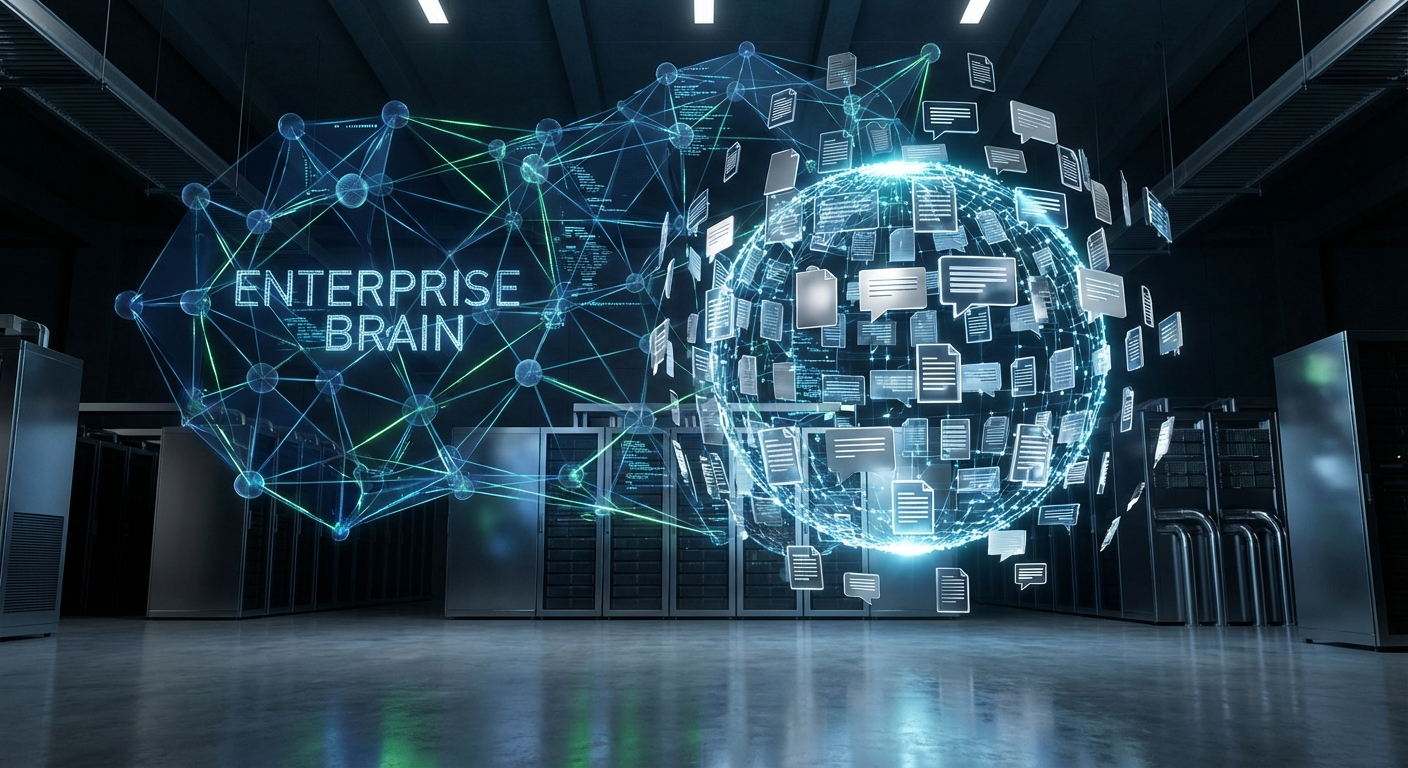
- Epsilla Semantic Graph: This is the enterprise-grade Agentic Encyclopedia. It's not a collection of flat files. It is a living, server-side, multi-modal knowledge graph. It’s a persistent data asset that compounds in value with every interaction. When a compiler agent "writes an article," it's not creating a markdown file; it's creating and connecting nodes in a rich, semantic graph that understands entities, relationships, and hierarchies. This is the persistent memory core for your entire organization.
- ClawTrace: This is the non-negotiable layer of governance and auditability. In an enterprise, "because the AI said so" is not an acceptable answer. ClawTrace provides complete data lineage. For any piece of information within the Semantic Graph, you can trace it back to its source—the specific Slack message, the exact commit, the precise sentence in a meeting transcript that generated it. This provides the transparency and explainability required for compliance, debugging, and, most importantly, trust.
The shift is from a stateless query-response loop to a stateful, continuously-evolving knowledge asset. Your company's intelligence is no longer ephemeral, trapped in the context window of a single API call. It is captured, structured, and made persistent.
The Strategic Payoff: A Compounding Knowledge Asset
This architectural shift from RAG to the Agentic Encyclopedia has profound strategic implications that go far beyond mere efficiency.
First, it establishes data sovereignty and model independence. The Semantic Graph is your intellectual property. It is a structured representation of your business's unique knowledge. This asset is portable. If tomorrow, Claude 4 outperforms GPT-5 for a specific task, you can swap the model without losing your corporate memory. The graph acts as a standardized abstraction layer, a "Model Context Protocol" (MCP), allowing you to leverage the best underlying model for the job without vendor lock-in. Your core asset is the knowledge, not the tool used to access it.
Second, it provides true transparency. Instead of a black box vector search that returns opaque "relevant" chunks, you have a browsable, auditable knowledge graph. You can literally see how the AI thinks, tracing its path through the graph to understand its reasoning. This is crucial for debugging complex agentic workflows and for building human trust in the system.
Finally, and most importantly, it creates a compounding competitive advantage. Companies still relying on RAG are stuck on a treadmill. They are perpetually re-discovering the same information. A company that invests in building a Semantic Graph is building an asset that grows more intelligent and valuable every single day. The insights generated today become the foundation for the more complex reasoning of tomorrow. This is how you build a durable moat in the age of AI. The future of business operations will be run by autonomous agents, an Agent-as-a-Service (AaaS) workforce. These agents will be useless without a persistent, reliable, and comprehensive memory. The Agentic Encyclopedia is that memory.
The choice for founders and technical leaders today is stark. You can continue to invest in the dead-end architecture of amnesiac RAG systems, treating AI as a slightly better search box. Or you can begin the critical work of building a persistent, compounding Corporate Brain. Stop renting intelligence. Start building a permanent knowledge asset.
FAQ: The Agentic Encyclopedia
Isn't this just a more complex form of RAG?
No. RAG is a stateless, "retrieve-then-read" process that starts from scratch with raw data every time. The Agentic Encyclopedia is a stateful, "compile-then-query" system. It pre-processes raw data into a persistent, structured knowledge graph that compounds over time, making future queries exponentially faster and more context-aware.
How is this different from a traditional knowledge graph like Neo4j?
Traditional knowledge graphs are typically human-curated and follow a rigid schema. The Agentic Encyclopedia is autonomously built, maintained, and evolved by LLM agents themselves. Its structure is fluid and optimized for machine readability and traversal, not necessarily for human browsing, making it a native environment for AI agents.
What's the first step for an enterprise to start building this?
Begin with a high-value, bounded domain, such as customer support tickets or a specific engineering team's documentation. Use a platform like Epsilla's AgentStudio to deploy compiler agents against this dataset. This allows you to build an initial, high-quality segment of the Semantic Graph and demonstrate immediate value before scaling across the organization.