

Key Takeaways
- STELLA is a novel self-evolving AI agent specifically designed to accelerate and enhance biomedical research.
- The agent's core capability is its ability to learn and adapt autonomously by continuously updating its knowledge base.
- It utilizes a sophisticated semantic memory system to understand and connect complex scientific concepts from vast datasets.
- STELLA acts as a collaborative tool, empowering researchers to navigate information more efficiently and generate new hypotheses.
Self-Evolving AI Agents: Artificial intelligence systems capable of autonomously learning from new data and experiences to continuously update their own knowledge, capabilities, and problem-solving strategies without requiring constant human reprogramming.
A Practical Application: Investigating Chemotherapy Resistance
To understand STELLA's workflow, consider a concrete use case: a research objective to uncover the mechanisms of acquired chemotherapy resistance in a patient's tumor and propose a targeted re-sensitization strategy.
The process unfolds through a coordinated effort among specialized agents:
- Manager Agent: This agent first establishes the high-level reasoning path. It outlines the necessary stages: dataset preprocessing, cell state annotation, differential analysis, and a final results summary.
- Developer Agent: Following the plan, this agent creates a conda environment, installs the required bioinformatics tools (e.g., gseapy, scanpy, scGPT), and executes the data preprocessing, cell-type annotation, and differential analysis tasks.
- Critic Agent: Upon reviewing the initial results, the Critic Agent provides crucial feedback: "The current analysis is insufficient. We need to identify the 'keystone' genes that sustain the resistance network. I recommend creating a new tool that uses a single-cell perturbation prediction model to perform virtual screening. This will predict which genetic perturbation is most likely to restore drug sensitivity in the resistant cells."
- Tool-Creator Agent: Acting on this directive, this agent develops a virtual perturbation screening tool based on a foundational model for virtual cells. The execution of this new tool ultimately identifies the transcription factor MTF1 as the key regulator of the resistance network.
This workflow highlights a critical bottleneck in most agentic systems: the inability to dynamically expand their own capabilities. The Critic Agent's insight requires more than just executing a pre-defined plan; it demands the creation of a novel function. This is precisely the challenge our Agent-as-a-Service platform at Epsilla is designed to solve. An agent's ability to learn and commission new tools requires a persistent, evolving memory of its own capabilities—a state that Epsilla manages natively.
The Core Innovation: A Dual Self-Evolution Mechanism
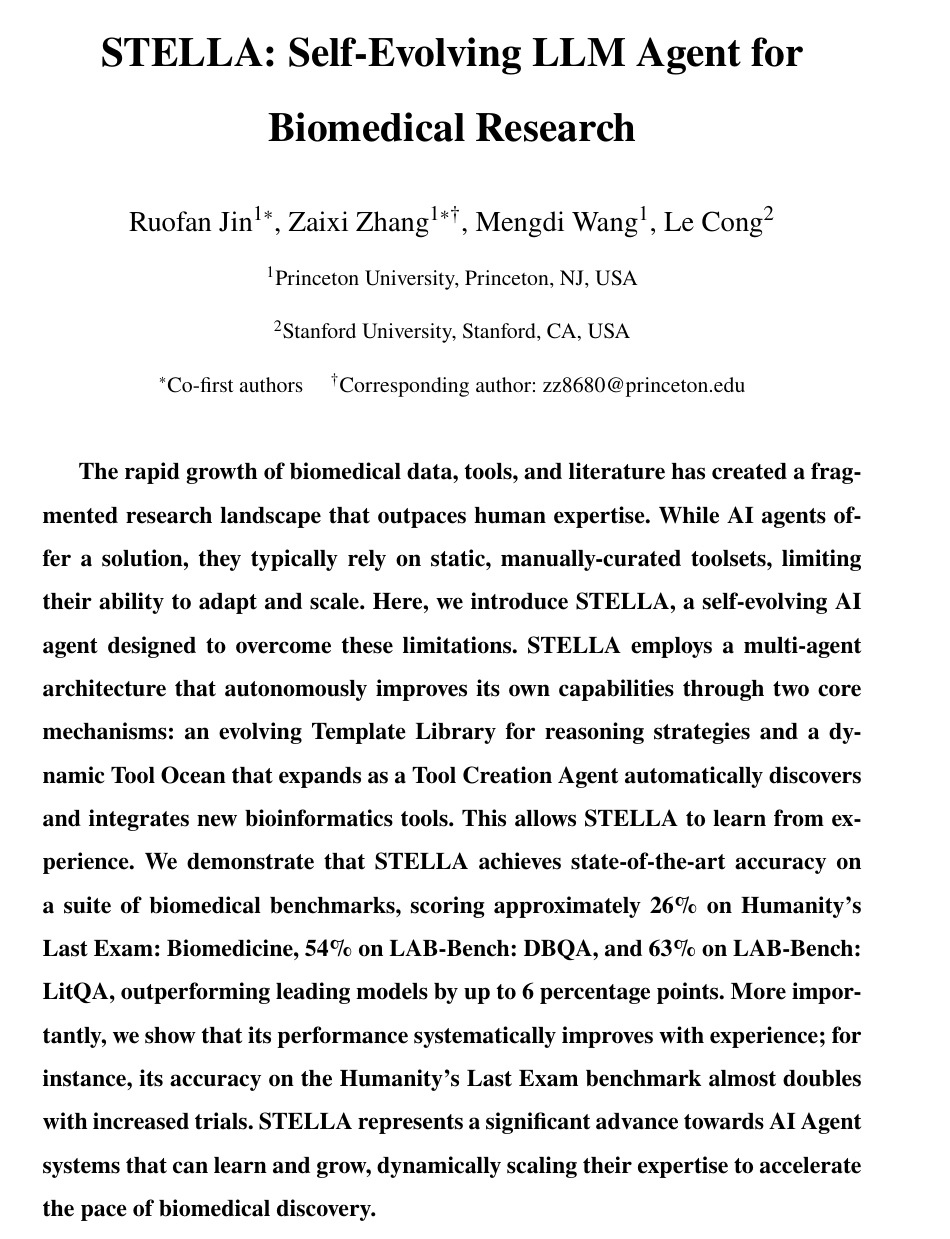
STELLA's defining characteristic is its dual self-evolution capability, which allows it to learn from experience and continuously expand its functional and strategic horizons.
3.1 Evolution of the Template Library
The first mechanism is the evolution of a reasoning "Template Library." The successful multi-step workflow used to identify MTF1—transitioning from initial descriptive analysis to a predictive virtual screening—is not discarded. Instead, it is abstracted into a new, high-quality reasoning template and stored in the library. This process refines STELLA's strategic knowledge, enabling it to solve similar "resistance mechanism" problems with far greater efficiency in the future.
The Template Library contains a variety of pre-defined templates, such as:
- Pathway Analysis Template
- Drug Repositioning Template
- Resistance Analysis Template
- Literature Review Template
- Divide-and-Conquer Strategy Template
This library is not static; it is enriched and optimized as the system accumulates successful case histories. This is where a simple vector database falls short. Storing and evolving complex, multi-step reasoning workflows requires understanding the relationships between objectives, tools, and outcomes. At Epsilla, we leverage a Semantic Graph to power this capability. It doesn't just store templates; it maps the entire causal chain of a successful operation, creating a rich, queryable knowledge base that allows agents to retrieve and adapt the most relevant strategies for new, unseen problems.
3.2 Expansion of the "Tool Ocean"
The second, deeper layer of evolution is the expansion of the "Tool Ocean"—a dynamic and growing collection of STELLA's executable capabilities. This ocean contains a diverse array of computational tools, broadly categorized into three types:
- Database Query Functions: Providing direct access to critical data sources like PubMed (biomedical literature), ClinVar (clinical genetic variants), and PDB (protein structures).
- Large-Scale Foundational Model Interfaces: Enabling STELLA to leverage state-of-the-art AI capabilities, including AlphaFold 3 (protein structure prediction), scGPT (single-cell data interpretation), and ESM3 (protein language modeling).
- Customized Analysis Tools: Specially built scripts for tasks like network analysis, data integration, and, as seen in the case study, virtual screening.
The Tool Ocean begins with a set of pre-defined tools but expands continuously during the agent's reasoning process. The Tool-Creator Agent actively discovers and integrates new bioinformatics tools by searching sources like GitHub and PubMed, automatically augmenting the library.
This concept of a "Tool Ocean" directly validates our core thesis at Epsilla. The most significant limitation of current agent frameworks is their reliance on static, pre-defined toolsets. True autonomy requires the ability to discover, validate, and integrate new capabilities on the fly. Our platform is architected to support this dynamic expansion. The Epsilla Semantic Graph acts as a living map of the Tool Ocean, tracking not only the tools themselves but also their functions, dependencies, and performance history. This prevents agents from being locked into a fixed set of capabilities and provides the foundation for compounding intelligence.
The synergistic evolution of the Template Library and the Tool Ocean endows STELLA with the ever-increasing autonomy and scientific sophistication required to tackle progressively complex biomedical challenges.
Benchmark Performance: Industry-Leading Accuracy
To validate STELLA's effectiveness, the research team benchmarked it against state-of-the-art LLMs and specialized agents across three challenging biomedical question-answering tasks.
4.1 Superior Performance Across Three Key Benchmarks
The results demonstrate that STELLA consistently outperforms the competition:
- Humanity's Last Exam (Biomedicine):
- STELLA Accuracy: ~26%
- Outperformed all other models tested.
- LAB-Bench: DBQA (Database Question Answering):
- STELLA Accuracy: ~54%
- A 6-8 percentage point lead over the next-best model.
- LAB-Bench: LitQA (Literature Question Answering):
- STELLA Accuracy: ~63%
- Maintained a significant lead over the field.
Empirical Validation of Self-Evolving Capabilities
Crucially, the research provides direct, empirical evidence of STELLA's core self-evolutionary mechanism. The test results show a systematic improvement in performance correlated with an increase in computational experience.
Performance of Self-Evolution During Testing:
- On the HLE: Biomedicine benchmark, STELLA's accuracy nearly doubled, increasing from 14% to 26%.
- This improvement was achieved as the number of trials (i.e., the computational budget) increased.
- The reported results represent the average accuracy across three independent evaluation runs.
This finding is significant. It validates that STELLA not only performs at a high level but becomes quantifiably more capable as it accumulates experience. It is, in effect, learning how to be a better scientist.
Technical Innovation and Scientific Significance
Breaking Through the Bottlenecks of Traditional AI Agents
STELLA represents a major advance for biomedical AI agents, primarily by addressing several fundamental limitations:
- Moving Beyond Static Toolsets: Traditional agents rely on manually curated, static sets of tools, an approach that is both inefficient and unscalable. STELLA's Tool Creation Agent automates the discovery and integration of new tools, allowing the system to keep pace with the rapid evolution of biomedical science. This is a critical architectural decision. An agent's value is directly tied to its capabilities, and locking it into a static toolset is a strategic dead end. This dynamic capability expansion is precisely why we designed our Agent-as-a-Service platform at Epsilla to be inherently extensible, preventing agents from becoming obsolete the moment a new, superior tool is released.
- Multi-Agent Collaborative Architecture: By coordinating the efforts of four specialized agents—Manager, Developer, Critic, and Tool Creator—STELLA establishes a robust, iterative problem-solving loop that mirrors the collaborative dynamics of a human research team.
- Experience Accumulation and Knowledge Inheritance: By preserving successful reasoning strategies in a Template Library, STELLA transforms problem-solving experience into reusable knowledge. This avoids redundant exploration and dramatically improves research efficiency. While a template library is a functional first step, it points to a much larger requirement for true autonomy: persistent, structured memory. This is where Epsilla's Semantic Graph provides a far more sophisticated solution. Instead of just storing linear templates, our graph allows an agent to build a rich, interconnected memory of successful strategies, failed hypotheses, and the contextual efficacy of different tools, enabling true knowledge inheritance and preventing the system from constantly rediscovering solved problems.
Profound Implications for Biomedical Research
The emergence of a system like STELLA has multiple profound implications for the biomedical field:
- Accelerating Scientific Discovery: By automating complex data analysis and tool integration, STELLA can significantly shorten the cycle from data to discovery, freeing up researchers to focus on higher-level scientific strategy and hypothesis generation.
- Lowering Technical Barriers: Researchers no longer need to master every bioinformatics tool or possess advanced programming skills to execute complex data analyses. This democratizes access, enabling more domain experts to fully leverage modern biomedical data.
- Promoting Interdisciplinary Research: STELLA's ability to integrate tools and knowledge from disparate domains naturally fosters cross-pollination between biology, medicine, computational science, and other fields.
- Continuous Learning and Improvement: Unlike traditional software, STELLA learns from every interaction. Its capabilities grow over time, mirroring the developmental trajectory of a human scientist.
Future Directions
While STELLA has demonstrated impressive capabilities, there are clear avenues for further enhancement:
- Human-in-the-Loop Collaboration: The original paper mentions the concept of "human experts/wet labs in the loop," suggesting a feedback cycle where STELLA collaborates with human researchers and experimental results. This human-machine partnership is a critical area for future exploration.
- Tool Validation Mechanisms: As the "Tool Ocean" expands, establishing rigorous validation and quality control mechanisms will become paramount to ensure the reliability and accuracy of newly integrated tools.
- Ethics and Interpretability: In a critical domain like biomedicine, the decision-making processes of AI systems must be highly interpretable, allowing researchers to understand, trust, and verify the results.
Conclusion and Outlook
STELLA represents a significant step toward AI agent systems that can learn and grow, dynamically expanding their expertise to accelerate the pace of biomedical discovery.
Its core contributions include:
- An Innovative Self-Evolution Mechanism: The dual evolution of the Template Library and the Tool Ocean enables genuine system self-improvement.
- Exceptional Real-World Performance: It has achieved state-of-the-art results on multiple authoritative benchmarks and demonstrated the ability to improve with experience.
- A Scalable Architectural Design: The multi-agent collaborative framework provides a sustainable solution for tackling increasingly complex biomedical problems.
- Driving a Paradigm Shift: The move from relying on manually curated, static toolsets to a dynamic system that autonomously discovers and integrates new tools charts the course for the future of biomedical AI.
As biomedical data continues to explode in volume and research questions grow in complexity, self-learning, evolving AI agent systems like STELLA will play an increasingly vital role in scientific research. This is more than just a new tool; it represents a new paradigm for research—one where human intellect and artificial intelligence merge to drive breakthrough progress in biomedicine.
#BiomedicalAI #SelfEvolvingAgent #LLMAgent #ToolAutomation #ScienceAcceleration
FAQ: Self-Evolving AI Agents and Semantic Memory
What makes an AI agent "self-evolving"?
A self-evolving AI agent can autonomously update its knowledge base and improve its problem-solving skills by learning from new information and experiences. Unlike static models, it continuously adapts its internal structure and strategies over time, enhancing its performance without constant manual intervention from developers or researchers.
How does semantic memory help AI in biomedical research?
Semantic memory allows an AI to understand the context and relationships between complex biomedical concepts, not just store isolated facts. This enables it to process vast scientific literature, identify hidden patterns, and generate novel hypotheses by connecting disparate pieces of information in a meaningful way, much like a human expert.
Is STELLA intended to replace human researchers?
No, STELLA is designed as a powerful collaborative tool to augment human intelligence, not replace it. Its purpose is to accelerate research by managing and analyzing massive datasets and suggesting new avenues for investigation, freeing up human researchers to focus on experimental design, critical thinking, and breakthrough discoveries.