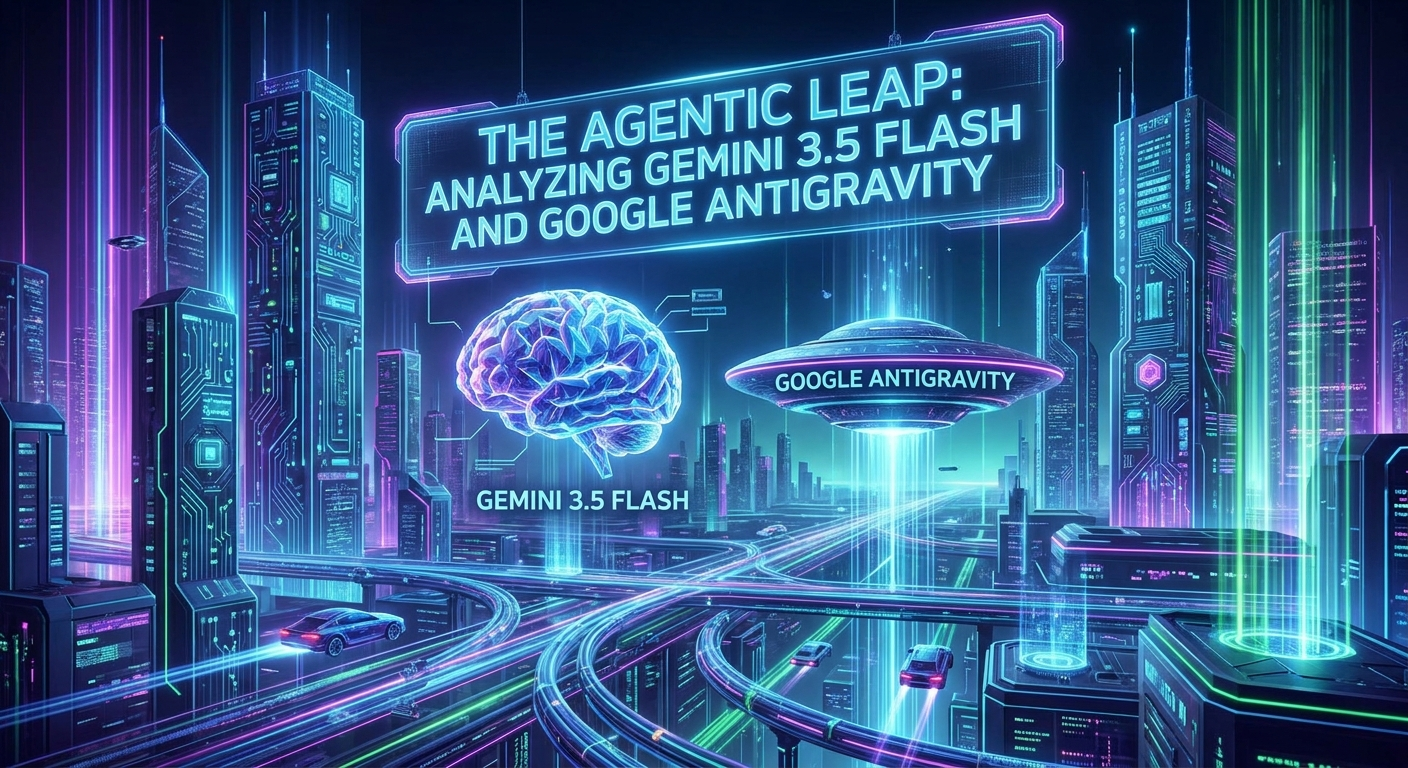
The recent announcements from Google surrounding Gemini 3.5 Flash are not an incremental update to a large language model. To view them as such is a fundamental misreading of the strategic landscape. What we are witnessing is the deliberate assembly of a full-stack, enterprise-grade agentic computing platform. This is the materialization of the shift from passive, text-generating systems to active, goal-oriented agents capable of executing complex tasks in the real world. For those of us building the infrastructure for the Agent-as-a-Service (AaaS) ecosystem, this is both a validation and a significant inflection point.
As a founding partner at Epsilla, my focus is on the systems that enable intelligent agents to perceive, remember, and act. The release of Gemini 3.5 Flash, coupled with the Google Antigravity platform, requires a deep, execution-focused analysis. We must look past the top-line performance numbers and dissect the underlying architecture and its implications for enterprise AI. The key components are not just the model itself, but the protocol it uses for action and the platform designed to orchestrate it.
Deconstructing Performance: Latency, Fluency, and Actionability
The true significance of Gemini 3.5 Flash is revealed not in its creative writing ability, but in a new class of benchmarks designed to measure agentic competence. These metrics signal a departure from evaluating models on static knowledge recall and towards assessing their ability to perform work.
First, consider the performance on Terminal-Bench 2.1 (76.2%). This benchmark is not a theoretical test of reasoning; it is a practical evaluation of a model's ability to operate within a Linux shell environment. A high score here indicates proficiency in executing commands, manipulating file systems, and interacting with software tools—the foundational skills for any automated DevOps, IT administration, or cybersecurity agent. This moves the model from being a "consultant" that suggests shell commands to an "operator" that can execute them, debug errors, and chain operations to achieve a high-level goal. For enterprises, this unlocks the potential for autonomous agents that can manage cloud infrastructure, respond to security alerts, or perform complex software deployments with minimal human oversight.
Second, and perhaps most critically, is the 83.6% score on MCP Atlas. The prompt specified that MCP stands for Model Context Protocol, a term that warrants significant attention. MCP appears to be Google's standardized framework for how a model discovers, understands, and interacts with external tools and APIs. This is a direct answer to the brittleness of current function-calling implementations, which often rely on carefully crafted prompts and rigid schemas. A high score on the MCP Atlas benchmark implies that Gemini 3.5 possesses a native fluency in a structured protocol for action. It suggests the model can dynamically query a tool for its capabilities, understand its constraints, format requests correctly, and parse responses robustly. This protocol-driven approach is the key to building scalable and reliable enterprise agents. It abstracts away the complexity of individual API integrations, allowing developers to focus on workflow logic rather than the minutiae of tool use.
Finally, the claim of 4 times faster output tokens per second is not merely a user experience enhancement; it is a critical enabler for complex agentic workflows. Any practical agent consists of a chain of thought, observation, and action. Each step in this loop incurs a latency penalty. For a single-step task, the difference between a 2-second and a 0.5-second response is noticeable. For a 10-step workflow, it is the difference between a 20-second process that feels broken and a 5-second process that feels interactive. This speedup makes real-time, multi-turn interactions with agents viable, whether in customer support, collaborative coding, or financial analysis. The cumulative effect of latency is the single greatest barrier to deploying sophisticated multi-step agents, and Gemini 3.5 Flash directly addresses this bottleneck.
The Orchestration Layer: Google Antigravity and Multi-Agent Systems
A capable model is necessary but insufficient. Without a robust orchestration platform, an agent is an engine without a chassis. This is the role of Google Antigravity, described as an "agent-first development platform" for "collaborative subagents." This terminology is precise and deliberate.
"Agent-first" implies that the platform's core abstractions are not functions, services, or containers, but agents themselves. This means the platform is purpose-built to handle the unique challenges of agentic computing: long-running tasks, state management, memory, and dynamic planning.
The concept of "collaborative subagents" signals a move away from monolithic, do-everything agents towards a microservices-like architecture of specialized, composable agents. In an enterprise context, one can envision a primary "Sales Operations Agent" that orchestrates subagents: a "Lead Qualification Agent" from Salesforce Agentforce, a "Financial Health Agent" from Ramp, and a "Data Analysis Agent" from Databricks. This modularity is essential for building complex, maintainable, and scalable enterprise solutions.
Antigravity, therefore, must be an operating system for a society of agents. It must provide the critical infrastructure for:
- Inter-Agent Communication: A standardized protocol for agents to pass tasks, data, and context to one another. This is likely deeply integrated with the Model Context Protocol (MCP).
- State and Memory Management: Ensuring that context is maintained across long-running, multi-agent workflows. This is where systems like Epsilla's vector database become critical, providing the long-term memory layer that agents can query.
- Resource Allocation and Cost Control: Managing the computational resources and token costs generated by a fleet of interacting agents to prevent runaway processes.
- Observability and Debugging: Providing the tools to trace the decision-making process of a multi-agent system, which is paramount for enterprise-grade reliability and safety.
The existence of Antigravity validates the entire Agent-as-a-Service model that companies like ours are pioneering. The future is not about deploying a single model endpoint; it is about managing a dynamic ecosystem of interconnected, specialized intelligent agents.
The Enterprise Moat: A Systemic Approach
Analyzing the list of launch partners—Shopify, Macquarie Bank, Salesforce, Ramp, Xero, Databricks—reveals Google's strategy. This is not a scattershot approach. These partners represent the core systems of record for modern enterprises: commerce, banking, customer relationships, finance, and data.
By integrating Gemini 3.5 and Antigravity directly into these platforms (e.g., Salesforce Agentforce), Google is embedding its agentic ecosystem into the very fabric of business operations. The goal is to make its platform the de facto orchestration layer for enterprise automation. The Model Context Protocol (MCP) becomes the standard for how these enterprise tools expose themselves to AI, and Antigravity becomes the environment where agents utilizing these tools are built and deployed.
This creates a powerful flywheel. As more enterprises adopt these integrated solutions, more third-party tool providers will be incentivized to make their APIs compatible with MCP, further enriching the ecosystem and strengthening the moat around Google's agentic platform.
For the broader AaaS ecosystem, including platforms like AgentStudio, this presents both a challenge and an opportunity. The challenge is the emergence of a powerful, vertically integrated competitor. The opportunity lies in interoperability. Enterprises will require multi-cloud and multi-model strategies. The need for platforms that can orchestrate agents built on various foundation models—including Gemini 3.5, but also models from OpenAI, Anthropic, and open-source alternatives—will become even more acute. Our role is to provide the neutral ground, the essential infrastructure like vector memory and orchestration logic that enables these heterogeneous agentic systems to function cohesively.
The release of Gemini 3.5 Flash and the Antigravity platform is a clear signal. The era of language model curiosities is over. We are now in the execution phase, building the foundational infrastructure for an economy run by intelligent agents. The benchmarks are changing, the architecture is solidifying, and the enterprise applications are moving from the whiteboard to the balance sheet. The time to build is now.
Find more information on the official Google Blog.