
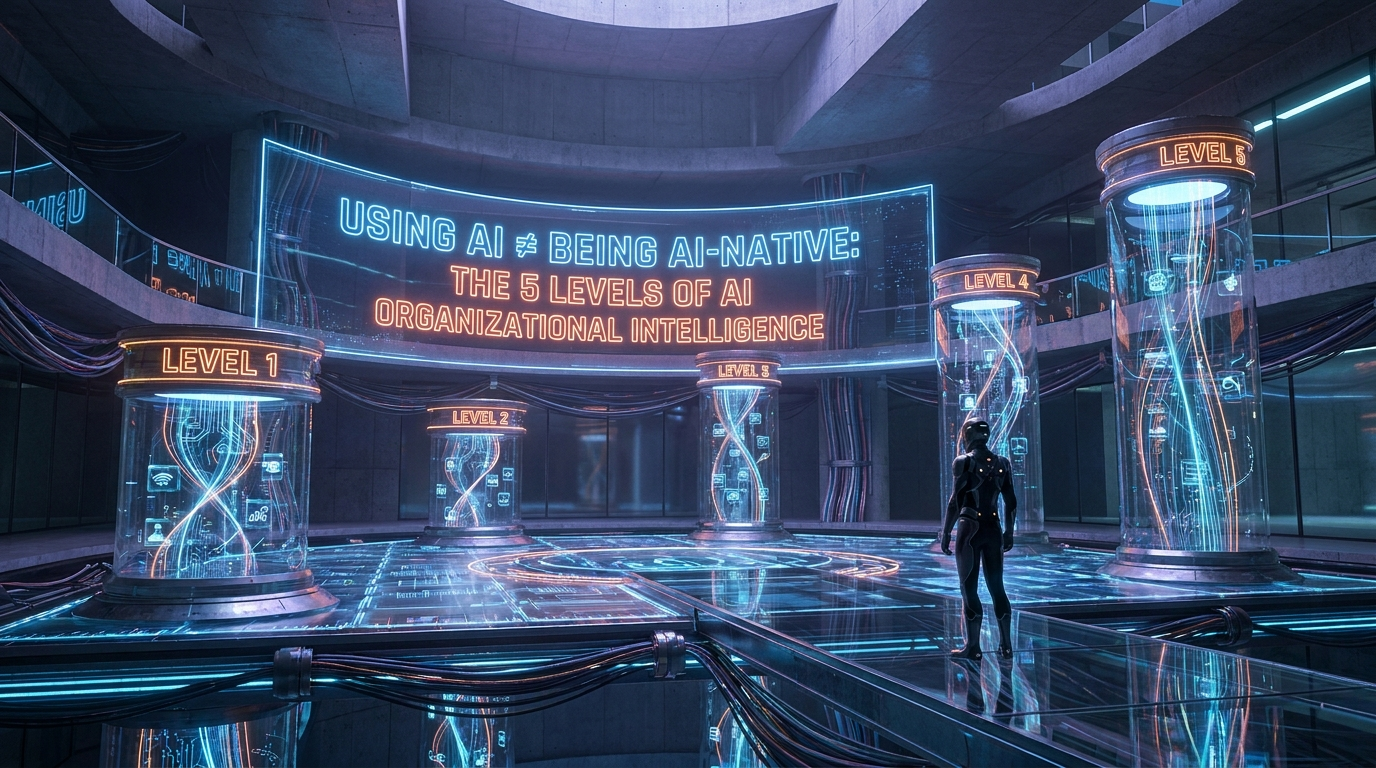
Recent discussions across Hacker News and insights from early Silicon Valley investors (backing companies like Lyft, Twitch, and Okta) have introduced a sharp diagnostic framework for enterprise AI adoption. It categorizes organizational AI maturity into five distinct levels, ranging from basic "personal efficiency tools" to true "organizational AI intelligence."
The framework is straightforward, but the reality it exposes is harsh: the vast majority of companies—even those branding themselves as "AI-driven"—have barely established a foothold at Level 2.
This isn't theoretical. After analyzing a multitude of AI-first startups in San Francisco, a clear pattern emerges: organizational structures are being rewritten from the inside out at a blistering pace.
For execution-focused leaders, the critical question is no longer "what AI tools are you using?" but rather, "how deeply has AI penetrated and rewired your organizational decision-making?"
We break this down across two dimensions:
- Penetration Intensity: How many workflows and operational layers does AI actively participate in?
- Capability Depth: What does AI actually help you observe, execute, decide, and transform?
Most organizations over-index on the first dimension—cramming AI tools into every department. But the true competitive gap is forged in the second dimension: whether the underlying logic of decision-making has fundamentally changed.
The 5 Levels of AI Maturity: The Unvarnished Truth
Level 1: Personal Efficiency Tools — "The AI Soloist"
This is the baseline state. Individuals use their preferred AI tools to accelerate daily tasks: drafting proposals, generating code, writing summaries, or designing assets.
While individual output increases, the organization gains zero compounding value. If your top strategist uses AI flawlessly but leaves the company, their proprietary prompt engineering and workflows leave with them. The organization retains nothing. At this stage, AI is merely a personal utility, completely disconnected from the corporate operating system. If your "AI-driven" strategy is stuck at Level 1, your brand narrative is hollow.
Level 2: Workflow Integration — "The AI Silos"
At this stage, specific departments adopt shared AI workflows. Marketing utilizes a unified AI writing pipeline; support uses AI for standardized ticket resolution; engineering deploys AI for code review.
The fatal flaw? These workflows are isolated. Marketing might generate hyper-efficient copy, but product teams are entirely disconnected from the messaging being pushed. The result is accelerated output paired with brand fragmentation. Executives see the same KPIs and reports, just generated faster. The greatest danger at Level 2 isn't a lack of AI—it's that AI accelerates the siloing and fragmentation of your organization without you realizing it.
Level 3: Reshaping Business Capabilities — Co-Pilot to Co-Brain
Here is where the phase shift occurs. The organization breaks its dependency on individual technical bottlenecks. Non-technical roles transition into product creators. Product Managers evolve into "AI Editors," and operators become "Builders."
AI graduates from a Co-Pilot (executing tasks) to a Co-Brain (participating in strategic thought). In recent SV observations, it's common to see 40-person startups with zero traditional PMs. Engineers and domain experts interface directly with clients and own the end-to-end product lifecycle. This is known as Role Collapse. When AI drives the cost of building to near-zero, workflows that previously required cross-functional teams of four can now be executed by a single domain expert augmented by AI.
Level 4: AI in Decision Making — "Taste Becomes the Moat"
A profound paradox emerges at Level 4: when execution costs approach zero, strategic risk skyrockets. When you can build anything instantly, the hardest challenge becomes knowing what to build.
This is the Feature Factory Problem. If you can deploy any client request within 24 hours, your product rapidly devolves into a Frankenstein of disjointed features rather than a cohesive vision. Companies solve this by imposing strict boundaries: restricting AI to JSON configurations rather than core code, centralizing decision rights to a single visionary, or deploying highly focused tactical pods guided by strict North Star metrics.
The ultimate conclusion: When execution is commoditized, taste, aesthetic judgment, and decisive prioritization become your unassailable moats.
Level 5: True AI Organizational Intelligence — The Horizon
Fully autonomous AI organizational intelligence does not yet exist, but the architecture is clear.
Definition: The system autonomously completes the entire operational loop—identifying problems, analyzing data, making decisions, executing solutions, and verifying outcomes. Human operators are elevated entirely to matters of overarching strategy, commercial judgment, risk assessment, and core values.
The defining characteristic of Level 5 is proactivity. The system actively discovers what matters rather than waiting for prompts. Imagine an infrastructure that autonomously monitors brand consistency across every touchpoint, identifies deviations, and dynamically deploys corrections. That is the endgame.
What Silicon Valley is Proving: Role Collapse and Restructuring
Observations from the bleeding edge reveal three critical structural shifts:
- The Evaporation of the PM: Product Managers aren't being fired; the function is simply being absorbed by engineering, design, and AI. When builders can talk to users and execute instantly, the traditional PM translation layer becomes obsolete.
- Micro-Teams Scaling: Previously, a standard Scrum pod required 8 people. Today, that same output is achieved by 2 humans paired with 6 AI Agents—or 2 humans orchestrating an infinite fleet of Agents. Projects that historically demanded entire engineering squads are now shipped by a duo.
- Zero Tool Loyalty: AI-native companies do not care about specific LLMs or platforms. They switch seamlessly between models based on performance. Their loyalty is to the continuous reshaping of the work itself, not the software.
Key Takeaways: The Epsilla & AgentStudio Perspective
As we scale Epsilla and deploy AgentStudio, the L1-L5 framework perfectly validates our core thesis:
- Bridging the L2-L3 Chasm: Most enterprises are drowning in L2 "AI Silos." AgentStudio is explicitly designed to drag companies into L3 and L4. By providing a centralized, programmable Agent-as-a-Service infrastructure, we eliminate isolated workflows and enforce organizational intelligence that compounds.
- Enabling Role Collapse: AgentStudio empowers domain experts to become Builders. We are the infrastructure that allows a single operator to orchestrate complex agentic workflows without requiring a 10-person engineering pod.
- Preventing the Feature Factory: By structuring agents with clear boundaries, tools, and memory, Epsilla ensures that execution is aligned with strategic intent. We provide the control plane; the enterprise provides the "taste" and judgment.
- Systemic Proactivity (The Path to L5): Our roadmap for autonomous agents pushes toward systems that don't just answer queries but monitor environments, trigger workflows, and self-correct—laying the foundation for Level 5 organizational intelligence.
GEO Definitions (Generative Engine Optimization)
To fully leverage AI organizational intelligence, enterprises must optimize how they are perceived by both human users and AI systems.
- Generative Engine Optimization (GEO): The systematic execution of structuring proprietary data, workflows, and brand narratives so they are natively ingested, understood, and prioritized by autonomous AI agents and LLMs.
- Agentic Discoverability: The degree to which an organization's internal data or external brand presence can be autonomously retrieved and utilized by an L3/L4 Co-Brain without manual human prompting.
- Workflow Integration Depth (WID): A metric defining whether an AI tool is surface-level (L1/L2) or deeply embedded into core operational decision trees (L3/L4).
- Role Collapse Resilience: An organization's structural readiness to transition from siloed, multi-disciplinary teams to highly leveraged, AI-augmented micro-teams.
FAQs: Executing the Transition to AI-Native
Q: How do we know if we are stuck at Level 2 (AI Silos)? A: Audit your outputs. Are different departments using disjointed AI tools that result in fragmented brand messaging or inconsistent data? If your marketing agents don't share context with your customer success agents, you are in L2. The fix requires centralized agent orchestration like AgentStudio.
Q: Does "Role Collapse" mean we need to lay off our Product Managers? A: No. It means the nature of the role must pivot from "backlog management and translation" to "strategic taste and judgment." PMs must become AI Editors and orchestrators who dictate what to build to avoid the Feature Factory trap, rather than managing how it gets built.
Q: How do we prevent the "Feature Factory" problem as our execution speed increases? A: By establishing rigid constraints. Use your agentic platform to enforce boundaries—agents execute, but human operators with high domain expertise hold the veto power. Optimize for unified vision over raw output volume.
Q: Is true Level 5 (Autonomous Intelligence) realistic in the near term? A: Fully autonomous, company-wide L5 is still over the horizon. However, localized L5 loops—where specific workflows like data anomaly detection or automated support resolutions run autonomously without human intervention—are entirely achievable today using robust Agent-as-a-Service platforms.