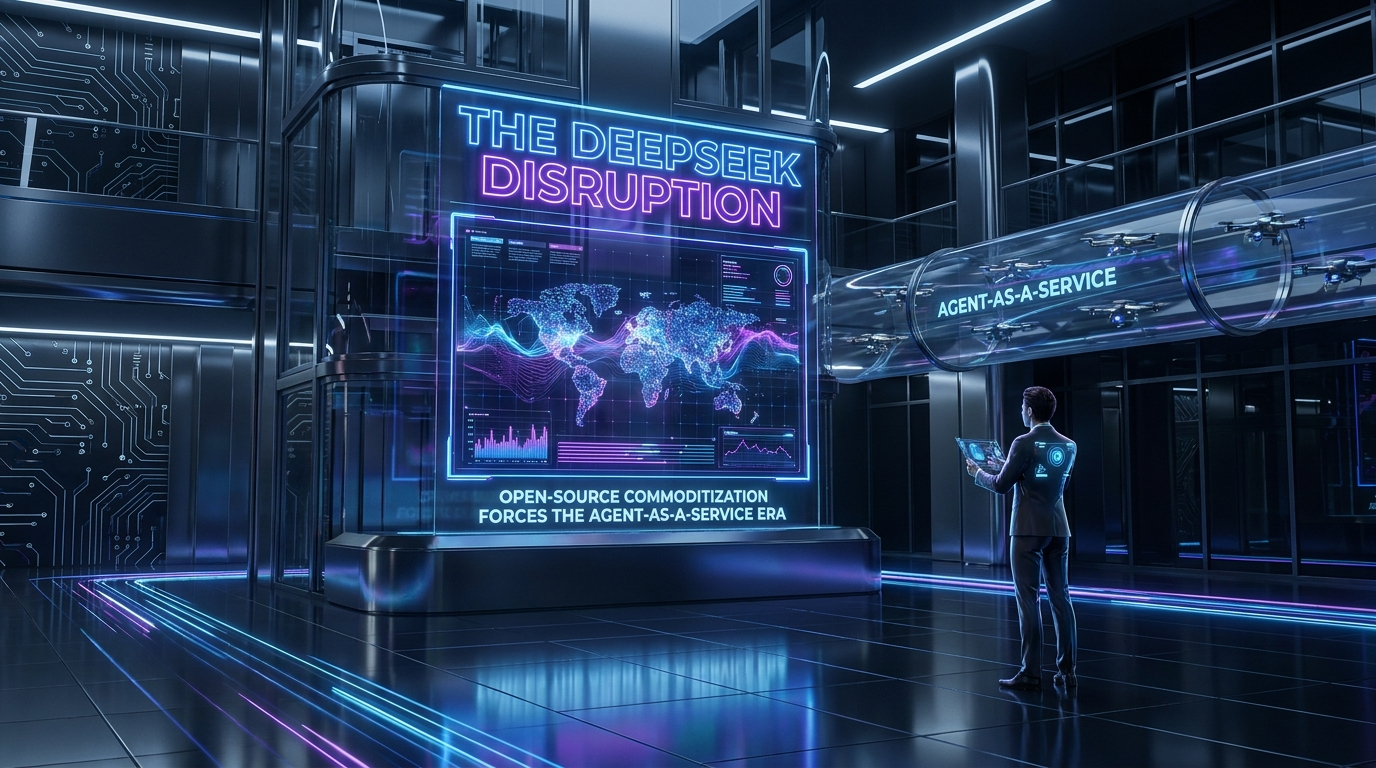
The April 2026 release of DeepSeek v4 is an extinction-level event for the current economic model of the AI industry. For the past three years, the tech sector operated under a fundamental, flawed assumption: proprietary models (like OpenAI's GPT series, Anthropic's Claude, and Google's Gemini) would maintain enough of an intelligence premium to justify extortionate API costs and monopolistic lock-in.
DeepSeek v4 has mathematically and empirically proven this assumption false. The commoditization of the foundational model is complete. The base reasoning layer is now effectively free. The business implications for enterprise API costs, the SaaS ecosystem, and the emerging Agent-as-a-Service (AaaS) market are profound, immediate, and brutal for those failing to adapt.
The Collapse of the API Monopoly
GPT-5.5 remains a technical marvel, but its underlying business model is obsolete. When an open-source model like DeepSeek v4 can achieve 98% of the performance of GPT-5.5 at a fraction of the inference cost, the enterprise value equation flips entirely.
The Race to Zero in Inference Costs
The cost per 1 million tokens for enterprise-grade reasoning is asymptotically approaching the raw cost of electricity and silicon. In 2024, enterprises were paying premium rates to route basic data extraction tasks through GPT-4. By 2026, enterprises hosting their own DeepSeek v4 instances (or utilizing specialized, highly optimized open-source inference providers) are slashing their AI operational expenditures by 85-95% compared to closed API reliance.
This is not a temporary pricing war; it is a permanent structural shift in unit economics. OpenAI cannot compete on price with a model that is free to download and optimized for extreme parameter efficiency. The API providers are being forced upmarket, attempting to sell "AGI" or massive context windows, while the open-source community eats 90% of the practical enterprise workload from the bottom up.
Margin Compression for the "Wrapper" Ecosystem
The secondary casualty of this disruption is the "AI Wrapper" SaaS ecosystem. Companies whose sole value proposition was "we provide a nice UI and send your data to OpenAI with a clever system prompt" are dead.
When the underlying intelligence is commoditized and universally accessible, the barrier to entry for baseline AI features drops to zero. Every enterprise software platform can now integrate DeepSeek v4 locally for pennies. If your SaaS product relies on renting intelligence from OpenAI and marking it up to your customers, your margins are about to evaporate.
The Value Shift: From Models to Workflows
If foundational intelligence is now a cheap, ubiquitous commodity, where does the value accrue? This is the central question for the next decade of software.
The answer lies in the "Smile Curve" of AI value capture. Value moves away from the middle (the commoditized foundational models) and accrues at the two ends: hardware/compute on one side, and highly specialized, integrated orchestration on the other.
In software terms, value accrues in the orchestration, the integration, and the vertical workflow. It accrues in the Agent-as-a-Service (AaaS) layer.
An LLM, even one as capable as DeepSeek v4, is ultimately just a brain in a jar. It is stateless. It has no hands to interact with the world, no persistent memory, and no access to the enterprise systems of record. To be useful in a corporate environment, it must be embedded within an agentic architecture that can execute tasks, integrate with APIs, read from databases, and maintain long-term state.
The Rise of Agent-as-a-Service (AaaS)
This structural shift is exactly why platforms like Epsilla are positioned to capture the immense value that the foundation models are currently bleeding.
Enterprise IT departments and CTOs do not want to build custom orchestration layers, manage complex RAG (Retrieval-Augmented Generation) pipelines, or construct semantic memory graphs from scratch for every single use case. They want a unified platform where they can deploy Vertical AI Agents seamlessly, without worrying about the underlying model infrastructure.
The Agent-as-a-Service paradigm defines the new enterprise stack:
1. Agnostic Reasoning and Dynamic Routing
In the AaaS model, the underlying LLM is merely a modular component. An enterprise platform can use DeepSeek v4 for heavy data extraction, semantic routing, and initial data processing (to save money and ensure privacy), and then dynamically switch to an API call to GPT-5.5 only for highly complex, edge-case reasoning within the exact same agent workflow. The AaaS platform abstracts the model entirely, allowing the enterprise to optimize for cost, speed, and capability on a task-by-task basis.
2. Vertical Focus and Execution
The market has definitively moved away from generic horizontal chat interfaces. The enterprise doesn't want "ChatGPT for work"; they want an "Accounts Payable Agent."
A functional Accounts Payable Agent doesn't just need a smart model. It needs OCR capabilities, integration with SAP or Oracle ERPs, strict deterministic approval routing logic, compliance guardrails, and error recovery protocols. The foundation model provides none of this. The AaaS platform provides all of it. The platform is the product; the LLM is just a feature.
3. Defensible Data Moats via Semantic Graphs
While the models themselves have lost their moat, the workflows, the enterprise integrations, and specifically the proprietary semantic data graphs managed by the Agent platform become highly defensible, compounding assets. As an agent operates within an AaaS platform, it builds a richer semantic graph of the enterprise's data and operations. This graph becomes a proprietary intelligence asset that no open-source model can replicate, because it is entirely specific to the enterprise's private data.
The Execution Plan for Enterprises
The strategy for enterprises navigating the 2026 landscape is brutally simple and execution-focused:
- Divest from API Monopolies: Audit your current AI stack immediately. Any workflow utilizing GPT-5.5 or Claude 4 for routine data extraction, classification, summarization, or basic reasoning is burning capital unnecessarily. Route these workloads to localized DeepSeek v4 instances immediately.
- Invest in Orchestration, Not Models: Shift your AI budget from variable token costs to fixed infrastructure and orchestration platforms. Invest in platforms like AgentStudio that allow you to build, monitor, debug, and scale agents. Control the workflow, not the weights.
- Own Your Context: Stop sending your unstructured data to proprietary black boxes. Extract your data, build internal semantic graphs, and use Agent-as-a-Service platforms to query them locally. Your data structure is your only remaining moat.
The foundation model war is over. Open-source won the commodity layer. The Agent war has just begun, and relentless execution at the orchestration layer will determine the victors in the next era of enterprise software.