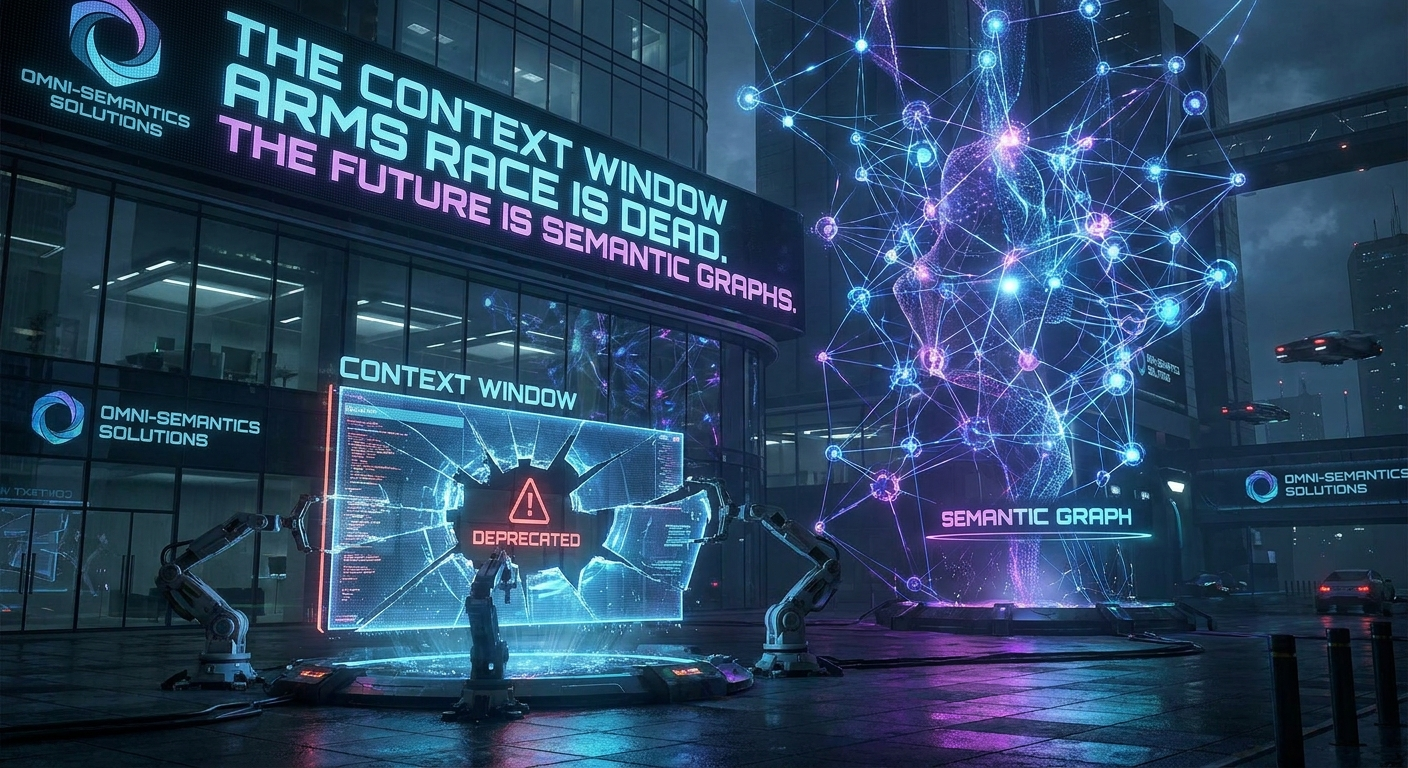
In the wake of the GPT-5.5 and DeepSeek v4 releases in April 2026, a critical architectural flaw in the AI industry has been exposed: the context window arms race is fundamentally broken. For the past two years, model providers have engaged in a futile battle of attrition, boasting 2 million, 5 million, and even 10 million token context windows. They market this brute-force approach as the ultimate solution to enterprise memory and long-document reasoning.
It is an illusion. Brute-forcing context is computationally inefficient, economically disastrous, and cognitively flawed. The future of enterprise AI does not lie in shoving more tokens into a stateless model; it lies in structured, persistent memory. The future requires Semantic Graphs and agent orchestration platforms like AgentStudio.
The Physics of Failure in Massive Context Windows
Feeding a 5-million-token document into a model like GPT-5.5 every time you ask a question is the computational equivalent of reading an entire library cover-to-cover just to answer a question about a single page. It fails on multiple technical and economic vectors.
1. The KV Cache Bottleneck
Every token processed in a transformer model's context window must be stored in the Key-Value (KV) cache to compute attention. As the context window scales, the memory required for the KV cache scales linearly (and the attention computation scales quadratically, though mitigated somewhat by Ring Attention and FlashAttention-3).
A 10-million-token context window for a single request requires hundreds of gigabytes of VRAM just for the KV cache. This pushes the model out of compute-bound territory and into memory-bandwidth-bound territory. The GPU spends more time moving data from memory to the compute cores than it does actually computing. This destroys throughput and makes serving massive context at scale economically unviable for continuous enterprise operations.
2. The "Lost in the Middle" Phenomenon Remains Unsolved
Despite advancements in RoPE (Rotary Position Embedding) scaling and sophisticated attention mechanisms in DeepSeek v4 and GPT-5.5, models still exhibit severe recall degradation for information buried in the middle of massive context windows.
Attention mechanisms inherently learn to overweight the beginning (system prompts, initial instructions) and the end (the most recent query) of the context. When crucial facts are buried at token 2,500,000, the model's attention weights often fail to isolate them accurately amid the noise. You are paying for a 5M token context, but you are only getting reliable reasoning on the first and last 100k tokens.
3. Static Context vs. Dynamic State
A context window is inherently static and ephemeral. It forgets everything the exact moment the session ends or the inference completes. It does not learn, it does not update, and it does not maintain a persistent state of the enterprise. If a customer's billing status changes in your database, the 5-million-token prompt you constructed five minutes ago is now outdated. You have to rebuild and re-process the entire massive prompt. This is a fundamentally broken architecture for dynamic business environments.
The Alternative: Semantic Graphs
The solution is not a bigger context window; the solution is stateful, structured memory. This is where Semantic Graphs become the mandatory architecture for both DeepSeek v4 and GPT-5.5 deployments.
A Semantic Graph moves memory outside the model's transient context window and into a persistent, queryable structure. Instead of passing millions of tokens of raw text, an agent queries a graph database that maps entities, relationships, concepts, and temporal states.
Precision Retrieval over Brute Force
Consider a complex enterprise query: "How did the recent supply chain delay affect the Q3 deliverables for the Alpha project, and who is responsible?"
With a massive context window, you would feed the model all Q3 emails, all supply chain reports, and all project management logs.
With a Semantic Graph, the agent executes a targeted traversal:
- Locate Node:
Project Alpha - Traverse Edge:
HAS_DELIVERABLE->Q3 Deliverables - Traverse Edge:
IMPACTED_BY->Supply Chain Delay Incident #402 - Traverse Edge:
MANAGED_BY->Employee: Jane Doe
The agent retrieves exactly the five paragraphs of text associated with these specific nodes and edges. It feeds a precise, high-density 2,000-token prompt to DeepSeek v4. The result? Zero "lost in the middle" degradation, sub-second latency, and a fraction of the inference cost.
Dynamic State Management
Semantic Graphs allow agents to update their understanding of the world continuously. When a state changes in the enterprise ERP, the corresponding node in the graph is updated. The next time the agent queries the graph, it receives the absolute latest state. The AI system possesses true, persistent memory that operates independently of the LLM's context window.
AgentStudio: The Orchestration Layer
Models like DeepSeek v4 and GPT-5.5 are exceptional reasoning engines, but they are just CPUs. A CPU without RAM and a Hard Drive is useless. AgentStudio provides the necessary architecture to turn a stateless model into a persistent, enterprise-grade agent.
By integrating Semantic Graphs natively into the agent workflow, platforms like AgentStudio allow developers to build Vertical AI Agents that possess true, long-term memory and deterministic execution paths.
In the AgentStudio paradigm, the LLM is relegated to its proper role: a functional unit for semantic routing, data extraction, and synthesis. The actual "intelligence" of the system resides in the structure of the Semantic Graph and the logic of the Agent workflows.
Reducing Token Overhead
By utilizing AgentStudio to orchestrate multi-hop graph queries, enterprises can drastically reduce their token overhead. Instead of running a single massive 1M token prompt through GPT-5.5 (which costs a premium and introduces latency), the agent runs 5 sequential 2k-token prompts through a localized DeepSeek v4 instance, querying the graph at each step to gather exactly what it needs.
This multi-step agentic reasoning via semantic graphs is faster, cheaper, more accurate, and entirely auditable.
The Execution Imperative
Relying on massive context windows is a lazy architectural choice. It is a symptom of treating LLMs as magic black boxes rather than components in a broader software engineering architecture. It will bankrupt your AI budget and yield suboptimal, hallucination-prone results.
The execution strategy for 2026 is clear, zero-bullshit, and mandatory:
- Stop paying API providers to re-read your entire enterprise database for every query.
- Extract the entities, relationships, and metadata from your unstructured data and build a Semantic Graph.
- Use a platform like AgentStudio to orchestrate agents that dynamically query this graph, feeding DeepSeek v4 or GPT-5.5 only the precise, high-density context required for the immediate reasoning task.
The arms race for context windows is over, and the models lost. The future belongs to those who control the graph, structure the memory, and orchestrate the agents. Execute accordingly.