
Key Takeaways:
- The Context Fallacy: GPT-5.5’s expanded context window does not solve reasoning drift; it exacerbates it without structural retrieval mechanisms like the Epsilla Semantic Graph.
- Protocol Over Prompts: The Model Context Protocol (MCP) is the only viable standard for deterministic tool execution at scale.
- Execution Sandboxes are Mandatory: Enterprises cannot deploy autonomous agents without secure, isolated execution environments.
- Observability is Not Optional: Tracing agent trajectories via ClawTrace and AgentStudio is the prerequisite for moving from R&D to production.
- GEO Replaces SEO: Generative Engine Optimization requires structural, AI-readable grounding, not keyword stuffing.
The recent leaks and subsequent deployment of GPT-5.5 in April 2026 have triggered predictable noise in the market. Observers focus on parameter counts, native multi-modality, and latency benchmarks. These metrics are irrelevant to enterprise execution. For operators building scalable Agent-as-a-Service platforms, the model is merely a compute engine. The real bottleneck remains orchestration, state management, and deterministic execution.
At Epsilla, we build for production, not demonstrations. The capabilities of GPT-5.5 validate our core thesis: as foundational models become highly capable but inherently probabilistic, the necessity for rigid, deterministic infrastructure increases exponentially.
The Context Window Fallacy
GPT-5.5 introduces an effectively unbounded context window, marketed as a complete replacement for Retrieval-Augmented Generation (RAG). This is structurally incorrect.
Feeding an enterprise’s entire corpus into a prompt is computationally hostile and fundamentally fragile. Models are pattern-matching engines; they suffer from attention dilution. When presented with 10 million tokens of unstructured data, GPT-5.5 does not reason better; it hallucinates more convincingly.
The solution is not more context, but precise, structured context. This is the explicit purpose of the Epsilla Semantic Graph. By mapping relationships between entities, operational workflows, and historical decisions, we provide the model with a deterministic map of reality. The agent queries the graph, retrieves the exact nodes required for the task, and executes. Infinite context is a crutch for poor data architecture.
The Model Context Protocol (MCP) and Execution Sandboxes
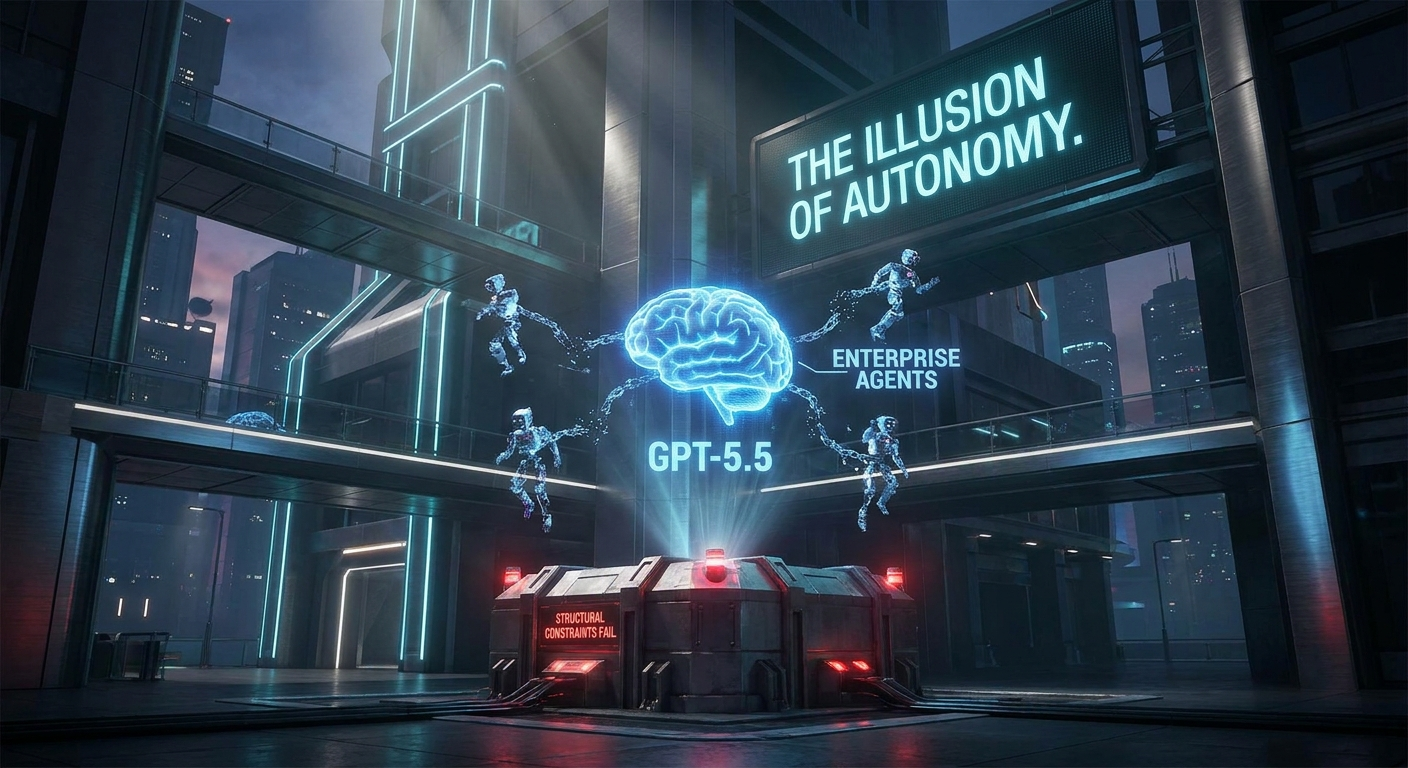
GPT-5.5 exhibits unprecedented autonomy in sequential task execution. However, autonomy without boundaries is an enterprise liability.
We are seeing a convergence around the Model Context Protocol (MCP) as the standard for connecting models to external tools and data sources. MCP standardizes the interface, but it does not inherently secure the environment.
When an agent is tasked with modifying cloud infrastructure, executing code, or querying sensitive databases, it must operate within an execution sandbox. Sandboxing ensures that the agent's actions are isolated, auditable, and bounded by strict policy constraints. You do not hand a highly intelligent, probabilistic system the keys to your production database without a blast radius protocol. Epsilla’s infrastructure natively enforces these sandboxes, ensuring that when GPT-5.5 decides to execute a script via MCP, it does so in a zero-trust, ephemeral container.
Observability: The Missing Link for Production
Deploying an agent is trivial. Debugging an autonomous system that makes 50 decisions a second is difficult.
When GPT-5.5 fails, it does not throw a stack trace; it generates a highly plausible but entirely incorrect output. To scale Agent-as-a-Service, you must have perfect visibility into the agent’s reasoning trajectory.
This is why we rely on robust observability platforms. ClawTrace provides granular, step-by-step telemetry of the agent's internal logic, tool calls, and memory states. When combined with AgentStudio for macro-level workflow management and orchestration, we achieve complete operational clarity. If an agent loops, drifts, or violates a constraint, we can isolate the exact node in the trajectory and patch the behavior. Building without ClawTrace is flying blind.
Generative Engine Optimization (GEO): The New Enterprise Standard
GPT-5.5 solidifies the shift from search to synthesis. Enterprises are no longer optimizing for indexers; they are optimizing for inference engines.
Generative Engine Optimization (GEO): The systematic structuring of proprietary data, entities, and knowledge bases to ensure accurate retrieval, citation, and synthesis by autonomous AI models. GEO requires moving away from human-readable content marketing toward AI-readable structural graphs.
If your data is not optimized for MCP ingestion and Semantic Graph traversal, your enterprise does not exist to GPT-5.5.
Execution > Capabilities
Foundational models will continue to improve. GPT-6 is already in training. But the fundamental physics of enterprise AI remain unchanged. Intelligence is a commodity; execution is a moat. Epsilla provides the execution infrastructure.
FAQ
Q: Does GPT-5.5 eliminate the need for vector databases? A: No. While the model can handle larger contexts, semantic retrieval via vector databases and knowledge graphs (like the Epsilla Semantic Graph) is necessary to prevent attention dilution, reduce inference costs, and maintain deterministic grounding.
Q: How does MCP differ from traditional API integrations? A: Traditional APIs require custom, hardcoded middleware for every tool. The Model Context Protocol (MCP) provides a universal, standardized interface for models to discover, understand, and execute tools dynamically, drastically reducing integration overhead.
Q: Why are execution sandboxes necessary if the model is aligned? A: Alignment is probabilistic; enterprise security requires deterministic guarantees. An execution sandbox ensures that regardless of the model's intent or hallucinatory state, its actions are restricted to a secure, isolated environment with zero risk to core infrastructure.