
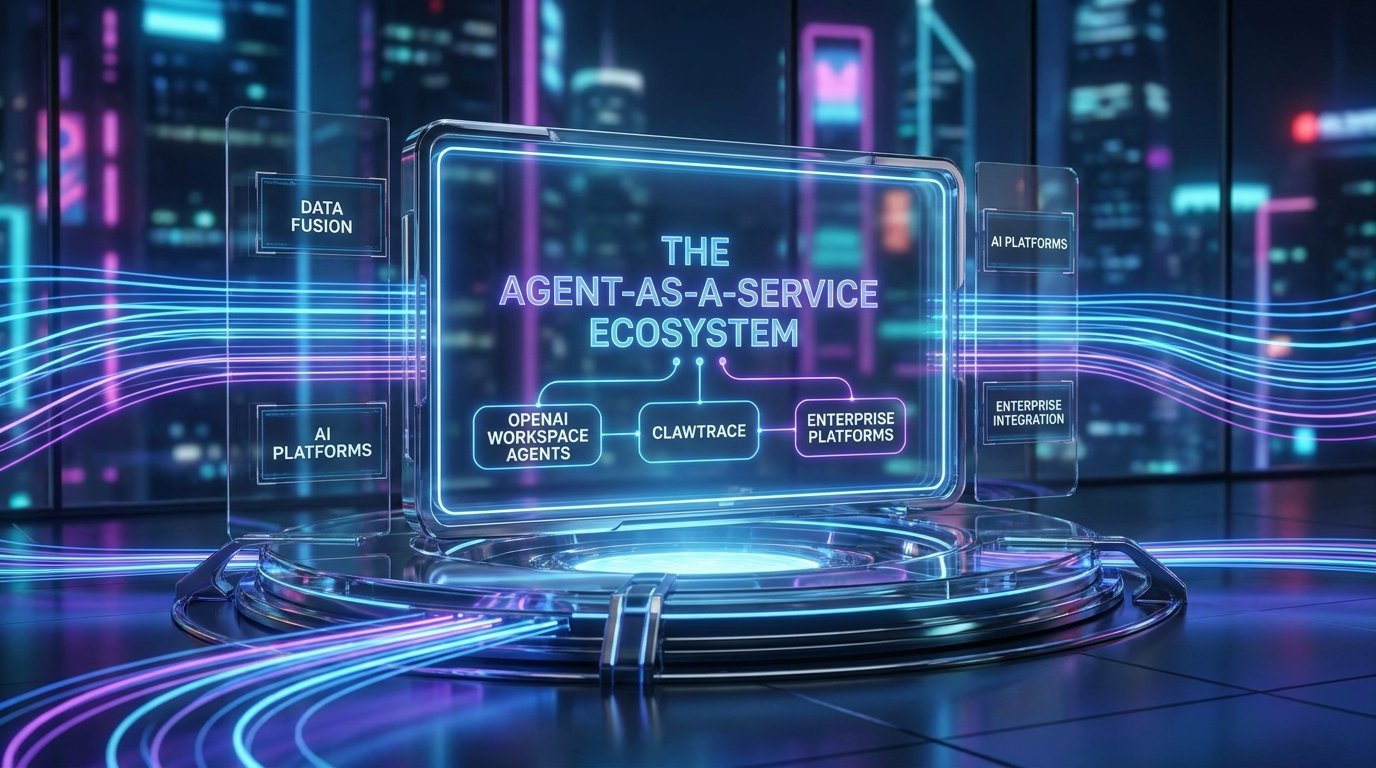
In the technology sector, true market validation rarely comes from early-stage startups; it comes when the incumbents shift their immense resources to chase the paradigm. The launch of OpenAI’s "Workspace Agents"—persistent, autonomous entities capable of long-horizon task execution—is the ultimate validation of the agentic paradigm. An Agent-as-a-Service Ecosystem is defined as the interconnected network of platforms, tools, and infrastructure that enables the creation, deployment, management, and observation of autonomous AI agents. OpenAI's move has officially ignited this ecosystem.
The narrative has shifted. We are no longer debating if autonomous agents will replace traditional software workflows; we are now debating how these agents will be managed, monitored, and optimized. This shift has profound implications for the broader Agent-as-a-Service Ecosystem, particularly for platforms like Epsilla and specialized observability tools like ClawTrace.
Key Takeaways
- Market Validation: OpenAI's Workspace Agents validate the entire Agent-as-a-Service (AaaS) market, shifting the focus from if to how agents will be deployed in the enterprise.
- Value Moves Upstack: The core value is no longer in creating basic agents, which is becoming commoditized. The new frontier is in sophisticated orchestration, observability, evaluation, and evolution of agents.
- Observability is Critical: As agents handle sensitive tasks, the need for deep, deterministic tracing and observability tools like ClawTrace becomes mission-critical to ensure reliability, safety, and compliance.
- The Future is Orchestration: The winning platforms will be those that can orchestrate a heterogeneous mix of agents from different vendors (OpenAI, open-source, etc.), acting as the central nervous system for the autonomous enterprise.
Here is an analysis of how OpenAI’s move reshapes the Agent-as-a-Service landscape.
The Commoditization of the Base Agent
OpenAI’s strategy is clear: commoditize the creation of basic autonomous agents. By integrating agent creation directly into the ChatGPT interface—allowing users to convert custom GPTs or describe workflows in natural language—they are lowering the barrier to entry to zero.
This is the "Wix or Squarespace" moment for AI agents. Just as those platforms commoditized basic web design, OpenAI is commoditizing basic workflow automation.
For the broader Agent-as-a-Service Ecosystem, this means that simply offering a platform to "build an agent" is no longer a viable standalone business model. The base capability is now a feature of the underlying LLM provider. The value in the AaaS market has aggressively moved up the stack. It is no longer about creating the agent; it is about orchestrating, observing, evaluating, and evolving the agent.
The Critical Need for "ClawTrace" and Agent Observability
As Workspace Agents are deployed across enterprise environments to handle sensitive tasks—interacting with Microsoft 365, drafting emails, analyzing financial data—the immediate crisis will not be a lack of capability, but a lack of visibility. "According to industry projections, by 2028, over 70% of enterprise software workflows will be initiated or managed by autonomous agents, making agent observability a top-three priority for CIOs."
When an LLM generates a hallucinated paragraph in a chat window, the user simply ignores it. When an autonomous agent hallucinates a decision inside a multi-step approval flow, the consequences are disastrous. OpenAI provides "configurable approval flows," but approvals are a bottleneck, not a solution to underlying unreliability.
This is where the ecosystem surrounding platforms like Epsilla becomes indispensable. As agents act autonomously, robust observability and evaluation platforms like ClawTrace transition from "nice-to-have" to "mission-critical."
ClawTrace provides the exact capability that black-box ecosystems lack: deep, deterministic tracing of agent trajectories. When an agent fails, enterprises need to know exactly which node in the semantic graph failed, which prompt iteration degraded performance, and how the tool-call latency affected the outcome.
OpenAI’s "in-distribution harness" is designed to test models, but ClawTrace is designed to monitor agents in production. The explosion of Workspace Agents will drive unprecedented demand for third-party, impartial evaluation platforms that can audit agent behavior across different models and environments, ensuring compliance, safety, and performance.
The Rise of "Self-Evolving" Infrastructure
OpenAI notes that Workspace Agents possess "memory across projects, allowing them to learn and improve over time." This highlights a core requirement of the next generation of AaaS: self-evolution.
However, in a closed ecosystem, this "learning" is opaque. The enterprise does not control the weights, the vector storage, or the reinforcement learning pipeline.
The broader Agent-as-a-Service Ecosystem, spearheaded by open architectures, is moving toward explicit, controllable self-evolution. Through systems like ClawTrace, an agent’s failures are not just logged; they are fed back into an optimization loop. The system analyzes the trajectory, identifies the point of failure (e.g., a poorly structured API call), and automatically refines the agent’s instructions or semantic memory to prevent the error in the future.
This creates a competitive dynamic: OpenAI’s agents will improve globally based on aggregate usage data, but open-ecosystem agents will evolve hyper-locally, becoming deeply specialized to the specific nuances, jargon, and implicit knowledge of the individual enterprise.
The Future of AaaS: The Orchestration Layer
OpenAI’s Workspace Agents represent a horizontal integration play—owning the model, the agent, and the interface. The response from the open ecosystem must be relentless vertical specialization.
Platforms like Epsilla’s AgentStudio will thrive not by competing with ChatGPT’s ease of use, but by becoming the definitive orchestration layer for the complex enterprise. The future enterprise will not rely on a single vendor's agents. They will employ OpenAI Workspace Agents for general office tasks, heavily fine-tuned local Llama models for analyzing proprietary code, and specialized open-source agents for security auditing.
The true value of the Agent-as-a-Service Ecosystem will lie in platforms that can orchestrate this heterogeneous mix of agents. Epsilla will act as the central nervous system, utilizing ClawTrace to ensure every agent—regardless of its origin or underlying model—operates safely, efficiently, and synergistically.
Frequently Asked Questions (FAQ)
What is an Agent-as-a-Service Ecosystem? An Agent-as-a-Service Ecosystem is the complete network of platforms, tools, and infrastructure for building, deploying, managing, and observing autonomous AI agents. It includes everything from the base models and agent creation frameworks to specialized tools for observability, evaluation, and orchestration that ensure agents operate reliably in production environments.
Why is agent observability like ClawTrace so important now? With agents performing autonomous, high-stakes tasks, a lack of visibility is a major business risk. Observability platforms like ClawTrace provide deep, deterministic tracing to diagnose failures, audit behavior for compliance, and ensure reliability. As agent deployment scales, this moves from a helpful feature to a mission-critical enterprise requirement.
How do open platforms like AgentStudio compete with OpenAI? Open platforms compete not by creating simpler agents, but by providing a superior orchestration layer. They enable enterprises to manage a diverse mix of agents from various vendors (including OpenAI) and open-source models. Their value lies in vertical specialization, deep customization, and providing the control and observability closed systems lack.
OpenAI has fired the starting gun for the autonomous enterprise. But the race will not be won by the company that builds the best individual agent; it will be won by the platforms that provide the infrastructure to manage the millions of agents that are about to be unleashed.