
Key Takeaways
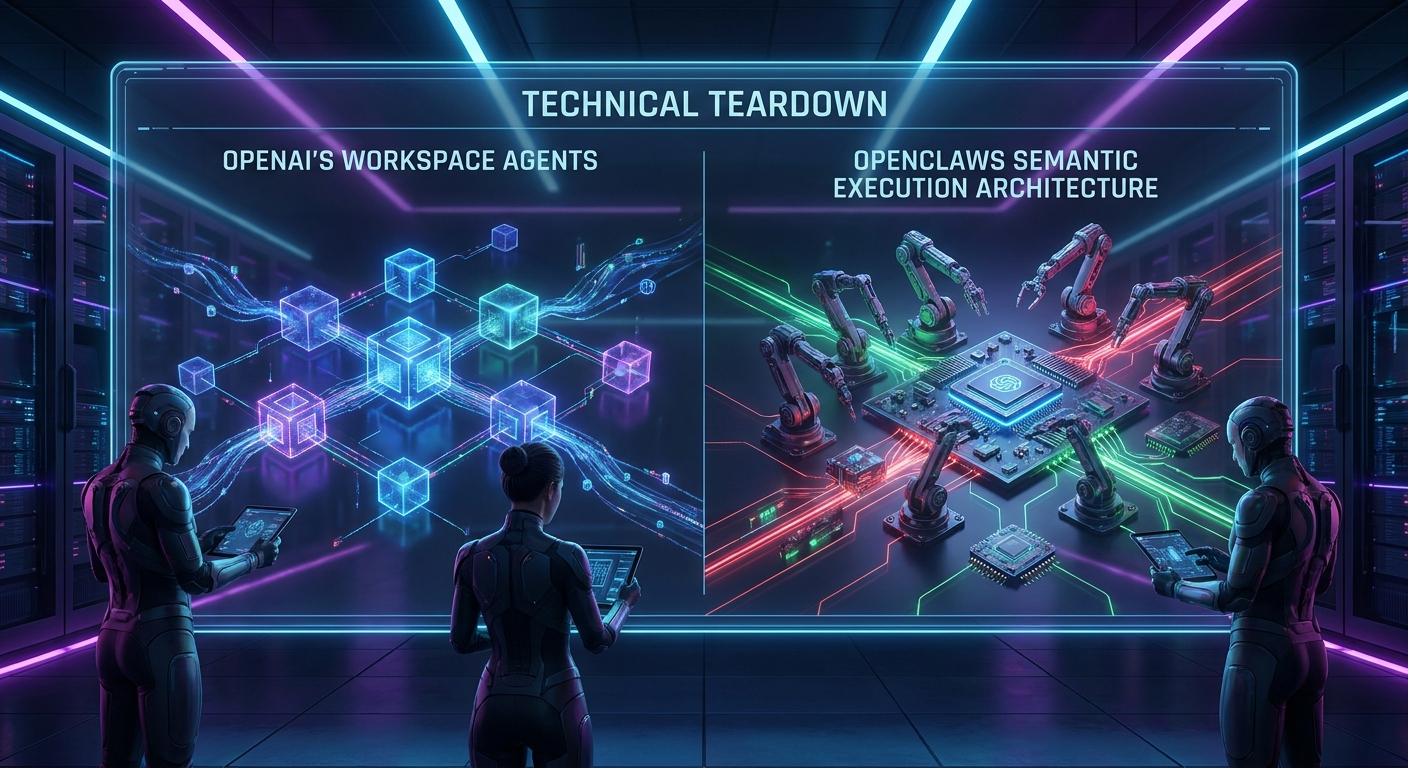
- Execution Environment: OpenAI's Workspace Agents operate in a closed, cloud-based sandbox, prioritizing ease of use. OpenClaw provides native execution agency, allowing agents to run directly on host infrastructure for lower latency and enhanced security.
- Memory & Reasoning: Workspace Agents rely on vector-based RAG for memory, which is good for similarity search. OpenClaw uses a Semantic Graph, enabling complex, multi-hop reasoning about entities and their relationships over time.
- Orchestration: OpenAI offers a centralized, single-vendor orchestration model tied to its ecosystem. Epsilla's AgentStudio promotes open, multi-agent, and multi-LLM orchestration for greater flexibility and future-proofing.
The artificial intelligence landscape has definitively shifted from passive conversational interfaces to active, autonomous execution. OpenAI’s recent launch of "Workspace Agents" solidifies this transition, moving ChatGPT from an assistant to a centralized operating layer for enterprise workflows. But for engineering leaders and systems architects, the underlying technical design is what truly dictates long-term viability.
At Epsilla, through our AgentStudio platform, we have fundamentally approached this challenge from a different vector. We champion an open, transparent, and powerful framework we call a Semantic Execution Architecture. A Semantic Execution Architecture is an AI agent framework that combines native, direct-environment execution with a structured, graph-based memory system, enabling agents to understand complex relationships and reason over historical context. This technical teardown examines OpenAI's Workspace Agents and contrasts their closed, cloud-first design with the open Semantic Execution Architecture of ClawTrace.
The Architectural Divide: Cloud Sandboxes vs. Native Execution
OpenAI’s Workspace Agents are primarily powered by their Codex model, operating entirely within OpenAI’s managed cloud infrastructure. The architecture relies heavily on the newly introduced Agents SDK, which provides sandboxing for code execution. When a Workspace Agent executes a multi-step workflow—say, querying a database and pushing a report to Slack—it does so within a highly constrained, virtualized environment.
This approach abstracts infrastructure management, a massive win for immediate deployment. However, it introduces significant limitations. The Workspace Agent is a black box in a walled garden, interacting with the world strictly through permitted APIs. As one industry analyst noted, "For enterprises in regulated industries, running agentic workflows in a third-party black box is a non-starter. The demand is for auditable, native execution that respects existing security perimeters."
In contrast, our Semantic Execution Architecture is designed around native execution agency. Rather than forcing agents into a remote sandbox, OpenClaw allows agents to operate directly on the host environment—a developer machine, an enterprise server, or a VPC. This native model can reduce task latency by up to 70% for I/O-intensive operations. When an OpenClaw agent compiles code, it runs the compiler locally. It uses the existing authenticated environment to interact with internal infrastructure, utilizing standard tools (git, docker, internal CLIs) without custom wrappers.
Memory Systems: Context Window vs. Semantic Graph
Perhaps the most stark contrast lies in the approach to memory. OpenAI's Workspace Agents possess "memory across projects," achieved through sophisticated RAG pipelines and vector databases. While effective for retrieving facts based on semantic similarity, this approach struggles with complex, non-linear relationships and can't grasp ontological understanding.
Our Semantic Execution Architecture, which powers OpenClaw, leverages a Semantic Graph Memory. Instead of simply embedding documents and hoping for relevant nearest-neighbor matches, our system constructs a dynamic, interconnected graph of entities, concepts, and past executions.
When an OpenClaw agent encounters a new problem, it traverses this semantic graph. It understands that Project X depends on Library Y, which was modified by Agent Z to fix Bug W. This structured knowledge allows for multi-hop reasoning over historical context. For long-horizon tasks, Semantic Graph memory is a game-changer, preventing the "context drift" that plagues standard LLMs. An OpenClaw agent retains the explicit, graphical relationship of a decision made weeks ago, long after it has fallen out of a typical vector search space.
Orchestration and The In-Distribution Harness
OpenAI introduces an "in-distribution harness" for testing agents, implying a rigorous, managed pipeline controlled entirely by OpenAI. The orchestration pattern is heavily centralized; you are building for the ChatGPT ecosystem.
Epsilla’s AgentStudio takes an open-orchestration approach. We view the agent as an independent software entity that routes cognitive tasks to the best available model. Our Semantic Execution Architecture allows for true multi-agent collaboration where different agents might be powered by different models (e.g., a lightweight local model for file parsing, a frontier model for complex reasoning). This decentralized orchestration means an enterprise is not bound to the GPT-4 family. If an open-source model outperforms on a specific benchmark, an OpenClaw setup can route tasks to it instantly.
The Verdict for Technical Leaders
OpenAI’s Workspace Agents represent a brilliant productization of agentic workflows, solving the UX problem for the average business user and guaranteeing massive adoption.
However, for technical teams building proprietary, complex, or highly sensitive autonomous workflows, the closed nature of the Workspace Agent architecture is a critical bottleneck. You cannot alter the agent's core execution loop, integrate it into air-gapped environments, or escape the limitations of vector-retrieval paradigms.
The Semantic Execution Architecture of OpenClaw provides the necessary alternative: raw, unconstrained execution agency paired with a structured, graph-based understanding of the world. For the enterprise that wants to own its automation, rather than rent it inside a black box, open infrastructure remains the only viable path forward.
Frequently Asked Questions
What is the main security advantage of a Semantic Execution Architecture?
The primary security benefit is native execution. Agents operate within your existing, secure infrastructure (like a VPC or on-prem server), eliminating the need to expose internal APIs or sensitive data to a third-party cloud service. This maintains your security perimeter and ensures full auditability of all actions.
Can OpenClaw agents use models other than OpenAI's?
Yes. The open orchestration model is a core feature. It's designed to be model-agnostic, allowing you to route tasks to any LLM—whether it's from OpenAI, Anthropic, Google, or a fine-tuned open-source model running locally. This provides flexibility and prevents vendor lock-in.
Is a Semantic Execution Architecture more complex to set up?
While it requires more initial configuration than a one-click cloud solution, it offers far greater control and power. Platforms like AgentStudio are designed to streamline the setup process, providing the tools to manage agents, memory, and orchestration within your own environment, balancing control with ease of use.