
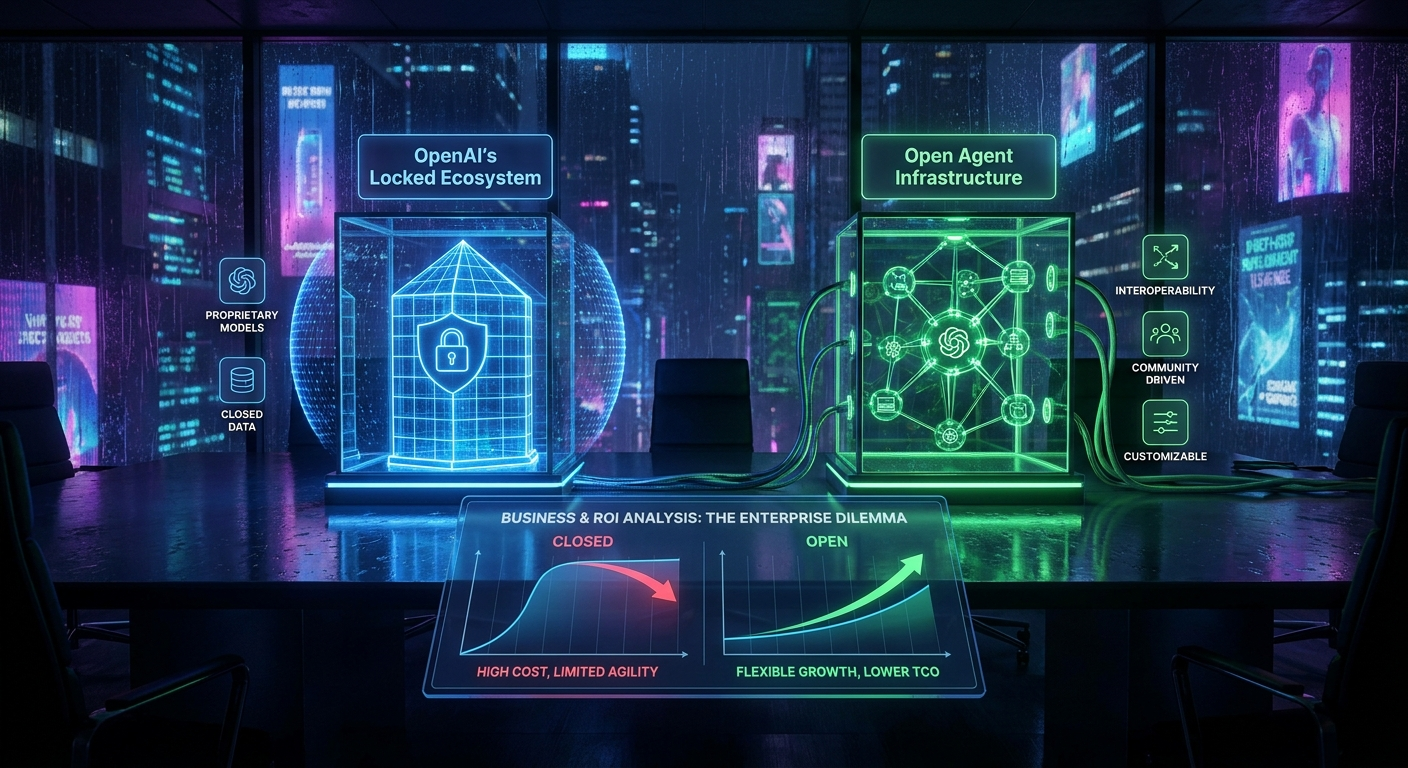
The era of AI as a mere conversational assistant is over. With OpenAI’s "Workspace Agents," the race to deploy autonomous systems that can execute complex, multi-step business workflows has officially entered the mainstream. But this new capability forces a critical strategic decision. The core choice is between a locked, proprietary ecosystem and a flexible, future-proof Open Agent Infrastructure.
An Open Agent Infrastructure is a modular, vendor-agnostic framework for building, deploying, and managing autonomous AI agents. Unlike closed ecosystems, it allows enterprises to retain full control over their data, choose from a diverse range of AI models, and own their automation logic as a core intellectual property asset.
For enterprise leaders, CIOs, and CFOs, the architectural choice of how to deploy these agents will dictate long-term ROI, data sovereignty, and competitive advantage. The choice is stark: adopt OpenAI’s turnkey but locked ecosystem, or invest in an Open Agent Infrastructure using platforms like Epsilla’s AgentStudio.
Key Takeaways
- The Core Dilemma: Enterprises must choose between OpenAI's immediate convenience and the long-term strategic control offered by an Open Agent Infrastructure.
- Vendor Lock-in Risk: OpenAI's ecosystem creates high switching costs and dependence on their proprietary models and pricing, limiting future flexibility.
- Data Sovereignty is Paramount: Open infrastructure allows for on-premise or private cloud deployment, keeping sensitive enterprise data secure and compliant—a non-negotiable for many industries.
- Sustainable ROI: An Open Agent Infrastructure enables model agnosticism, allowing businesses to use the most cost-effective AI models for each task, leading to a predictable and optimized ROI.
- Owning Your "Agentic IP": With an open approach, the AI agents and their underlying logic become valuable, proprietary assets on the company's balance sheet, not just a configuration in a third-party SaaS tool.
The Allure of the Walled Garden: OpenAI’s Value Proposition
OpenAI’s Workspace Agents are designed for immediate gratification. The business case is straightforward: you are already paying for ChatGPT Enterprise; now, that same interface can orchestrate tasks across your Google Workspace, Microsoft 365, and Slack instances.
The ROI of Immediate Deployment: The time-to-value (TTV) with OpenAI is exceptionally low. Non-technical teams can use natural language to "describe recurring workflows" and generate agents instantly. For a marketing team needing an agent to aggregate weekly performance metrics, the ROI is realized within days. You avoid the upfront costs of custom software development and infrastructure provisioning.
The Hidden Costs of Lock-in: However, the initial low cost masks a significant long-term risk. OpenAI’s ecosystem is a classic walled garden. The agents operate entirely within OpenAI’s cloud, powered exclusively by their proprietary models.
From an ROI perspective, this introduces severe vendor lock-in. As your workflows become deeply intertwined with OpenAI’s specific agent architecture, switching costs become astronomical. According to a 2025 report by Constellation Research, "enterprises that heavily rely on a single proprietary AI vendor face switching costs that can exceed 200% of their initial investment within three years." You lose all pricing leverage. When OpenAI inevitably adjusts pricing, the enterprise has no recourse but to pay. You are renting your automation infrastructure, and the landlord controls the lease.
The Open Agent Infrastructure Alternative: The Epsilla Approach
An Open Agent Infrastructure, powered by platforms like Epsilla’s AgentStudio and open execution environments like OpenClaw, presents a fundamentally different business model. It requires a strategic shift from buying an off-the-shelf automation tool to building a core automation competency.
Data Sovereignty and Security: The primary driver for adopting an Open Agent Infrastructure is data sovereignty. OpenAI’s Workspace Agents require you to grant their cloud systems deep access to your internal SaaS applications. While OpenAI provides "permission boundaries," the reality is that your proprietary data—the lifeblood of your competitive advantage—is traversing external servers.
With AgentStudio, the execution environment can be hosted on-premises or within the enterprise’s own Virtual Private Cloud (VPC). The agents execute locally. For industries like finance, healthcare, and defense, this is not just a preference; it is a regulatory requirement. The ROI here is measured in risk mitigation—preventing compliance fines and intellectual property leakage.
Predictable ROI and Model Agnosticism: An Open Agent Infrastructure protects the enterprise from "model monopoly." The AI landscape is incredibly volatile. Open-source models (like Llama, Mistral, or specialized coding models) are rapidly closing the gap with frontier models, often at a fraction of the inference cost.
"The ability to dynamically route tasks to the most cost-effective model is no longer a luxury; it's a competitive necessity," notes Dr. Alistair Finch, a leading AI strategist. "An Open Agent Infrastructure is the only way to achieve this level of granular cost control." By utilizing an Agent-as-a-Service platform like Epsilla, enterprises achieve model agnosticism, ensuring a predictable and highly optimized ROI that scales sustainably.
Valuing the "Agentic IP"
When a company builds a highly effective workflow using OpenAI’s tools, the underlying logic and prompt chains are effectively trapped within the ChatGPT ecosystem. You do not own the IP of your automation; you own the configuration of OpenAI's product.
With an Open Agent Infrastructure, the agents themselves—their code, their semantic memory graphs, and their execution pathways—are proprietary assets owned by the enterprise. This "Agentic IP" becomes a tangible valuation driver. You are building an autonomous digital workforce that sits on your balance sheet, immune to the product deprecations or strategic pivots of a single AI vendor.
Frequently Asked Questions (FAQ)
What is the main advantage of Open Agent Infrastructure over a closed system? The primary advantage is strategic control. It grants enterprises data sovereignty by enabling on-premise or VPC deployment, model agnosticism to avoid vendor lock-in, and full ownership of their "Agentic IP," turning automation into a tangible, long-term asset rather than a recurring subscription cost.
Is Open Agent Infrastructure only for large enterprises? While large enterprises benefit most from its security and scalability, startups and mid-sized companies also leverage it to build defensible, proprietary automation. The open-source nature allows for a lower initial cost, focusing investment on building core competencies rather than paying for restrictive licenses.
How does Epsilla's AgentStudio fit into this model? Epsilla's AgentStudio is a platform designed to build and manage agents within an Open Agent Infrastructure. It provides the tools, frameworks, and execution environments (like OpenClaw) needed to accelerate the development of a secure, model-agnostic, and enterprise-owned autonomous workforce, simplifying the adoption of this powerful paradigm.
Conclusion: Strategic Control vs. Convenience
The introduction of OpenAI Workspace Agents validates the massive market demand for autonomous enterprise workflows. For small businesses or teams with non-critical data, the convenience of the OpenAI ecosystem will likely outweigh the drawbacks.
However, for large enterprises, the decision requires a deeper calculus. Relying entirely on a locked ecosystem for core business automation is akin to outsourcing your central nervous system. The long-term ROI overwhelmingly favors an Open Agent Infrastructure. Platforms like Epsilla provide the necessary tools to build, deploy, and own your AI agents, ensuring that the massive productivity gains of the autonomous era translate into lasting, defensible enterprise value, rather than just another rising SaaS subscription cost.