
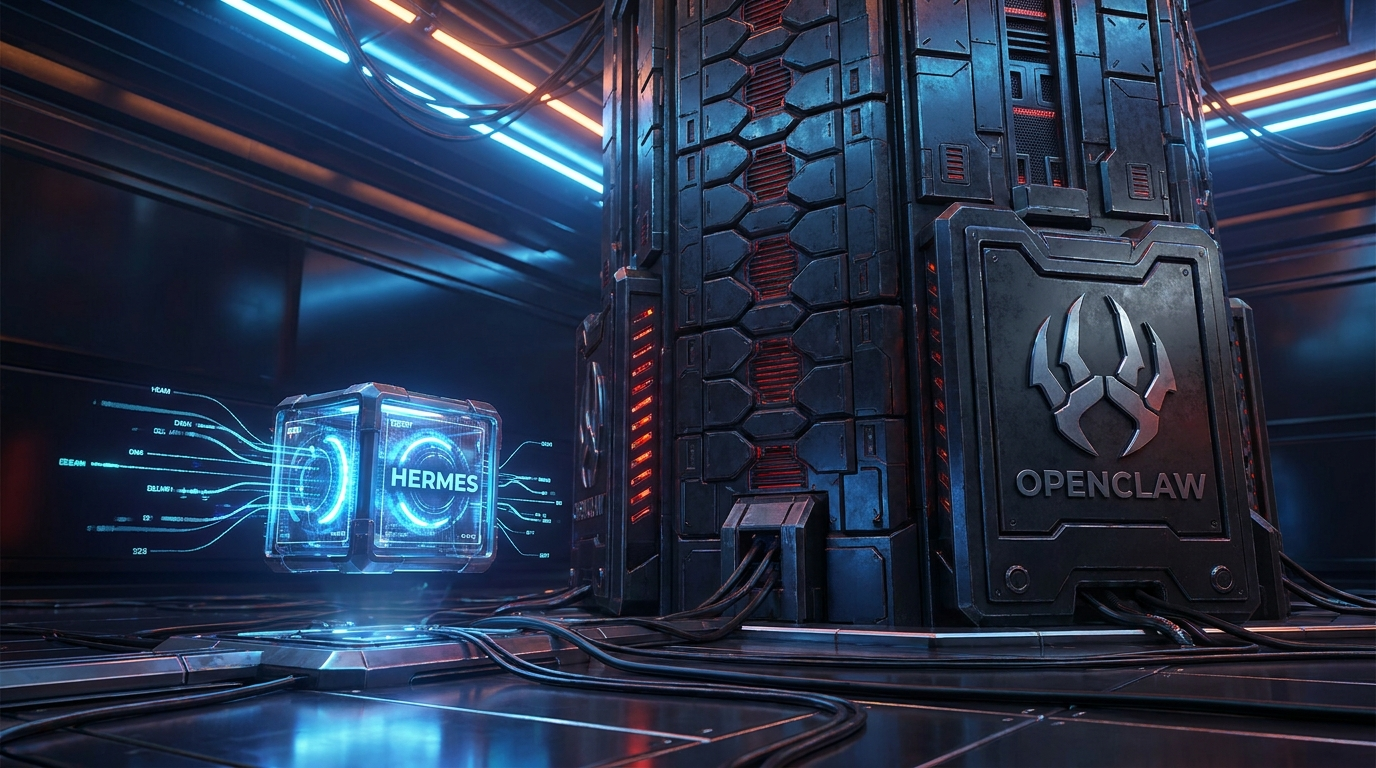
The autonomous AI landscape is bifurcating. As enterprises move beyond the proof-of-concept phase and demand production-grade reliability from their artificial intelligence systems, two dominant architectural philosophies have emerged, fundamentally opposed in their approach to agency, memory, and execution. On one side of this chasm, we have Hermes—a highly optimized, reasoning-focused model and lightweight agentic wrapper defined by what can only be called a "self-evolving cognitive core." It leans into algorithmic plasticity, dynamic prompt rewriting, and schema evolution to solve problems on the fly. On the other side, we have OpenClaw—a heavyweight, stateful operating system and runtime environment designed not for cognitive gymnastics, but for complete, grounded execution agency within a rigid, highly controlled sandbox.
For technical founders, CTOs, and platform architects building on enterprise-grade platforms like AgentStudio, understanding this architectural schism is no longer a purely academic exercise. It is the fundamental technical decision that will determine whether your autonomous systems scale securely, adapt to changing external environments, or ultimately collapse under the sheer weight of their own context windows.
The Hermes Paradigm: The Self-Evolving Cognitive Core
To understand Hermes, one must stop looking at agents as simple state machines and start viewing them as fluid, adaptive cognitive engines. Hermes represents the absolute pinnacle of the "smart router" philosophy, but it takes this concept far beyond simple if-then-else API mapping. It is an instruction-tuned powerhouse designed to do one thing exceptionally well: parse complex, ambiguous user intent and map it to deterministic function calls using an architecture that actively reshapes itself during inference.
At the heart of the Hermes framework is the concept of a self-evolving cognitive core. Unlike traditional agents that rely on static, hardcoded system prompts, Hermes employs dynamic prompt rewriting. As it encounters an ambiguous user request or a failing API endpoint, it does not simply crash and return an error. Instead, its algorithmic plasticity allows it to internally restructure its own reasoning framework. It generates intermediate, self-correcting prompts—essentially talking itself into a new mental model of the problem space—before attempting another function call.
This cognitive core also excels at schema evolution. In the wild, enterprise APIs frequently change, documentation rots, and data structures mutate. A standard agent tightly coupled to a static schema will fail the moment a JSON payload expects an integer instead of a string. Hermes, however, leverages its algorithmic plasticity to analyze the error response from the external system, intuitively deduce the required schema mutation, and evolve its internal function-calling blueprint on the fly. It learns and adapts dynamically, without requiring a developer to patch the orchestration code.
In a typical deployment, the Hermes agent acts as a stateless, highly adaptive orchestrator. It receives a prompt, uses its deep reasoning capabilities and self-evolving structures to determine which tool to execute, generates the JSON payload for that tool, and waits for the external system to return the result. This architecture is incredibly fast, astonishingly token-efficient, and inherently resilient to minor environmental deviations. Because Hermes does not attempt to manage the underlying state of the host machine or sandbox—preferring instead to manage its own cognitive state—it can execute single-turn and shallow multi-turn tasks with unparalleled speed. For lightweight customer support bots, data extraction utilities, or complex but stateless API routing, Hermes’s cognitive plasticity makes it a formidable engine.
The Limits of Plasticity: Where Statelessness Fails
However, this reliance on an internal, self-evolving cognitive core introduces a significant, sometimes fatal, flaw when deployed in long-horizon enterprise workflows. Cognitive plasticity is brilliant, but it is fundamentally ephemeral.
When an agent is tasked with migrating a sprawling legacy database schema, debugging a massive multi-repository codebase, or orchestrating a multi-day marketing campaign across twelve different SaaS platforms, the internal context window inevitably overflows. Hermes requires the orchestration layer or the developer to constantly inject the external environment state back into the prompt. While its cognitive core can rewrite prompts to maximize context utilization, it cannot alter the physical limits of transformer models.
Hermes lacks intrinsic, durable memory. More importantly, it lacks a dedicated execution sandbox. It possesses an incredibly sophisticated, self-evolving brain, but it has no hands. It relies entirely on the developer to build the nervous system, the skeletal structure, and the muscles required to actually manipulate the physical or digital world. When a task requires compiling a program, installing a package, or traversing a file system, Hermes can only output the instructions to do so; it cannot perform the action itself, nor can it naturally maintain the state of the machine between turns.
The OpenClaw Paradigm: The Heavy Stateful Sandbox
OpenClaw approaches the problem of autonomous execution from the exact opposite direction. It rejects the idea that cognitive plasticity alone can solve enterprise challenges. Instead, OpenClaw is built on the principle of heavy, durable state. It is not just an intelligence layer or a smart router; it is a full-fledged Agent Operating System.
OpenClaw operates on the principle of "Execution Agency." It intentionally decouples the reasoning model from the execution environment. When you deploy an OpenClaw agent, you are not just spinning up a chat interface or a lightweight API router—you are provisioning a secure, isolated, and highly durable container (the sandbox) where the agent has native, root-level access to a virtualized terminal, a local file system, and an interactive headless browser.
This architectural difference is profound. Where Hermes uses its self-evolving core to rewrite its internal prompts, OpenClaw uses its sandbox to rewrite actual files. If an OpenClaw agent is tasked with writing a Python script to scrape a heavily authenticated website, it doesn't just output a hypothetical block of code. It physically writes the code to a file in its local sandbox. It executes the script via the terminal. It reads the standard output and error trace logs. If there is a syntax error, it debugs the issue autonomously, installs any missing dependencies via pip, and repeats this physical read-eval-print loop (REPL) until the script functions perfectly.
This is the raw power of the Model Context Protocol (MCP) integrated deeply into a stateful runtime. OpenClaw maintains a durable session log and snapshot state. If the heavy sandbox crashes due to a memory leak or an infinite loop, the OpenClaw daemon immediately revives it. It injects the exact state checkpoint from milliseconds before the crash, restoring the file system, the terminal history, and the memory state. The agent resumes its work seamlessly. This level of environmental resilience and durable state is completely absent in raw Hermes deployments, which would be forced to start the entire cognitive process over from scratch.
Telemetry and the Observability Mandate
When an enterprise makes the transition from deploying a stateless, plastic router like Hermes to a heavy, stateful execution engine like OpenClaw, the security, governance, and observability requirements scale exponentially.
Giving an AI agent OS-level agency—the literal ability to manipulate files, execute bash commands, alter network configurations, and traverse internal subnets—is a massive security risk if left unmonitored. While Hermes’s internal cognitive evolution might result in a hallucinated API call, an unmonitored OpenClaw agent could accidentally drop a production database.
This is precisely why enterprise deployments of OpenClaw necessitate ClawTrace. ClawTrace provides the deterministic telemetry required to audit highly non-deterministic models operating within stateful environments. Every single function call, every terminal command keystroke, every browser DOM interaction, and every file system mutation executed by an OpenClaw agent is logged, indexed, and visualized in real-time. If a compromised or hallucinating agent attempts to access an unauthorized directory or executes a destructive database query outside its permitted scope, ClawTrace flags the anomaly instantly, allowing the orchestration layer or a human-in-the-loop to kill the process before damage occurs. You simply cannot deploy a heavyweight OS agent like OpenClaw in an enterprise setting without this level of granular, execution-level observability.
Anchoring Both Paradigms: AgentStudio and the Semantic Graph
At Epsilla, we recognize that whether you choose the cognitive plasticity of Hermes or the heavy stateful sandbox of OpenClaw, raw execution power must be anchored by deep structural knowledge. OpenClaw provides the hands, and Hermes provides an incredibly adaptive brain, but both still need a reliable map of the enterprise environment to operate effectively without hallucinating.
This is where the integration of these architectures into AgentStudio utilizing the Epsilla Semantic Graph becomes the ultimate enterprise moat. While a raw Hermes deployment relies solely on its context window to deduce relationships, and a raw OpenClaw agent relies on trial-and-error within its sandbox, an agent backed by a Semantic Graph can traverse the explicit, predefined relationships of an enterprise's data architecture.
It doesn't have to guess how a legacy internal API is structured; it queries the graph, retrieves the exact endpoint schema, and then executes the call. For Hermes, the Semantic Graph provides a massive shortcut for its self-evolving core, reducing the cognitive load required to figure out complex relationships. For OpenClaw, the Semantic Graph acts as a set of guardrails and a treasure map, guiding its physical execution within the sandbox.
Conclusion: The Evolutionary Divergence
The architectural schism between Hermes and OpenClaw is not a battle of right versus wrong; it is a classic engineering tradeoff between cognitive agility and durable depth.
If your objective is to build a fast, localized application that requires dynamic prompt rewriting, rapid schema evolution, and the ability to route API calls across a fluid landscape of data transformations, Hermes and its self-evolving cognitive core provide a highly optimized, cost-effective solution. Its algorithmic plasticity is unmatched for stateless operations.
But if your goal is to build an autonomous digital workforce—persistent agents that can operate independently for hours or days, physically manipulating host systems, debugging their own code, compiling software, and recovering from runtime crashes without losing a beat—OpenClaw’s heavy stateful sandbox is the only viable architecture.
As enterprises graduate from the era of simplistic "AI Copilots" to deploying full-fledged "AI Employees," the market will likely adopt a hybrid approach. The most successful platforms will use a Hermes-like cognitive core for rapid triage and reasoning, directing an OpenClaw-like sandbox to handle the heavy, stateful lifting. Regardless of the path chosen, the future belongs to architectures that are governed by robust telemetry and firmly anchored by semantic truth.