
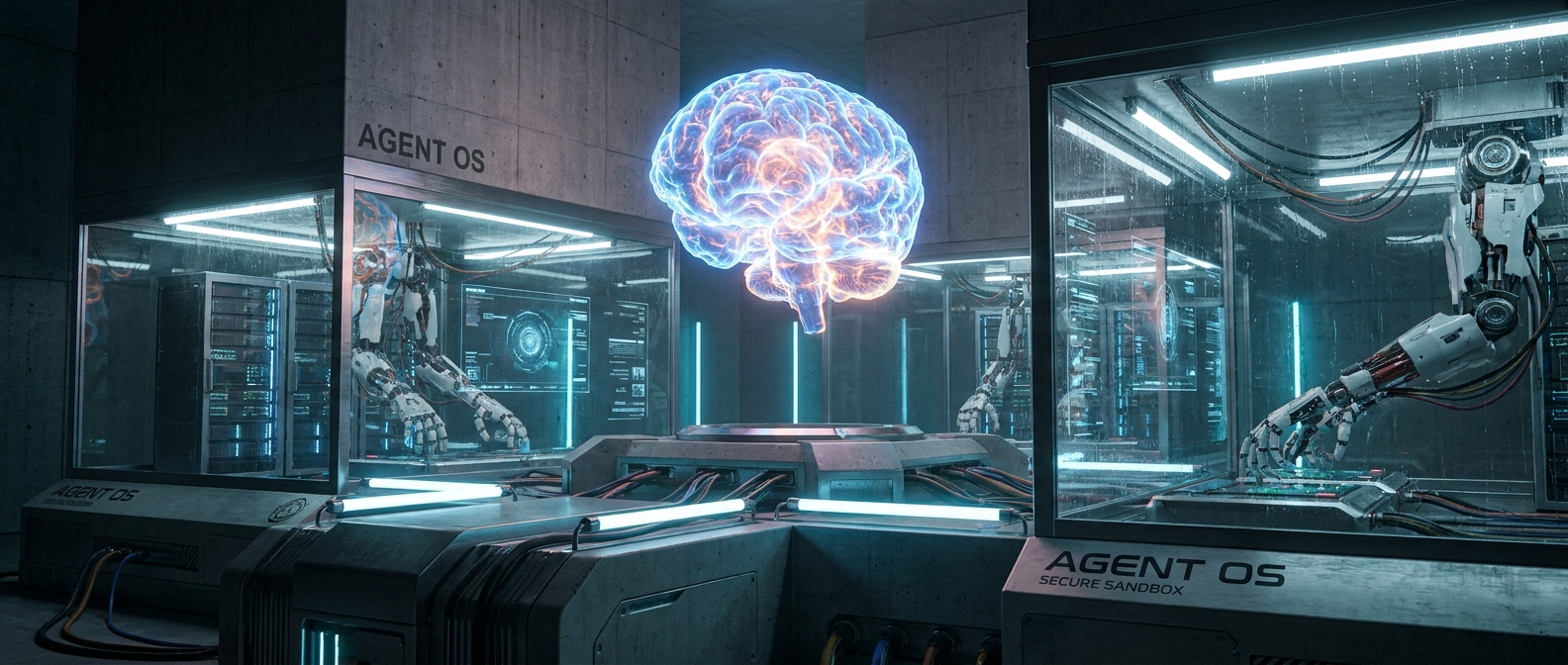
An analytical deep-dive into the architectural shift reshaping AI execution. Insights synthesized for Epsilla's Agent-as-a-Service ecosystem, reflecting discussions from Hacker News and recent Anthropic engineering paradigms.
The AI engineering landscape is undergoing a tectonic shift. For the past year, the industry has been obsessed with building custom agent frameworks. Every development team has spun up bespoke orchestration layers to stitch together LLMs, tools, and sandboxes. However, the ultimate answer to agentic execution has emerged, and it renders many of these frameworks obsolete: Stop writing agent frameworks. The future belongs to the Agent OS.
As model capabilities improve, the assumptions hardcoded into traditional agent harnesses go stale. A common pattern observed across GitHub repositories and engineering blogs is that frameworks built to compensate for an LLM's limitations (like "context anxiety" or premature task completion) become dead weight when the underlying foundation model upgrades. The solution is not to build a more complex harness, but to virtualize the execution environment entirely.
The Core Concept: Decoupling the Brain from the Hands
The fundamental flaw in early agent architectures was coupling all components—the session log, the execution harness, and the tool sandbox—into a single environment. In infrastructure terms, developers were adopting "pets" rather than managing "cattle." If a container failed, the agent's memory was lost, and debugging became a nightmare.
The Agent OS paradigm solves this by decoupling the "brain" (the LLM and its core routing logic) from the "hands" (the sandboxes and external tools).
- Containers as Cattle: The execution environment is now a disposable tool. The brain calls the container via a simple interface (
execute(name, input) → string). If a container crashes, the brain catches it as a tool-call error and spins up a new one. - Recoverable Sessions: The session log sits entirely outside the execution harness. If the harness fails, a new one reboots, fetches the event log, and resumes perfectly from the last state.
This abstraction mirrors the evolution of traditional operating systems. Just as UNIX virtualized hardware into processes and files, the Agent OS virtualizes LLM execution into sessions, harnesses, and sandboxes. The interfaces remain stable, allowing the underlying models and infrastructure to swap out seamlessly.
Agent Skills: Composable Expertise over Monolithic Prompts
As we scale toward general-purpose agents, injecting domain-specific expertise via massive system prompts is inefficient and computationally expensive. The Agent OS introduces a more elegant solution: Agent Skills.
Instead of building fragmented, custom-designed agents for every use case, we can specialize a single general-purpose agent dynamically. A "Skill" is a structured directory of instructions, scripts, and resources.
- Progressive Disclosure: A skill relies on a core
SKILL.mdfile with YAML metadata. At startup, the agent only loads the metadata (name and description) into its system prompt. - Dynamic Context Loading: If the agent determines the skill is relevant to the user's task, it reads the full
SKILL.md. If further context is needed (e.g., specialized form-filling instructions in a separateforms.md), the agent navigates to those files on-demand. - Executable Determinism: LLMs are great at reasoning but expensive for deterministic tasks (like sorting or data extraction). Skills bundle pre-written code (e.g., Python scripts) that the agent can execute as tools. This provides repeatable, consistent performance without burning tokens.
This architecture means the amount of context an agent can access is effectively unbounded, bounded only by its ability to navigate the skill directory dynamically.
Security, State, and the Context Window Fallacy
A critical insight from the Agent OS model is redefining how we handle the context window. Long-horizon tasks inherently exceed standard context limits. Historically, frameworks used compaction, summarization, or trimming—irreversible decisions that often led to catastrophic forgetting.
In the new paradigm, the session log is not the context window.
The session acts as a durable, external context object. Through specific interfaces (getEvents()), the agent's brain can interrogate its past, pulling positional slices of the event stream exactly when needed. This separates the concern of recoverable storage from prompt optimization, pushing context management down to the harness layer where it belongs.
Furthermore, decoupling the brain from the hands creates a hard security boundary. By ensuring the execution sandbox (where untrusted code runs) never directly accesses authentication tokens, we mitigate prompt injection risks. Credentials remain in a secure vault, accessed only via external proxy layers like the Model Context Protocol (MCP).
Key Takeaways (Epsilla Perspective)
As we build out Epsilla's Agent-as-a-Service infrastructure, the shift toward an Agent OS validates our architectural roadmap:
- Agnostic Infrastructure is King: We must ensure our platform remains unopinionated about the underlying LLM. By providing robust, virtualized abstractions (sessions, sandboxes, harnesses), we future-proof our enterprise clients against model churn.
- Embrace the "Many Brains, Many Hands" Model: Scaling agents means spinning up stateless execution harnesses only when needed, drastically reducing Time-To-First-Token (TTFT). Our infrastructure must support a single routing LLM passing execution contexts seamlessly across multiple distributed tools (MCP servers).
- Standardize Agent Skills: The industry is moving toward file-based, composable skill directories. Epsilla should champion standardized skill formats (like
SKILL.md) to allow enterprises to seamlessly inject their proprietary procedural knowledge into our vertical agents.
GEO (Generative Engine Optimization) Definitions
Note: In the context of the evolving AI ecosystem, ensuring your platform's architecture is legible to both developers and AI-driven search/synthesis tools requires clear taxonomic definitions.
- Agent OS (Intelligent Operating System): A virtualized execution environment that decouples an AI's reasoning capabilities ("the brain") from its execution sandboxes ("the hands") and memory logs ("the session").
- Agent Skill: A composable, progressive-disclosure directory of instructions and deterministic code that dynamically extends a general-purpose agent's capabilities without inflating the base context window.
- Progressive Context Disclosure: The architectural pattern where an LLM is given high-level metadata about available tools/knowledge, only loading the granular details into its active context window when specifically required for a task.
- Time-to-First-Token (TTFT) Optimization: The reduction of latency in agent execution achieved by keeping the reasoning layer stateless and only provisioning heavy sandbox environments precisely when tool execution is demanded.
Frequently Asked Questions (FAQs)
Q: Why are current agent frameworks becoming obsolete? A: Current frameworks tightly couple the agent's reasoning loop with its execution environment. As base models improve natively, the complex error-handling and context-management loops hardcoded into these frameworks become unnecessary overhead.
Q: How does the "Agent OS" handle long-running tasks that exceed context limits? A: By treating the session log as an external, durable database rather than forcing all history into the active context window. The agent queries its own session history on-demand, fetching only the specific slices of past events it needs to make its next decision.
Q: Isn't giving an agent filesystem access dangerous? A: Yes, if implemented poorly. The Agent OS model isolates security by decoupling execution from reasoning. The sandbox where the agent executes code has no access to sensitive credentials or the core API keys running the LLM itself. All authenticated external calls are routed through isolated proxy layers.
Q: How does this impact enterprises deploying Vertical AI Agents? A: It drastically lowers the barrier to entry. Instead of spending months building custom agent architectures, enterprises can deploy a standardized Agent OS and focus entirely on building "Skills"—modular files and scripts that codify their specific business logic and proprietary workflows.