
Key Takeaways
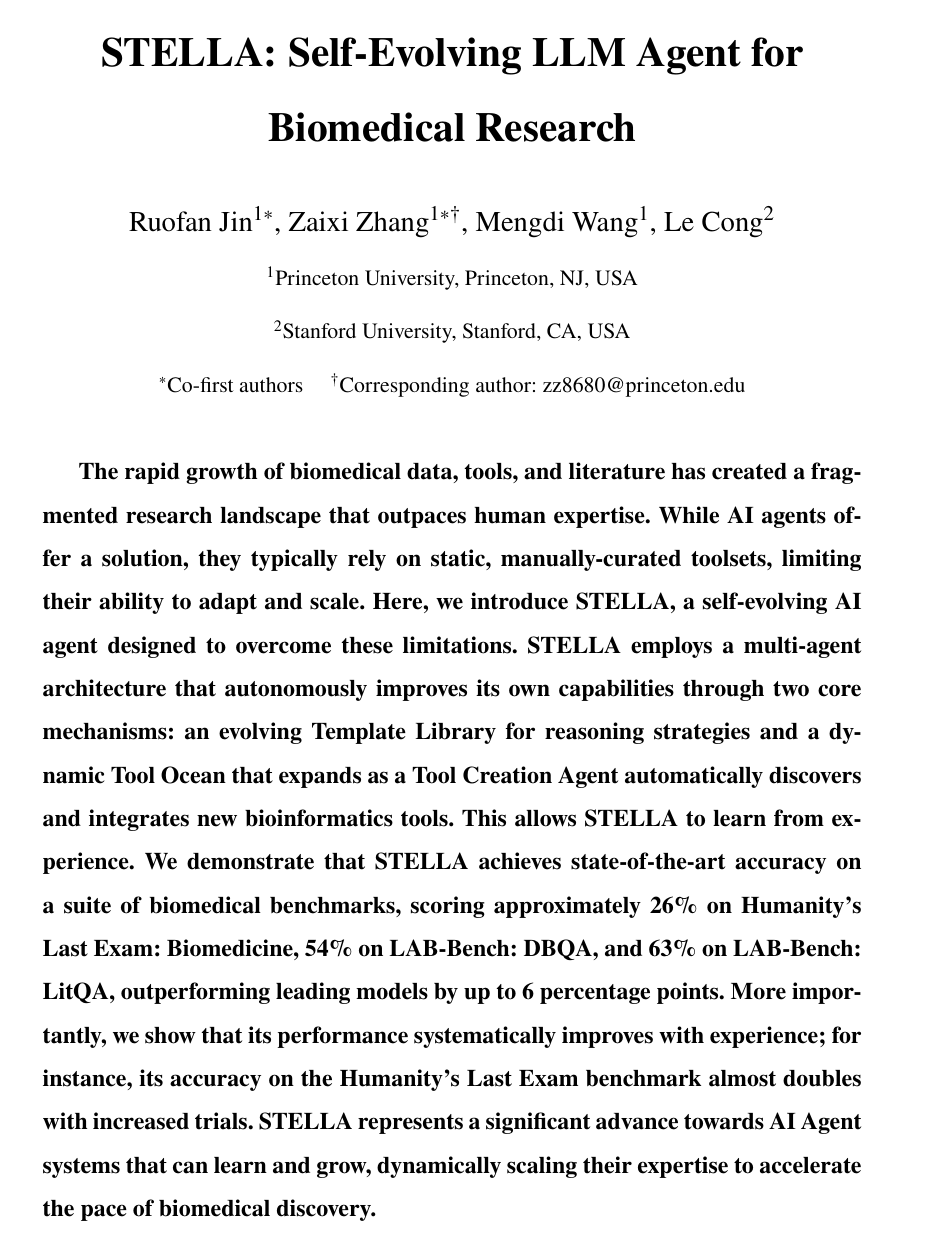
- STELLA is a pioneering self-evolving AI agent designed to accelerate biomedical research by autonomously conducting experiments and analyzing data.
- The agent utilizes a sophisticated semantic memory system, allowing it to learn from past interactions, retain knowledge, and improve its problem-solving strategies over time.
- Unlike traditional AI, STELLA can independently adapt its own operational framework, enabling it to tackle complex, multi-step research challenges more efficiently.
- This technology represents a significant step towards automating the scientific discovery process, potentially leading to faster breakthroughs in medicine and biology.
Self-Evolving AI Agents: Autonomous systems that can independently modify their own internal architecture, parameters, or problem-solving strategies based on experience and new data. They continuously learn and adapt to improve their performance on complex tasks without requiring direct human reprogramming.
Operational Workflow: A Case Study in Chemotherapy Resistance
To understand STELLA's methodology, consider a concrete operational example:
Research Objective: Uncover the mechanisms of acquired chemotherapy resistance in a patient's tumor and propose a targeted re-sensitization strategy.
The workflow unfolds through a coordinated multi-agent system:
- Manager Agent: Establishes the high-level reasoning path. This includes defining key stages: dataset preprocessing, cell state annotation, differential analysis, and final result synthesis.
- Developer Agent: Executes the technical plan. It creates a conda environment, installs the necessary bioinformatics tools (e.g., gseapy, scanpy, scGPT), and performs the initial data preprocessing, cell-type annotation, and differential analysis.
- Critic Agent: Reviews the initial output and provides critical feedback. In this case, it determined: "The current analysis is insufficient. We need to identify the 'keystone' genes that sustain the resistance network. I recommend creating a new tool that uses a single-cell perturbation prediction model to perform a virtual screen, predicting which genetic perturbation would most effectively restore drug sensitivity in the resistant cells."
- Tool Creation Agent: Acting on the Critic's directive, this agent develops a novel virtual perturbation screening tool based on a virtual cell foundation model. This process ultimately identifies the transcription factor MTF1 as the key regulator of the resistance network.
The Core Innovation: A Dual Self-Evolution Mechanism
STELLA's defining characteristic is its dual self-evolution capability, which allows it to learn from experience and continuously expand its operational capacity. This is not a static system; it is designed for growth.
1. Evolution of the Template Library
The first mechanism is the evolution of a reasoning template library. The successful multi-step workflow used to identify MTF1—from initial descriptive analysis to the pivot toward predictive virtual screening—is not discarded. Instead, it is distilled into a new, high-quality reasoning template and stored in the library. This process refines STELLA's strategic knowledge, enabling it to solve similar "resistance mechanism" problems with far greater efficiency in the future.
The template library contains a variety of predefined strategic outlines, such as:
- Pathway Analysis Template
- Drug Repurposing Template
- Resistance Analysis Template
- Literature Review Template
- Divide-and-Conquer Strategy Template
This library is a living repository, continuously enriched and optimized as the agent successfully navigates new challenges.
2. Expansion of the Tool Ocean
The second, and arguably more profound, evolutionary mechanism is the expansion of the "Tool Ocean"—a dynamic and growing collection of STELLA's executable capabilities. This directly validates our architectural thesis at Epsilla: an agent's power is defined by its ability to dynamically acquire and utilize tools, not by a static, pre-compiled set of functions.
The Tool Ocean contains a diverse set of computational instruments, broadly categorized into three types:
- Database Query Functions: Providing direct API access to critical data sources.
- PubMed: Biomedical literature database
- ClinVar: Clinical variation database
- PDB: Protein structure database
- Large-Scale Foundation Model Interfaces: Enabling STELLA to leverage state-of-the-art AI capabilities.
- AlphaFold 3: Protein structure prediction
- scGPT: Single-cell data interpretation
- ESM3: Protein language modeling
- Customized Analysis Tools: Purpose-built scripts for specialized tasks like network analysis and data integration.
The synergy between the Template Library and the Tool Ocean is where the system's true potential is unlocked. This dual evolution represents two forms of persistent, long-term memory: procedural (how to solve a problem) and capability (what tools are available to solve it). This is precisely the challenge our Agent-as-a-Service platform at Epsilla is designed to address. A simple vector store is insufficient for managing this level of complexity. Our Semantic Graph architecture is built to natively support this self-evolving context, mapping not just tools but the relationships between them, their parameters, and their successful application in past workflows. The Tool Ocean begins with a set of predefined tools but is designed for perpetual expansion. The Tool Creation Agent actively discovers and integrates new bioinformatics tools by searching resources like GitHub and PubMed, autonomously augmenting the agent's core capabilities. This prevents the agent from becoming obsolete, ensuring its problem-solving capacity grows in tandem with the scientific landscape.
Benchmark Performance: Leading the Industry in Accuracy
To validate STELLA's effectiveness, the research team benchmarked it against state-of-the-art LLMs and specialized agents across three challenging biomedical question-answering tasks.
Superior Performance Across Three Key Benchmarks
The results demonstrate that STELLA consistently outperforms the competition across all benchmarks:
- Humanity's Last Exam (Biomedicine)
- STELLA Accuracy: ~26%
- Outperformed all other models tested.
- LAB-Bench: DBQA (Database Question Answering)
- STELLA Accuracy: ~54%
- A significant 6-8 percentage point lead over the next-best model.
- LAB-Bench: LitQA (Literature Question Answering)
- STELLA Accuracy: ~63%
- Maintained a clear leadership position.
4.2 Empirical Validation of Self-Evolution
More critically, the research team provided direct evidence of STELLA's core self-evolutionary capability. The test results demonstrate a systematic improvement in STELLA's performance as its computational experience increases.
Self-Evolution Performance During Testing:
- On the HLE: Biomedicine benchmark, STELLA's accuracy nearly doubled, increasing from 14% to 26%.
- This improvement was realized as the number of trials (i.e., the computational budget) increased.
- The reported results represent the average accuracy across three independent evaluation runs.
This finding is significant: it validates that STELLA not only performs at a high level but becomes more capable as it accumulates experience. It is, in effect, learning how to be a better scientist.
5. Technical Innovation and Scientific Significance
5.1 Breaking Through the Bottlenecks of Traditional AI Agents
STELLA represents a major advance for biomedical AI agents, primarily in the following areas:
- Transcending the Limits of Static Toolsets: Traditional AI agents rely on manually curated, static toolsets, which are both inefficient and unscalable. STELLA overcomes this by using a Tool Creation Agent for the automatic discovery and integration of new tools, enabling the system to keep pace with the rapid evolution of biomedical science. This directly validates the core thesis behind our work at Epsilla. An agent's value is crippled if it's locked into a static, manually curated toolset. Our Agent-as-a-Service platform is architected precisely to prevent this, enabling agents to dynamically expand their capabilities in real-time.
- Multi-Agent Collaborative Architecture: Through the coordinated efforts of four distinct agents—Manager, Developer, Judge, and Tool Creator—STELLA establishes a robust, iterative problem-solving loop that simulates the collaborative model of a human research team.
- Experience Accumulation and Knowledge Inheritance: By saving successful reasoning strategies in a template library, STELLA can convert problem-solving experience into reusable knowledge. This avoids redundant exploration and enhances research efficiency. While effective, this is where we see the next frontier. A simple library avoids redundant work, but for an agent to truly evolve, it needs a more sophisticated, persistent memory. This is the exact problem our Semantic Graph at Epsilla is designed to solve. It provides a native long-term memory layer where agents don't just store successful workflows but build a rich, contextual understanding of why they were successful, creating a self-evolving context that compounds over time.
5.2 Profound Impact on Biomedical Research
The emergence of STELLA has multiple implications for the field of biomedical research:
- Accelerating Scientific Discovery: By automating complex data analysis and tool integration processes, STELLA can significantly shorten the path from data to discovery, allowing researchers to focus on higher-level scientific thinking.
- Lowering the Technical Barrier to Entry: Researchers no longer need to be proficient in every bioinformatics tool and programming language to perform complex data analysis. This will empower more domain experts to fully leverage modern biomedical data.
- Promoting Interdisciplinary Research: STELLA can integrate tools and knowledge from different fields, fostering cross-pollination between biology, medicine, computational science, and other disciplines.
- Continuous Learning and Improvement: Unlike traditional software, STELLA learns from every interaction. Its capabilities grow over time, mirroring the developmental trajectory of a human scientist.
5.3 Future Directions
While STELLA has already demonstrated impressive capabilities, there is still room for further enhancement:
- Human-in-the-Loop Collaboration: The original paper mentions the concept of "human experts/wet labs in the loop," suggesting that STELLA can form a feedback cycle with human researchers and experimental results. This model of human-AI collaboration is a rich area for future exploration.
- Tool Validation Mechanisms: As the "Tool Ocean" expands, establishing rigorous tool validation and quality control mechanisms will become increasingly critical to ensure the reliability and accuracy of newly integrated tools.
- Ethics and Interpretability: In a critical domain like biomedicine, the decision-making processes of AI systems must be highly interpretable, allowing researchers to understand and verify the results.
6. Conclusion and Outlook
STELLA represents a significant step toward AI agent systems that can learn and grow, dynamically expanding their expertise to accelerate the pace of biomedical discovery.
Its core contributions include:
- An Innovative Self-Evolution Mechanism: Achieves genuine system self-improvement through the dual evolution of a template library and a "Tool Ocean."
- Exceptional Real-World Performance: Achieved industry-leading results on multiple authoritative benchmarks and demonstrated the ability to improve with experience.
- A Scalable Architectural Design: The multi-agent collaborative model provides a sustainable solution for tackling increasingly complex biomedical problems.
- Driving a Paradigm Shift: The move from relying on manually curated, static toolsets to a dynamic system that autonomously discovers and integrates new tools points the way forward for the future of biomedical AI.
As biomedical data continues to grow in volume and research questions become more complex, self-learning and continuously evolving AI agent systems like STELLA will play an increasingly vital role in future scientific research. This is not merely a new tool; it represents a new paradigm for research—one where human intelligence and artificial intelligence merge deeply to drive breakthrough progress in the biomedical field.
#BiomedicalAI #SelfEvolvingAgent #LLMAgent #ToolAutomation #ScienceAcceleration
FAQ: Self-Evolving AI Agents and Semantic Memory
1. What makes an AI agent "self-evolving"?
An AI agent is considered "self-evolving" when it can autonomously alter its own operational logic or internal structure. Unlike static models that require manual updates, these agents learn from their successes and failures to refine their strategies, effectively rewriting parts of their own programming to become more efficient and capable over time.
2. How does semantic memory enhance a research AI?
Semantic memory acts as a structured, long-term knowledge base for the AI. It allows the agent to store, recall, and contextualize complex information and relationships from previous experiments and data. This prevents redundant work, facilitates more sophisticated reasoning, and enables the AI to build upon its accumulated knowledge for future tasks.
3. What is the main advantage of using this technology in biomedicine?
The primary advantage is the acceleration of discovery. By automating the process of hypothesis generation, experimentation, and data analysis, self-evolving agents like STELLA can sift through massive datasets and explore novel research avenues far faster than human teams. This can significantly shorten timelines for developing new drugs and treatments.