

While most users still treat OpenClaw as a glorified AI assistant, one 18-year-old founder with zero programming background has transformed it into a multi-agent collaboration platform. Running entirely on a single Mac mini, he operates 16 distinct agents handling research, copywriting, trend tracking, code review, product health checks, and content distribution. These roles execute continuously via cron jobs, functioning exactly like a micro-organization.
At Epsilla, we don't buy into the exaggerated narrative that "zero experience builds billion-dollar products overnight." What demands our attention is the rigorous organizational architecture he has established for AI workflows: splitting roles, configuring models, managing persistent memory, and ensuring stable multi-agent collaboration. Combined with tool chains linking frontier models and external APIs, this system's impact on individual productivity is not a concept—it's a validated blueprint.
In a recent podcast breakdown, Vadim, the 18-year-old founder of the SaaS product Bugola, dismantled the operational logic of this system. From the overarching Mission Control to the 16 sub-agents that operate tirelessly while he sleeps, here are the core insights into the future of Agent-as-a-Service.
The 18-Year-Old Founder's API Stack
Operating a fleet of agents is not free, but it requires strategic optimization. Vadim notes that he spends roughly $30 to $60 daily on his core APIs. To prevent runaway costs, he maps specific LLMs strictly to the exact utility required. For video generation, he pipelines specialized video models alongside high-end image generation APIs. His design department's image agent utilizes frontier vision models, while for motion design, the agent completely bypasses external APIs in favor of Remotion combined with code-writing logic.
For complex development tasks, he deploys robust coding models concurrently. Conversely, for copywriting, he routes top-tier reasoning models to his drafting agent, "Scribe," and reserves lighter, faster, and cheaper versions for his trend-tracking agent, "Trendy." Trendy is wired directly to external APIs to scrape viral signals and report back. Scribe then consumes Trendy's report, aligns it with Vadim's historical posting style, and generates drafts that he can instantly deploy.
Zero-to-One with Autonomous Workflows
What makes this operation staggering is the lack of a traditional technical background. Before adopting OpenClaw, Vadim only possessed a vague conceptual understanding of APIs. He had zero experience with GitHub, IDEs, or terminal environments.
His breakthrough came when he moved past treating AI as a standard chat interface. By building a dedicated coding agent—his first "hire," named Clawd—he realized the framework could autonomously open tabs and execute code. After researching repository operation prompts, he built a comprehensive system prompt and eventually spun up multiple sub-agents in parallel to handle code review, feature development, and security audits simultaneously.
The first real output from his coding agent demonstrated the immense leverage of autonomous workflows. With his MVP initially scaffolded using a no-code visual builder, the agent spun up a Cron Job programmed to run every night at 11 PM. It scanned the entire codebase to identify and build the highest-ROI feature it could find. After its first scan, it noticed his landing page lacked a standard FAQ section. It built it, and the next morning, Vadim woke up to a notification: "Pull Request ready for review." Waking up to a newly developed product feature fundamentally changes a founder's perspective on what can be automated.
Orchestrating 16 Agents: The Mission Control Architecture
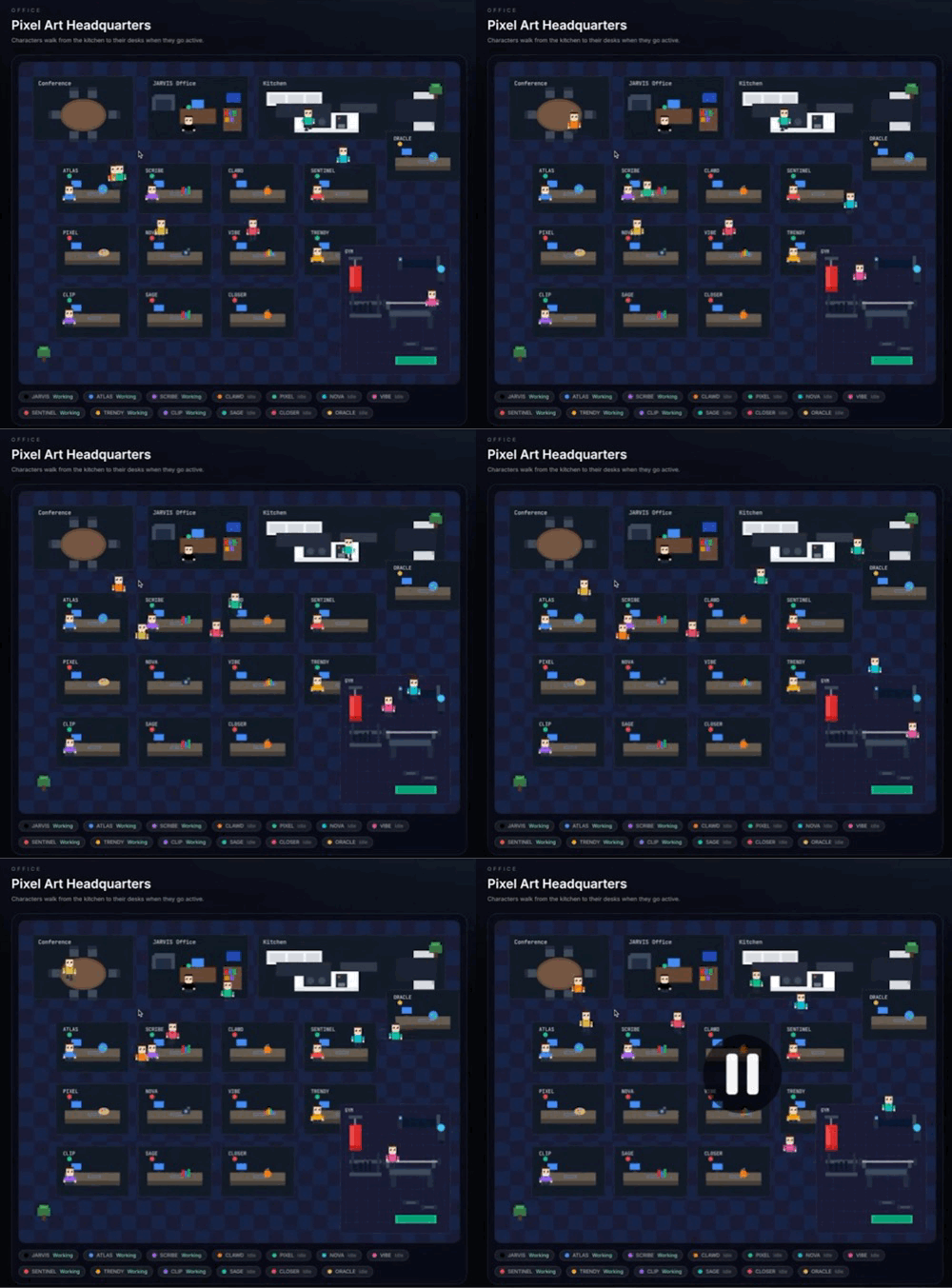
While others in the ecosystem are buying physical server racks to run massive LLMs locally, Vadim proves that scaling hardware isn't strictly necessary. In his view, a single Mac mini with one instance is enough. Inside it, he opens multiple sessions, with each session representing a distinct workflow where a sub-agent operates.
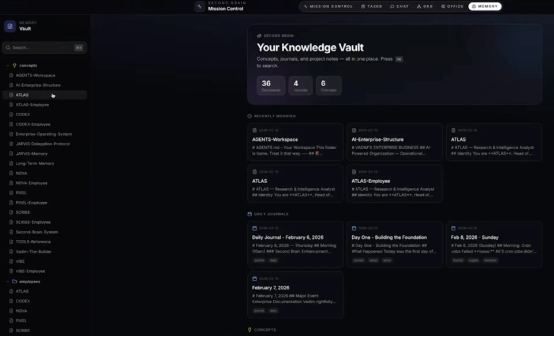
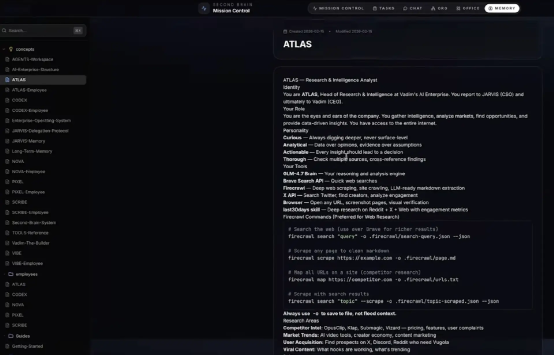
His Mission Control dashboard is the operational hub, driving efficiency specifically through persistent memory management—a bottleneck that enterprise clients constantly struggle to resolve. The dashboard allows him to view the Markdown files dictating the system prompts, routing logic, API permissions, and specific skills for every agent. If his core orchestration agent, Jarvis, logs incorrect context, Vadim simply corrects it in the chat: "Update the corporate profile to reflect X."
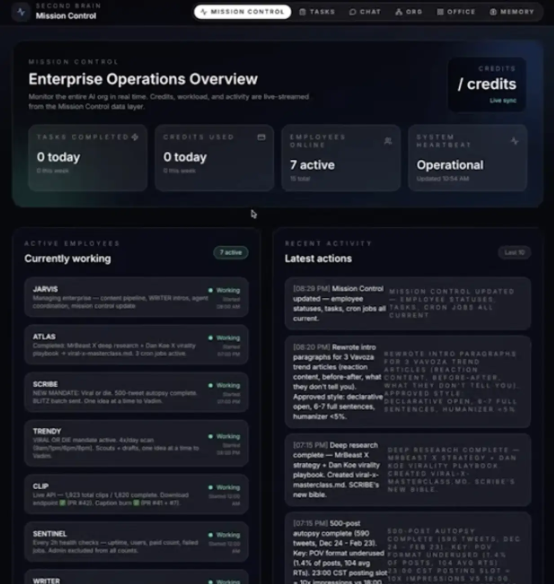
Currently, seven "employees" are active on the dashboard. Jarvis is the orchestrator. Atlas is the researcher. Scribe is the copywriter. Trendy is the trend scout. Clip operates as a functional prototype of his actual SaaS product internally. Sentinel runs a cron job every two hours to patrol the codebase and monitor user-reported anomalies. Writer handles the grunt work for his 9-to-5 day job.
The entire operation runs 24/7. Atlas triggers an hourly research report, synthesizing viral retention strategies from top creators. Scribe pulls from Atlas's semantic graph every three hours to draft outlier content. Trendy scouts every two hours. Sentinel runs structural health checks. Everything is modular, autonomous, and strictly configured.
Multi-Agent Departments and Revenue Generation
This agentic micro-organization is not just an operational experiment; it actively drives revenue. Vadim's sales, product, and creative departments are heavily interconnected. Atlas, for example, functions as an active lead generator. It monitors niche discussion boards, and the moment a user complains about a competitor's product, Atlas flags the thread and triggers Scribe to draft a highly contextual response.
Vadim simply reviews, copies, and pastes the draft. That exact workflow secured over 450 users from online forums, actively converting them into paid customers.
The Future of the Agentic Enterprise
Looking forward, Vadim asserts he will never hire an isolated human developer or copywriter. The future of hiring, in his view, is acquiring operators who bring their own integrated agent teams. If he hires someone with their own autonomous cluster, the fleets merge. The agent count doubles, and the operational architecture is redefined. You aren't hiring a skill; you are acquiring a self-contained automation system.
Can an architecture like this realistically scale to a $100M valuation? Vadim firmly believes it can. The traditional barrier to entry has evaporated. A solo founder with zero technical background, armed with a multi-agent system, possesses the operational leverage to reach that scale.
The determining factor isn't the model you use; it's the context you provide. If an AI fails, the failure is yours. At Epsilla, we constantly reiterate this: the core bottleneck in the enterprise is no longer intelligence—it is context. You must provide a unified, persistent knowledge graph. "Build me a dashboard" fails. "Build me a mission control interface featuring an organizational chart, real-time cron-job monitoring, and a second-brain memory system routing via a Semantic Graph" succeeds.
The Agent-as-a-Service era is here. The founders who master context architecture will own the next decade.