
The reality of modern enterprise data is deeply complex. It exists simultaneously as structured connections (explicit relationships like social networks or user behaviors) and unstructured text (implicit semantic associations hidden in reviews or documents). Effectively integrating these two forms of data has become a core challenge for modern AI applications.
Recently, researchers from the Hong Kong University of Science and Technology (HKUST) introduced GraphAgent, an innovative, automated agent framework that tackles this exact problem. By utilizing a multi-agent collaboration mechanism, it seamlessly integrates structured graph data with unstructured text to unify predictive and generative tasks.
Most importantly: it allows users with zero background in graph theory or machine learning to conduct complex data analysis using only natural language.
The Complexity of Real-World Data
Real-world scenarios expose the limitations of traditional Large Language Models (LLMs) when dealing with complex relational structures.
For instance, in Academic Network Analysis, research papers form an explicit graph structure through citations (nodes and edges). But combining this with the unstructured text of the papers themselves allows researchers to trace the evolution of thought or predict research trends.
Similarly, in E-commerce Recommendation Systems, the interaction between users and products forms structured behavioral data. When combined with unstructured product reviews, companies can gain deep insights into consumer behavior to improve recommendation accuracy.
While earlier methods like GraphGPT and LLaMA attempted to convert graph structures into tokens that LLMs could understand, they primarily focused on traditional graph tasks (like node classification or link prediction) and struggled to flexibly handle mixed scenarios of structured and unstructured data.
The core question GraphAgent solves is: How do we allow ordinary users to analyze complex graph data and extract predictions simply by asking questions?
The Tri-Agent Collaborative Architecture
To solve this, GraphAgent models the problem using a unified heterogeneous graph definition: G = (V, E, N, R), where V is the set of entities, E represents the edges, and N and R represent node types and relation types respectively. Each edge possesses meta-type attributes (nh, ri, nt) describing the meta-types of the head node, relation, and tail node.
Building on this, it adopts an Agentic Architecture formalized as Y = f(O; LLM), where the agent function receives observations (structured graph links or unstructured text) and generates actions (predictions or text).
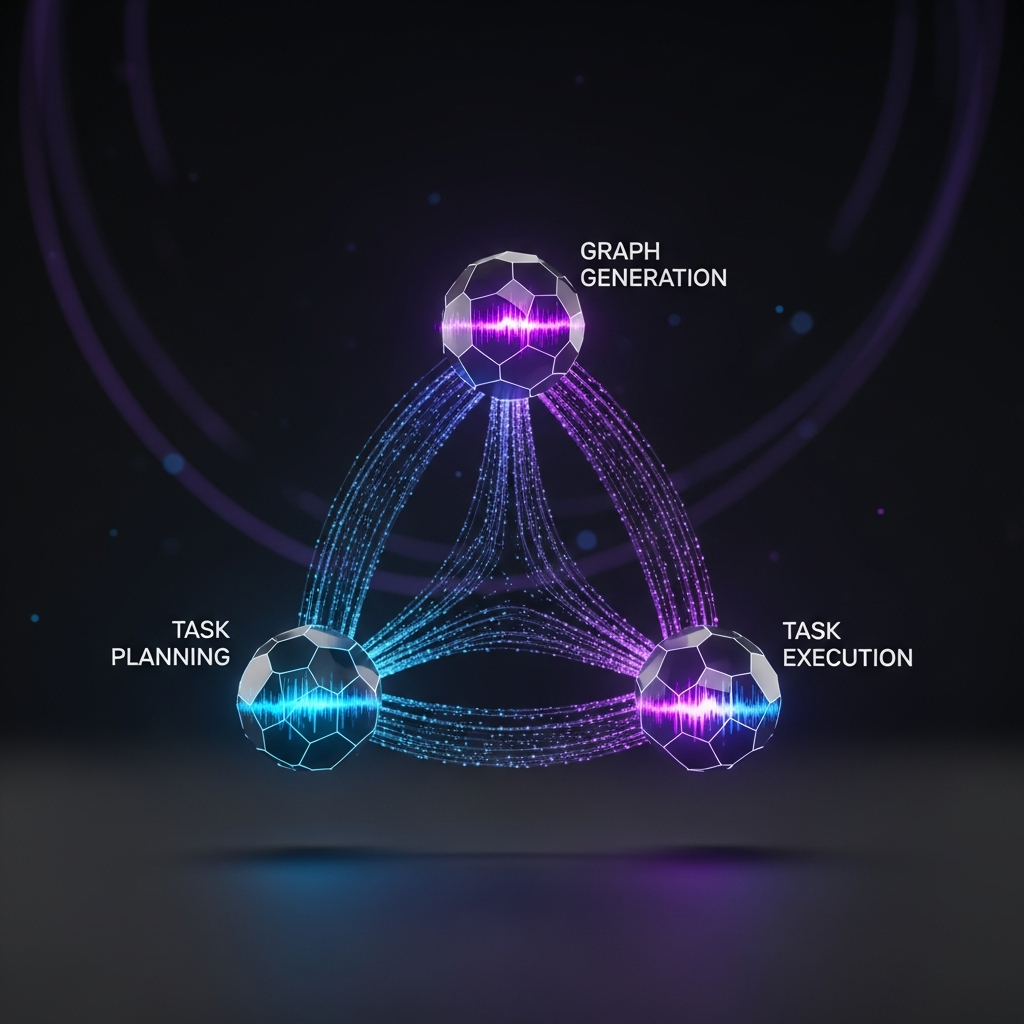
This framework is built upon three core, collaborating agents:
- Graph Generator Agent: Responsible for building Semantic Knowledge Graphs (SKGs) directly from user text to mine underlying semantic associations. Its workflow operates in three steps: Scaffold Node Extraction (identifying key entities from text through k iterations), Knowledge Description Enhancement (supplementing the extracted nodes with rich semantic descriptions), and Graph Construction (establishing the relational network between the entities). This module solves the problem of how to derive latent semantic connections from complex text data.
- Task Planning Agent: Acts as the brain that interprets diverse user queries. It decomposes natural language requests into a sequence of actionable tasks (predictive or generative). Its core workflow involves Intent and Task Parsing (accurately understanding the type of user demand), Graph Grounding (associating the requested task with specific graph data), and Graph Tokenizing (translating graph structures into a format the model can process). For example, it can take a query like "I uploaded an academic graph... can you tell me the most possible category for paper ID [239]?" and map it to a text-enhanced predictive task.
- Task Execution Agent (Graph Action Agent): Operates dynamically as the "hands" of the system. Based on the sub-task sequence provided by the Planning Agent, it automatically matches and invokes the necessary tools to return the correct result. Its workflow includes Cross-Modal Fusion (integrating the LLM processing language tokens with a GNN processing embedded graph tokens via a linear layer) and Multi-Output Support (handling reasoning generation, content generation, and direct answer outputs seamlessly).
Through extensive experiments, the researchers demonstrated that GraphAgent, even when powered by smaller open-source models like LLaMA-8B, can outperform closed-source giants like GPT-5 on multiple tasks involving explicit graph dependencies and implicit semantic inter-dependencies.
Three Major Breakthrough Contributions
The researchers identified three massive leaps forward achieved by this architecture:
- Complex Empirical Data Integration: GraphAgent provides robust processing power for real-world scenarios. By seamlessly blending structured data, unstructured data, and graph entity relationships, it achieves a "dual capability"—simultaneously supporting predictive analytics and text generation tasks.
- Multi-Agent Workflow: This is the first graph language assistant to introduce multi-agent collaboration, enabling autonomous semantic graph construction from text, predictive task formulation from queries, and highly efficient task execution.
- Small Models, Big Capabilities: The entire agent framework utilizes relatively small open-source LLMs (like LLaMA-8B), yet it demonstrates significant superiority over state-of-the-art closed-source models (like GPT-5 and Gemini) on generative tasks. This breakthrough proves that architectural design is more critical than mere model scale.
Experimental Validation across Four Research Questions
The research team evaluated GraphAgent across four core Research Questions (RQs):
- RQ1: Dual Capture of Graph Relations and Text Semantics. GraphAgent excelled in node classification and link prediction tasks across multiple baseline datasets, proving its deep understanding of both explicit graph structures and implicit text semantics.
- RQ2: Predictive Capability on Implicit Semantic Dependencies. Even in pure text data lacking explicit graph structures, the framework accurately extracted implicit associations and completed predictions by constructing its own semantic knowledge graph.
- RQ3: Competitiveness in Graph-Enhanced Text Generation. In tasks like writing "Related Work" sections for academic papers or analyzing peer review feedback, GraphAgent's generated content surpassed GPT-5 and Gemini in coherence, accuracy, and relevance.
- RQ4: Ablation Studies on Key Components. By removing the graph generation agent, simplifying the task planning agent, or replacing the execution agent, the researchers confirmed that all three agents are indispensable—the synergistic effect is critical.
Real-World Application Scenarios
The implications of GraphAgent span widely from academia to commercial enterprises:
Academic Research Scenarios:
- Automated Literature Reviews: Researchers input a title and a list of citations, and GraphAgent automatically generates a structurally complete and logically clear "Related Work" chapter.
- Paper Quality Assessment: Systematically analyzes peer review comments and acceptance probabilities to provide improvement suggestions.
- Research Trend Prediction: Predicts emerging research directions based on academic citation networks.
Commercial Business Intelligence Scenarios:
- Intelligent Recommendation Systems: Integrates user behavior graphs with product descriptions to provide personalized recommendations paired with explanatory text.
- Customer Insight Analysis: Extracts key patterns from user reviews and interaction data to generate comprehensive business reports.
- Knowledge Management: Enables intelligent search and content generation across enterprise knowledge bases.
Why GraphAgent Stands Out: Technical Advantages
- Zero-Threshold User Experience: Traditional graph learning tools require deep knowledge of graph theory and machine learning. GraphAgent uses natural language interactions, allowing anyone from enterprise decision-makers to scientific researchers to analyze graph data with zero programming or modeling experience.
- Unified Processing of Heterogeneous Data: It achieves true unified processing of structured and unstructured data, rather than simple splicing.
- End-to-End Automation: Complete automation from data input to results output, including automated knowledge graph construction (no manual labeling), automated intent understanding (no predefined task types), and automated tool execution (no manual configuration).
Future Outlook: The Next Step in Multi-Modal Fusion
The research team plans to extend the framework to multi-modal data, integrating visual information (images, video) so the system can understand and generate content that fuses relationships, text, and visual elements. Potential applications include Medical Image Analysis (combining patient networks, text records, and medical imaging), Smart Cities (traffic networks, text reports, and surveillance video), and Social Media Analysis.
Conclusion: A New Era of Graph Data Analysis
GraphAgent represents a paradigm shift in graph data analysis—from an expert tool to a democratized platform. Through its innovative multi-agent architecture, it seamlessly integrates graph reasoning with advanced language modeling to effectively handle complex language assistant scenarios involving relational and textual data.
Core Value Proposition:
- Technical Innovation: The first truly automated graph language assistant.
- Performance Superiority: An architectural victory where small models surpass large models.
- Democratized AI: Making graph data analysis as simple as chatting.
The Epsilla Perspective: Engineering the Hybrid Reasoning Enterprise
The breakthrough of GraphAgent is its profound realization that true intelligence requires both structural constraints and generative freedom. This validates a core architectural thesis we are championing at Epsilla.
While GraphAgent demonstrates the immense power of this hybrid reasoning in academic and specific predictive scenarios, the next frontier is applying this exact Tri-Agent collaborative paradigm to the entirety of enterprise operations.
We are moving away from treating AI as a simple text generator and moving toward building an Enterprise Reasoning Engine. Just as GraphAgent uses a Task Planning Agent to decompose complex logic into API calls against a graph, modern enterprise AI must be able to navigate the heterogeneous data structures of an organization—understanding the explicit hierarchies of a corporate database alongside the implicit sentiments of a customer support email.
The value proposition for the next generation of AI platforms is not merely orchestrating LLMs; it is providing the infrastructure that allows these distinct types of intelligence (Predictive/Structural and Generative/Semantic) to collaborate dynamically without human intervention. The integration of robust graph logic into fluid agentic workflows is how we stop building "smarter chatbots" and start engineering truly autonomous enterprise reasoning systems.