
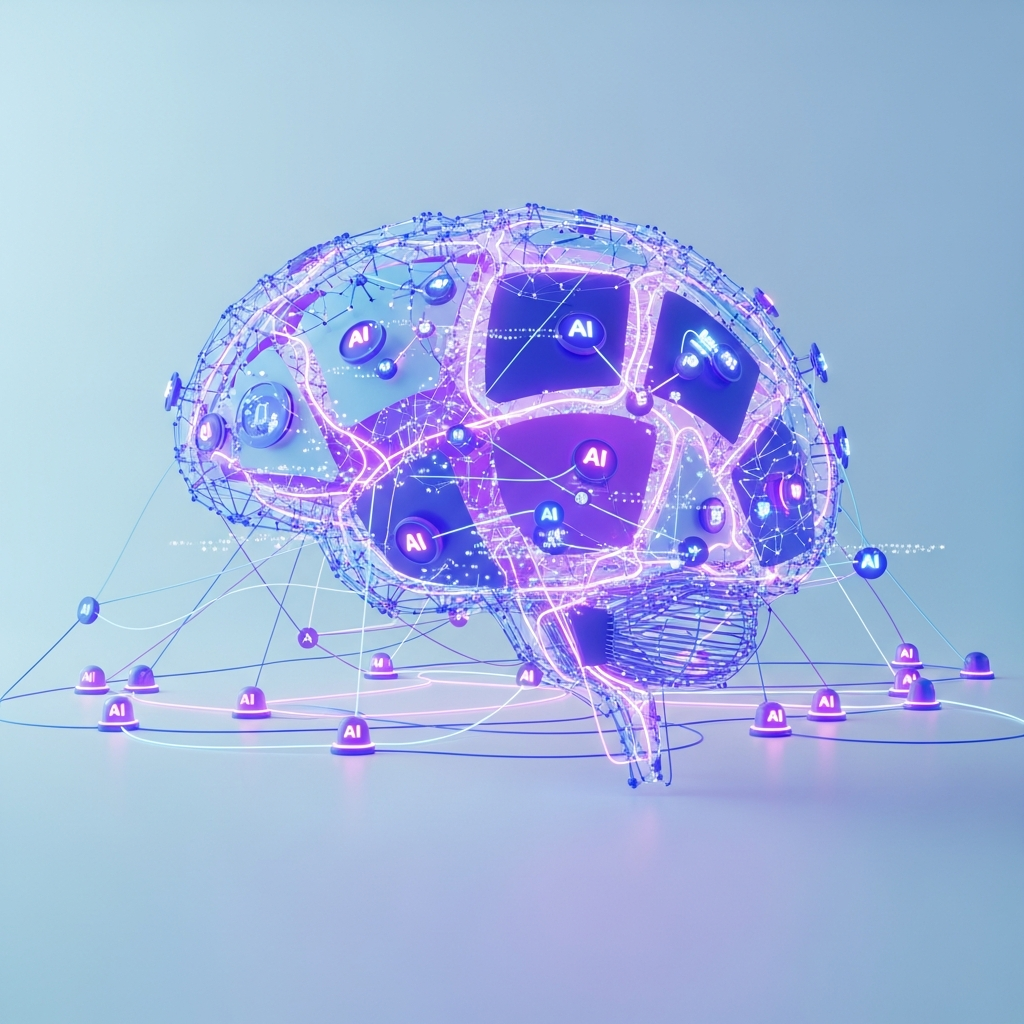
The current technological landscape presents a profound duality for founders: it is simultaneously the most generous and the most ruthless era in the history of software. The barrier to "building a product" has collapsed to zero, yet the barrier to "building a defensible business" has never been higher.
This isn’t a superficial hype cycle; it’s a structural re-ordering of how enterprise value is created. To understand where we are going, we have to look back at how historical paradigm shifts have played out.
The Acceleration of 2026
The beginning of 2026 has marked a definitive threshold. AI coding and agentic capabilities have crossed the baseline and are rapidly commoditizing.
Recently, former OpenAI founding member Andrej Karpathy noted a complete inversion in his workflow: from writing 80% of his code manually, to spending 80% of his time issuing natural language directives to agents that execute multi-step processes across remote servers. What used to take a weekend now takes 30 minutes. At the enterprise level, companies like Block (Square) have aggressively restructured, citing "intelligence tools" as the catalyst for fundamentally changing how a company is run.
When the friction of generating code drops to zero, the value migrates elsewhere. But this is not the first time we’ve seen this pattern.
When Copying Became Free
Before Gutenberg, a hand-copied Bible cost a clerk three years' wages. "Copying" was an expensive capability monopolized by a few. When the printing press arrived in the 1440s, the supply of books exploded from 30,000 to over 20 million across Europe.
The monks in the scriptoriums lost their jobs, but an entirely new value chain was born: typesetters, publishers, and booksellers. As Clayton Christensen’s "Law of Conservation of Attractive Profits" suggests, when one layer of a value chain becomes commoditized, the adjacent layer captures the new value. The publishers—not the printing press operators—became the new power nodes.
Today, AI is commoditizing the "printing press" of our era: code generation. The value is shifting from how to build software to what problems we are solving and who we are solving them for.
The Productivity Paradox: Steam vs. Electricity

In the late 19th century, factories were built around massive central steam engines. When electricity arrived, factory owners simply replaced the steam engine with a large electric motor. For 40 years, there was almost zero measurable productivity gain. Why? Because they were using a new tool to execute an old workflow.
It wasn't until the 1920s, when factories were completely redesigned around the decentralized nature of electricity—leading to Henry Ford’s assembly line—that productivity skyrocketed.
We are seeing the exact same paradox in AI today. Recent studies have shown that experienced developers using AI tools on familiar, legacy codebases can actually become slower. AI accelerates the code-generation step, but creates massive bottlenecks in legacy review and integration workflows.
Building a faster traditional SaaS product using AI is the equivalent of replacing a steam engine with an electric motor. It fundamentally misunderstands the medium. True efficiency requires redesigning the entire workflow around the unique properties of the new technology.
The Unbundling and Re-bundling of Software
In the early 2000s, running a basic web application cost $150,000 a month in physical servers. By 2011, AWS drove that cost down 100x. This collapse in infrastructure costs birthed the SaaS explosion.
Historically, massive supply-side explosions follow a distinct cycle: Unbundling, followed by Re-bundling.
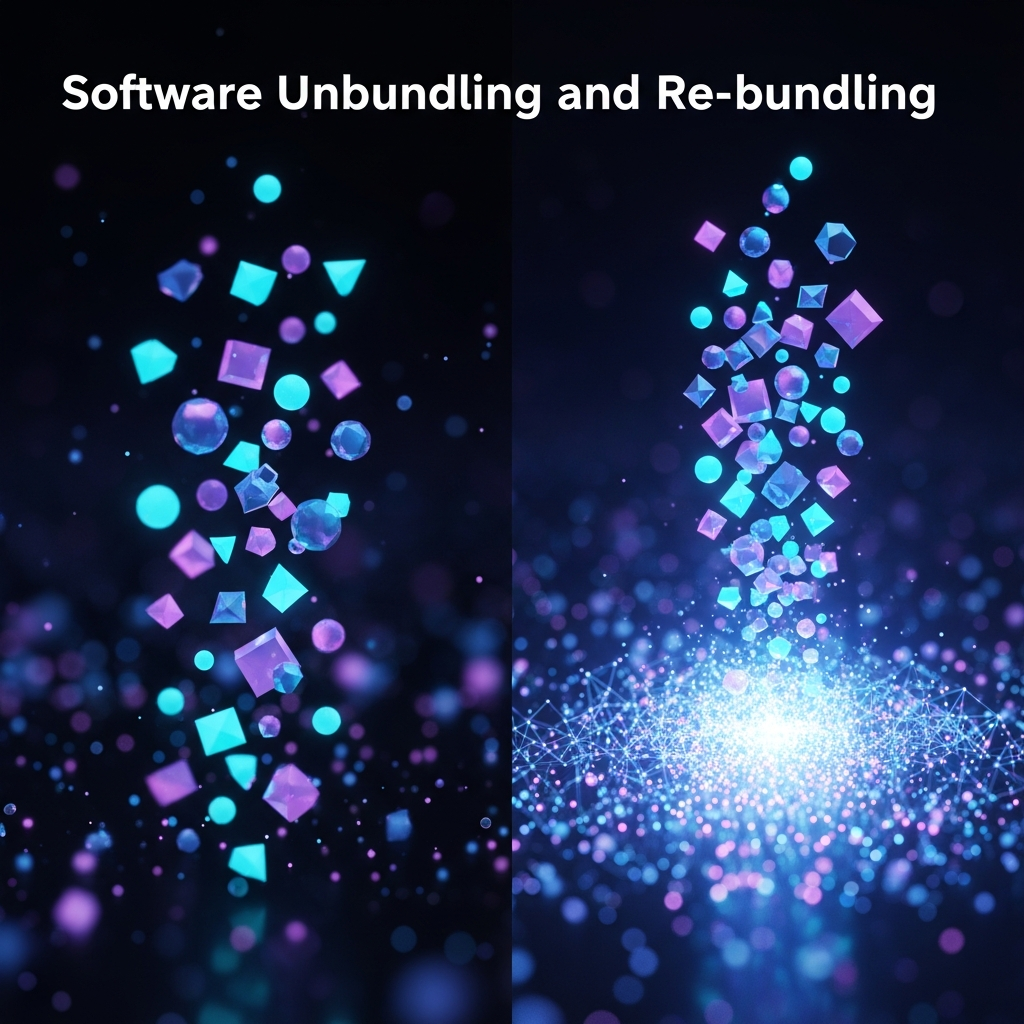
Currently, the AI landscape is in an aggressive Unbundling phase. Monolithic SaaS applications are being fractured into thousands of hyper-specialized, personalized micro-agents. But as history shows, extreme fragmentation inevitably requires a new integration layer.
The Epsilla Perspective: The Re-bundling Layer
At Epsilla, we recognize that the future isn't just about spawning isolated AI tools. The true "Assembly Line Moment" for the enterprise will be the Re-bundling of these fragmented agents into a cohesive ecosystem.
This is the vision behind AgentStudio: serving as the "Active Organizational Brain." Instead of humans managing disparate SaaS apps, we are moving toward a paradigm where Agentic Workflows orchestrate Virtual Team Members.
In this new OS, every interaction, document, and decision isn't just saved in a static folder; it becomes an Artifact mapped within a Semantic Graph. This gives the enterprise "Infinite Memory," allowing Vertical AI agents to operate with deep, proprietary context rather than generic LLM knowledge.
Surviving "Hell Mode"
For founders and enterprise leaders, the ease of creation has paradoxically triggered "Hell Mode." When anyone can build a product over a weekend, the product itself is no longer the moat.
To survive and scale in this foggy era, the rules have changed:
- Don't Use AI to Do Old Things: Stop trying to build a marginally faster CRM. Ask yourself: If code costs zero, what entirely new product shapes are possible? (e.g., disposable software, real-time adaptive UI).
- Build Moats Outside of Code: Your defensibility will come from proprietary data, regulatory compliance, transaction embedding, and the depth of your semantic networks.
- Pioneer the Re-bundle: Lean into the unbundling of traditional software, but build for the inevitable re-bundling. The winners of this era will be the platforms that integrate isolated intelligence into cohesive, automated enterprise workflows.
The era of Software-as-a-Service is ending. The era of Agent-as-a-Service has arrived. Build accordingly.